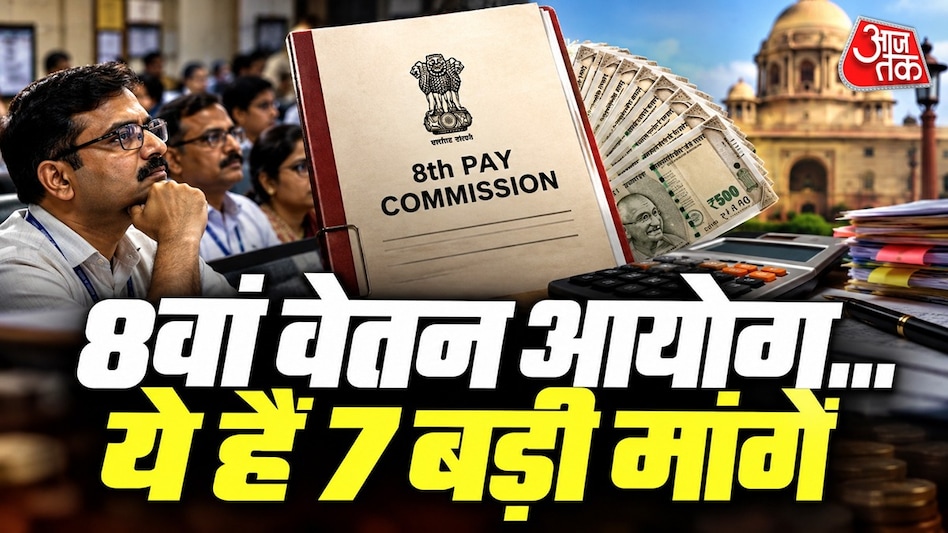
Nine Key Demands of Employees to the 8th Departmental Wage Committee
Read more
Aaj Tak
www.aajtak.in

Nine Key Demands of Employees to the 8th Departmental Wage Committee

Information regarding the 8th Departmental Wage Committee is extremely important for central government employees and pensioners. Representatives of workers and pensioners presented the committee with a complete list of their demands. These demands go beyond a simple salary increase and include requests to restore the old pension system, ensure unimpeded medical care, support children's education, raise salaries without promotion, and improve several previous benefits related to pensions and risk allowances.

These demands may affect approximately 4.5 million employees and 6.8 million pensioners. The National Consultative Machine of the Joint Advisory Body (NC-JCM) plays a key role in conveying these demands to the government. This structure serves as a platform for dialogue between the government and workers, where issues such as wages, allowances, pensions, and working conditions are discussed. Currently, T.V. Somanantan's cabinet secretary chairs this council.

About six months ago, the government initiated the work process of the 8th Central Departmental Wage Committee. Since then, the committee has held meetings with various organizations of central employees and pensioners in different cities. At these meetings, numerous trade unions and pensioner organizations presented their proposals and demands to the committee. Although a final decision on these demands has not yet been made, adopting some of them could lead to significant changes in salaries, allowances, and post-retirement benefits for employees.

One of the most significant demands from the trade unions is the reintroduction of the old pension scheme (OPS). This demand is particularly relevant for employees who began state service after 2004 and are currently under the new National Pension System (NPS). In the NPS, contributions are made by both the employee and the government. Trade unions insist on returning to the old pension system, which provided a fixed pension upon retirement. In other words, the employees' side wants to make retirement more secure and guaranteed.

A request was also made for convenient and cashless medical care for employees and pensioners. This means that an employee or pensioner would not have to initially spend significant funds out of pocket for treatment; the cost of treatment should be paid directly through the relevant system. This requirement is especially important for pensioners, as medical expenses can constantly rise after retirement. Trade unions emphasized the need to make healthcare more accessible and comprehensive.

The workers' side also demanded increased benefits related to children's education. It was proposed to expand educational allowances and living subsidies up to the postgraduate level. This means that the scope of these benefits should be extended to higher education, exceeding current levels. This could ease the situation for employees whose children study for a long time.

Trade unions demanded improvements to conditions related to death benefits upon retirement, family pensions, and a lump-sum portion of the pension. The lump-sum portion is the amount a pensioner can take immediately in exchange for some reduction in their monthly pension. The workers' side wants the old provisions regarding the restoration of this reduced portion after 12 years to be implemented more effectively.

In the 8th Departmental Wage Committee, trade unions also demanded a change in the method of determining the minimum wage. Employee representatives proposed increasing the criterion defining family expenses from 3 to 3.6 units. Simply put, this means that when determining the minimum wage, greater attention should be paid to the needs and expenses of the family. This could directly impact the starting salary level. This proposal is based on the report of the Ministry of Labor's expert commission.

Many employees have struggled for a long time to receive a promotion. For such employees, a financial increase is provided at a specified time within the Modified Guaranteed Career Progression Scheme (MACPS). Trade unions demand the elimination of inconsistencies in this scheme. Furthermore, it was proposed to amend existing salary levels. The workers' side believes that salary levels that do not correspond to current job duties should be merged to create a more sophisticated compensation structure.

Unions associated with railways raised the issue of paying a risk and hardship allowance for railway workers within the 8th Departmental Wage Committee. Railway employees' work often involves risky and difficult conditions. The workers' side insists that these conditions must be taken into account.

Similar stories

Potential Pension Amount with the 8th Departmental Commission Review: Calculations Based on Different Coefficients
Read more
www.aajtak.in

Potential Pension Amount with the 8th Departmental Commission Review: Calculations Based on Different Coefficients

The formation of the eighth departmental commission review (8th Pay Commission) is actively being discussed in the country, raising expectations among millions of employees. This new commission review, which could potentially take effect on January 1, 2026, will depend on the Fitment Factor used in calculating pension increases.

According to the current rules of the seventh departmental commission review, the minimum basic pension is 9,000 rupees. However, depending on the fitment factor applied under the 8th departmental commission review, a significant increase is expected. Particular interest is shown by employees working under the Old Pension Scheme (OPS), who are monitoring possible changes to the basic pension after the introduction of the new commission review.

As a general rule, an employee's pension is calculated as 50% of their last basic salary or average basic salary over the last 10 months. Various trade unions demand that when determining the rules and conditions of the 8th departmental commission review, employees who retired before January 1, 2026, be included in the calculation on equal terms.

Based on data from various media and expert forecasts, if the 8th departmental commission review applies fitment factors of 2.1, 2.28, or 2.57, the following calculations for the minimum basic pension for levels 5 through 9 are possible:

Fitment Factor 2.1

Even with the minimum factor of 2.1, a substantial pension increase is expected. For level 5, the minimum basic pension may amount to about 30,660 rupees per month. For level 6, an increase to 37,170 rupees is projected. The minimum basic pension for level 7 is estimated at approximately 47,145 rupees, for level 8 at 49,980 rupees, and for level 9 at around 55,755 rupees.

Fitment Factor 2.28

With the application of a moderate factor of 2.28, the pension for level 5 will rise to 33,288 rupees per month. The pension for level 6 may reach 40,356 rupees. Level 7 employees may receive a minimum basic pension of 51,186 rupees. For level 8, the minimum basic pension will increase to 54,264 rupees, and for level 9, up to 60,534 rupees per month.

Fitment Factor 2.57

If the government maintains the factor of 2.57, similar to that in the 7th departmental commission review, pensioners will receive a significant benefit. The minimum basic pension for level 5 will be 37,522 rupees per month. For level 6, the minimum pension will rise to 45,489 rupees. The basic pension for level 7 may reach 57,697 rupees. The minimum basic pension for level 8 may reach 61,166 rupees, and for level 9, it may increase to 68,234 rupees per month.

Several organizations, including the All India Defence Employees Federation (AIDEF), insist on increasing the pension share from the current 50% of the last basic salary to at least 67%, and the family pension to 50%. Furthermore, 'Bharat Pensioners Samaj' demands that the minimum pension under the 8th departmental commission review be set at no less than 45,000 rupees monthly. After the new commission review comes into force, the current Dearness Relief (DR) factor will be zeroed out (0%), and a new inflation/assistance allowance will be established based on the adjusted basic pension.

It is important to note that all the calculations provided are based solely on hypothetical factors and approximate data; the actual pension situation will only become clear after the final recommendations of the 8th departmental commission review are approved and officially published by the central government.

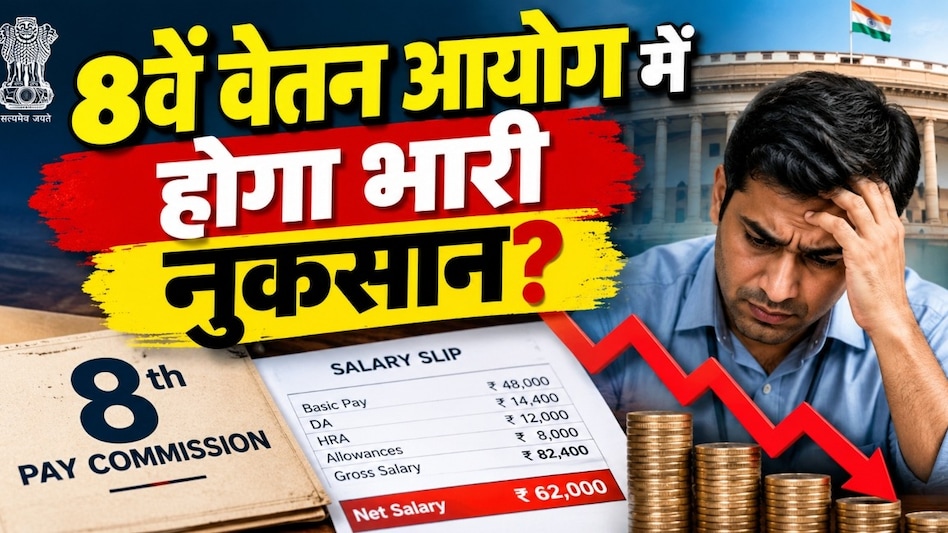
Delay in implementing the 8th salary attestation committee could lead to a loss of 300 thousand rupees
Read more
www.aajtak.in

Delay in implementing the 8th salary attestation committee could lead to a loss of 300 thousand rupees

The wait for the implementation of the eighth salary attestation committee continues, but currently, the committee is only holding meetings with representatives and stakeholders. It has a general deadline of 18 months to prepare the report. It is anticipated that the report may be submitted after May of next year, after which the government will make a decision on the matter.

Against the backdrop of the delay in implementing the eighth salary attestation committee, various questions arise among civil servants regarding potential losses in case of this postponement. According to one report, it is estimated that level 7 employees could incur losses of 300 thousand rupees if the implementation is delayed.

It is being discussed that the eighth salary attestation committee may come into force or become effective on January 1, 2026, making central staff eligible for significant allowances (erier). Some experts believe that the calculation of erier can be based on the difference between the revised basic salary and the previously received basic salary.

The situation with benefits such as HRA may develop differently. This is where the probability of potential losses arises. If the new salary is introduced quickly, the employee can promptly receive benefits calculated based on the revised base. However, if the implementation is prolonged and the erier for the corresponding benefits is not paid during this period, employees may face substantial losses.

Speaking of potential losses for level 7 employees, their current basic salary is 44,900 rupees. Applying a conformity coefficient of 2.1 within the framework of the eighth salary attestation committee will increase the basic salary to approximately 94,290 rupees.

With the current basic salary of 44,900 rupees, the HRA benefit is 10,776 rupees at a rate of 24 percent. However, with a basic salary of 94,290 rupees, based on the assumed conformity coefficient of 2.1, the same HRA benefit will amount to about 22,630 rupees. The difference between these amounts is approximately 11,854 rupees monthly.

If the government introduces the eighth salary attestation committee by January 2028, erier payments for the basic salary may be made. Nevertheless, they may suffer losses in terms of HRA, as shown in the above calculations. That is, a level 7 employee may lose 11,854 rupees monthly in HRA.

If the implementation occurs in January 2028, which means a delay of 25 months, the employee could incur losses of 296,350 rupees.

Discussion of the Fitment Factor within the Eighth Departmental Commission
Read more
www.aajtak.in

Discussion of the Fitment Factor within the Eighth Departmental Commission

Central employees and pensioners are closely monitoring the work of the Eighth Departmental Commission (8th Pay Commission), as their recommendations determine the revision of their salaries and pensions. Currently, the eighth commission is holding meetings in various cities across the country to gather opinions and record demands from employee and pensioner trade unions. Among the most important demands put forward by these organizations is the Fitment Factor.

Various trade unions are demanding a fitment factor ranging from 1.92x to 2.57x, and even over 3x. This leads to different calculation metrics regarding basic pay and minimum wage. Therefore, it is first necessary to understand what the fitment factor is, on what basis it is calculated, and how it might affect an employee's basic salary.

Simply put, the fitment factor is a multiplier used to convert the current basic salary into a new pay structure. For example, if an employee's basic salary is ₹18,000 and a fitment factor of 1.92x is applied, the new basic salary will be: ₹18,000 × 1.92 = ₹34,560, which means an increase in basic salary of ₹16,560. Similarly, with the application of a 2.57x factor, the basic salary of ₹18,000 will increase to ₹46,260, and with a 3x factor—to ₹54,000. However, it should be understood that these figures only serve as an illustration of the potential impact of different factors on the basic rate, not as a final announcement of a new salary.

Currently, there are numerous demands and forecasts regarding the fitment factor. Different trade unions propose their calculations according to their requirements, leading to figures such as 1.92x, 2.57x, and 3x being heard. These demands are based on various assumptions, including salary increases, inflation, and real income growth for workers.

To understand the mathematics of the fitment factor, two aspects are important. The first is the Dearness Allowance (DA) that employees currently receive, and the second is the actual additional salary increase provided by the government. When forming a new pay structure, the new basic salary is determined taking into account the current salary and the impact of inflation. It is based on this comparison that the fitment factor multiplier arises. Thus, it is not enough to just look at the current basic rate; one must also consider what the Dearness Allowance will be when the recommendations of the Eighth Departmental Commission come into effect, and what additional real wage increase the government wishes to provide.

The mention of a 60% Dearness Allowance (DA) in the discussion about the fitment factor is also significant, as this figure will indeed reach 60% by January 2026. When developing the pay structure under the Seventh Departmental Commission, the mathematics of the new structure after adjusting DA into the basic salary was also taken into account. Similarly, when implementing the recommendations of the Eighth Departmental Commission, both the DA and the proposal for a new salary hike may affect the calculation of the fitment factor. Nevertheless, the final fitment factor is not directly determined based on the current DA; the final figure will only become clear after the recommendations of the Eighth Departmental Commission and the government's decision.

It must be realized that the fitment factor primarily affects the basic rate. An employee's total salary includes not only the basic rate but also other allowances, such as House Rent Allowance (HRA), Transport Allowance (TA), and other benefits. Consequently, if we take the example where the basic salary of ₹18,000 increases to ₹34,560 with the application of a 1.92x fitment factor, this does not mean that the employee's total salary will increase in the same proportion. The actual salary amount will depend on the new pay matrix and the rules in force at that time.

If we consider only the calculation, the minimum basic salary for a Level 1 employee can rise from ₹18,000 to ₹34,560 using a 1.92x fitment factor. Similarly, with a 2.57x factor, the basic salary will be ₹46,260, and with 3x—₹54,000. From this, it becomes evident that even a small difference in the fitment factor can cause significant differences in the new basic salary figures. This is why the trade unions' demand for the fitment factor is such a critically important issue.

At present, none of the factors—1.92x, 2.57x, or 3x—can be considered final. These figures are calculations based on the demands of various organizations and forecasts made based on those demands. The size of the fitment factor will depend on the recommendations of the Eighth Departmental Commission and the subsequent decision of the government. The future will determine what data and economic grounds the commission considers. The central government formed the Eighth Departmental Commission on November 3, 2025, chaired by retired Supreme Court Judge Ranjana Prakash Desai. The commission is required to submit its recommendations within 18 months of its formation, suggesting the report will be published around May 2027.

Popular