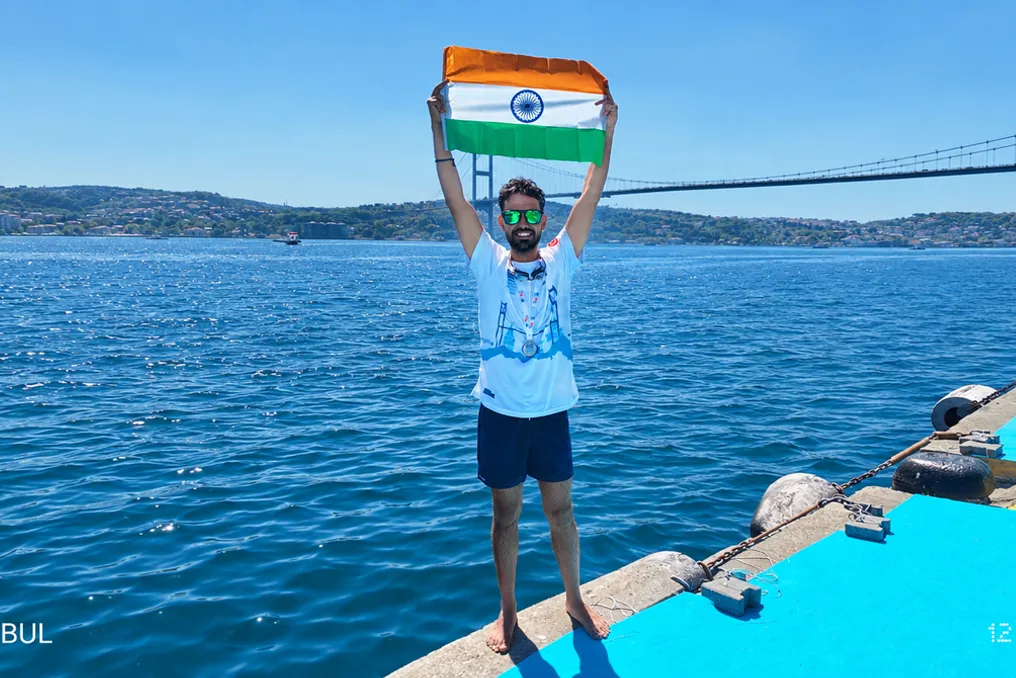
An IT specialist from Bengaluru, Akshai Sharma, shared his experience that began with a one-kilometer run and led him to swim across continents.
During one of the most challenging stages of his latest endurance test, he recalled the thought: 'I realized that if I stay calm and keep moving, I can handle this.' This thought occurred on August 23, 2026, when he was swimming across the Bosphorus in Istanbul, heading from the Asian side of the city towards Europe.
Around him were open water, changing currents, and waves that could throw the swimmer off course. He did not use smartwatches or GPS devices for navigation, nor was the route marked by navigational buoys. Swimming in the Bosphorus outside of annual competitions is prohibited because it is a busy shipping lane. Furthermore, he had never trained in these waters before.
Nevertheless, after 1 hour and 32 minutes, he reached the European shore, completing the Bosphorus continental crossing race over a distance of 6.5 kilometers and finishing within the event's two-hour limit.
For someone who only started running in January 2023, this swim became another complex chapter in a journey that already included participating in an Ironman, climbing high altitudes, and long endurance training, all while continuing to work full-time in IT and cybersecurity.
It Started with Running
His path to endurance was not pre-planned. Initially, he started running because he wanted to reach Everest Base Camp. At that time, even running one kilometer was difficult for him.
He began training on January 1, 2023, setting himself a simple goal—to run 10 kilometers in under an hour. By March of the same year, he achieved this goal. In the same year, he completed the trek to Everest Base Camp. In April 2024, he climbed Lobuche East, a peak of 6119 meters in Nepal.
By then, running expanded to cycling and swimming; he was no longer training for one specific event but was exploring the limits of his body. In October 2024, he participated in his first Ironman 70.3 in Goa. The race included a 1.9-kilometer swim, a 90-kilometer bike ride, and a 21.1-kilometer run. He finished in 7 hours and 30 minutes and 30 seconds.
A year later, he went further. On November 1, 2025, he completed a full Ironman in Langkawi, Malaysia. This race included a 3.8-kilometer swim, a 180-kilometer bike ride, and a full marathon of 42.2 kilometers. He finished the race in 15 hours and 40 minutes, staying within the two-hour limit.
Preparing for this event required him to fit long training sessions into his corporate schedule. He has worked in IT and cybersecurity for over 12 years, and his training had to be done before or after work. Ironman also changed his view on endurance. He told The Better India: 'Endurance is not something you are born with. It is something you build over time. You must be consistent and get used to discomfort.'
This experience became important when he decided to try swimming across the Bosphorus.
From Malaysia to Istanbul
Akshai's interest in intercontinental swimming attracted attention for a different reason. Since he had already completed a full Ironman, this time he wanted to test his strength if the challenge was solely swimming.
The Bosphorus continental crossing race is held for swimmers traveling from Asia to Europe through the strait in Istanbul. The annual event is the only time swimmers can legally participate in this route, as the waterway is usually used for intense maritime traffic.
The athlete arrived in Istanbul four days before the start. He could observe the water but could not practice on the route. This meant that most of his preparation had to take place in Bengaluru. He began targeted training for the race near the end of May 2026, dedicating about three months.
Usually, he swam three to four times a week, covering about 10-15 kilometers each week. His longest sessions could last around two and a half hours. On other days, he engaged in running, cycling, or strength training. Most of the swimming took place in a 50-meter pool in Bengaluru, especially due to the monsoon season and the difficulty of regular open-water training. He noted: 'I had to rely on my previous open-water swimming experience gained during Ironman.'
Unlike Ironman preparation, he didn't need to divide his focus between swimming, cycling, and running. The Bosphorus required him to concentrate most of his training time specifically on swimming. He also trained largely independently. He reported: 'I didn't have a coach or a training group specifically for the Bosphorus. I watched many videos and relied on my previous Ironman experience.'
Race Morning
On the day of the start, excitement was accompanied by some nervousness. Swimmers from different countries gathered on the Asian side of Istanbul before being transported to the starting point. As soon as the race began, he entered the water, knowing that he had no GPS or smartwatch to know his exact location. He had to read the water and maintain pace.
The Bosphorus has currents that behave differently in various locations. Near the shores, countercurrents can carry swimmers in the opposite direction, while the main current flows from the Black Sea to the Sea of Marmara. For the athlete, managing these currents was one of the most difficult parts of the swim. At one point, a wave and current pushed him back about five feet. Instead of trying to fight it directly, he moved away from the countercurrent and continued swimming.
There were also moments when he doubted his actions. He remembered the mountains he had conquered, recalling Lobuche Peak. He remembered the full Ironman in Malaysia. These experiences reminded him that he had gone through periods where continuing seemed difficult. The difference was that this time he was alone in the water, without road signs, without route arrows, and without a watch showing how much distance he had left.
Maintaining a Steady Pace
Akshai believes that for long-distance swimming, the biggest problem is not just physical strength, but maintaining momentum. He focused on his breathing and tried not to waste energy. Hydration was also very important. During some of his early long swims, he underestimated the required amount of fluid and felt dizzy. For the Bosphorus, he paid more attention to hydration and carbohydrates during training and the race itself. The goal was to conserve enough energy for the entire distance, rather than exerting excessive effort in the early stages.
Eventually, the European shore appeared on the horizon. Having swum for 1 hour and 32 minutes, he completed the crossing over a distance of 6.5 kilometers. His certificate recognized him as an intercontinental certified swimmer. However, for the athlete, the significance of this swim was less related to the certificate and more to what the challenge represented. He traveled from Bengaluru to Istanbul alone because obtaining a Turkish visa for his family and friends was difficult. Usually, people are with him during major events.
This time, he had to manage the trip, preparation, and the race entirely on his own.
Starting at 5:30 AM Before a 10-Hour Workday
The training preceding the swim had to fit into his regular working life. On a typical training day, he wakes up around 5:30 AM. After eating and getting ready, he heads to the pool, located about 10 kilometers from home, around 6:30 AM. He arrives around 7:15 AM and can spend about two and a half hours in the pool. On some days, he adds a run. He returns home around 11 AM, has breakfast, and starts work around 1:00 PM. His workday can continue until 10:00 PM, after which he goes to sleep around 10:30 PM or 11:00 PM.
He also visits the office three times a week. The office is about 15 kilometers away, and the round trip can take about an hour and a half. Thus, finding time for training was less about having free time and more about fitting training into an already tight schedule. This is one reason why he does not view endurance as something separate from his professional life. He says: 'Consistency beats intensity.'
For him, one tough workday, one failed project, or one workout that doesn't go according to plan does not determine the outcome of the entire long journey.
From Training Himself to Training Others
Akshai's interest in endurance sports also began to influence the people around him. Some of his friends registered for the Ironman in Goa after seeing his achievements. He reports that about five to seven friends are participating in this event this year. In May 2026, he also started training working professionals who wished to engage in endurance sports. Over the last four months, he has coached eight people. Among them are CEOs of brands and sports companies, neurosurgeons, chartered accountants, an IAS officer, and IT specialists. He also started creating TriUrge—an endurance coaching initiative. For him, the goal is not limited to training people for races; he wants more working professionals in India to incorporate fitness into their lives. His own approach has always been to start before everything is perfectly planned. He advises: 'Don't wait until you feel ready. Your first step doesn't have to be perfect. Just do it, keep moving, and be consistent. That's what really matters.'
What's Next
Swimming across the Bosphorus is not the end of Akshai's list. His next major goal is Mount Everest. He has already completed the trek to Everest Base Camp and climbed Lobuche East at an altitude of 6119 meters. After completing a full Ironman and crossing the Bosphorus, he now wants to attempt to reach the summit of Everest.
However, the pattern remains the same. He works in cybersecurity. He wakes up before dawn to train. He swims, runs, cycles, and does strength training amidst a demanding work schedule. Then he sets a new physical challenge for himself. He describes his achievements as personal experiments, ways to find out what he is capable of, rather than a checklist of things to collect. Perhaps this is why the Bosphorus was so significant to him. The swim was only 6.5 kilometers, but those kilometers carried him from one continent to another, across unknown currents and without the equipment he usually uses to measure distance. And when the water pushed him back, he kept moving forward.