An idea that began when a teenager from Dubai read about arsenic contamination led to village residents in Uttar Pradesh now filling bottles and large containers with purified drinking water from a solar installation he helped design and fund.
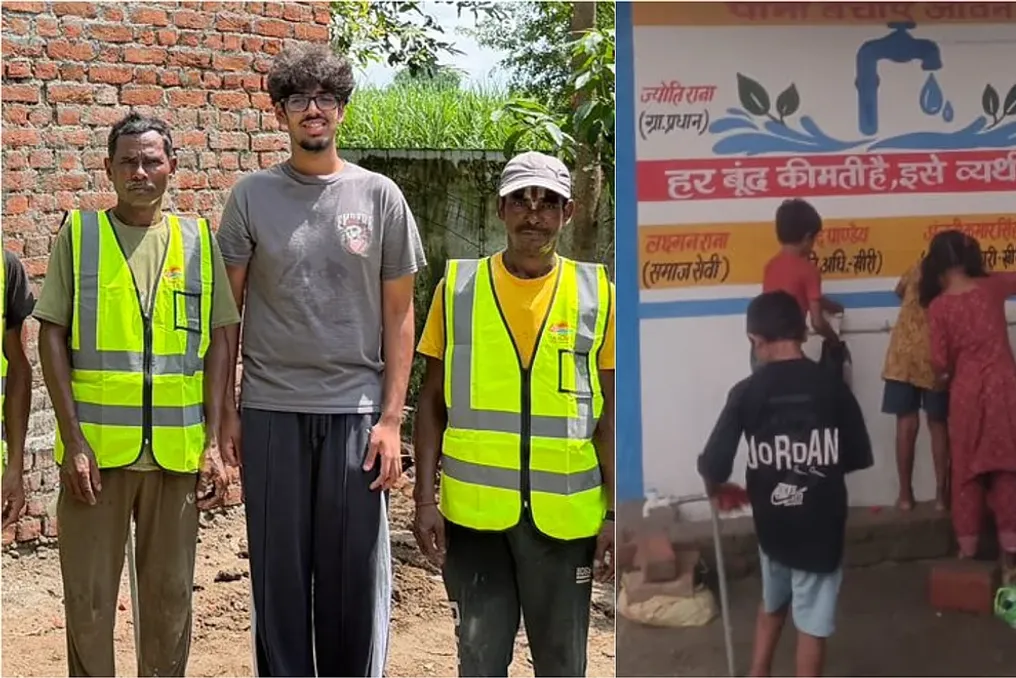
Eighteen-year-old Vehan Subramanian, a student at Dubai College, completed the construction of a water purification station in Parsia village, Lakhimpur Kheri district, intended to serve over 3,000 people from more than 1,000 families.
According to village head Lakshman Prasad Rana, the station, commissioned on September 6, is capable of purifying about 2,000 liters of groundwater per hour and is already being used by local residents.
Laboratory analyses provided by Vehan show that the level of arsenic in untreated groundwater decreased from 0.026 mg/L (or 26 micrograms/L) to less than 0.005 mg/L after filtration, which was below the laboratory's detection limit.
The pre-treatment sample was tested at an EIAC accredited lab in Dubai on September 10, and the treated water sample was tested at an NABL accredited lab in Lucknow on September 18. The tests also demonstrated a reduction in turbidity from 2.61 NTU to zero, and the content of iron and sulfates in the treated sample was below the detection limits.
For Vehan, the project started after a LinkedIn post about groundwater contamination in India. He noted: 'I had heard about water pollution before, but I didn't realize the scale of the arsenic problem or that water could look perfectly normal while containing a dangerous contaminant.'
The more he researched the topic, the further the problem moved away from scientific curiosity. He emphasized: 'What struck me most was that arsenic is invisible. A family can fill a glass of perfectly clear water from a hand pump, drink it every day, and have no obvious reason to know that something harmful is in it.'
The initial question was how to remove arsenic from water. It later transformed into the question: 'If we already know how to remove arsenic from water, why are people still drinking it?'—this became the question behind Project ARUNA, or Arsenic Removal Using Non-regenerative Adsorption.
Vehan stated that he did not want the project to be limited to understanding the problem, conducting an experiment, or publishing a scientific paper. He aimed to trace the issue from research and chemistry to engineering, government permitting, and ultimately, to having safe tap water in the affected village.
Before developing his own design, Vehan studied data on groundwater and existing community treatment systems. He also collaborated with Professor Rehab Mahmud and researchers from Beni-Suef University on an advanced adsorbent for arsenic removal. Their research was published in the journal Catalysts in May.
However, he deliberately decided not to use this research material in the first village installation. He explained that 'the research material still required further long-term testing, scaling studies, and field trials with continuous flow.' Instead, he chose granular ferulic hydroxide, or GFH—a more established medium for arsenic removal. He added: 'The goal is not to prove that your own idea must be used. It is about using evidence to select the most appropriate solution.'
The final system was designed considering the conditions of rural Uttar Pradesh, including unreliable power supply and groundwater containing both iron and arsenic. The system is powered by solar panels, and groundwater is pumped from a well approximately 200 feet below the surface into a 2,000-liter raw water tank. The water then passes through stages of iron and other impurity removal before the arsenic adsorption stage.
Vehan stressed that the goal was not to create a technologically complex object. He aimed to create something reliable enough to operate in a remote village, effective enough to solve real groundwater problems, and simple enough for local residents to maintain.
The installation was built with the help of local workers, including masons, plumbers, welders, painters, and electricians. Vehan was on site with Rana, who supervised the work.
Before the installation, the Parsia families relied on groundwater from hand pumps for drinking and domestic needs. Those who could afford it bought drinking water, and some families used small household filters when there was electricity. Rana reported that commercially available reverse osmosis filters did not last long due to groundwater contamination.
Rana said that residents were aware of the water problem. He described how water collected from the hand pump turned yellow within a few hours if left in a container. The area around the pump developed a permanent yellow stain, and white clothes turned yellow when washed in the groundwater.
Residents also reported illnesses, including stomach ulcers, kidney stones, and jaundice, but Rana noted that medical confirmation would be needed to establish a causal link.
Today, the situation has changed. Rana reported: 'The station is working, and residents have started collecting and drinking clean water.'
The facility is located in a central spot near the village office, the state school, and the primary healthcare center, where residents use three taps to fill bottles and large containers. Vehan clarified: 'Some people simply collect water for immediate consumption in bottles. Most fill it into large containers and transport it.'
Rana noted the strong community response: 'Residents collect water for both immediate use and household use. Having the facility within the village makes it convenient for the community.'
Vehan stated that he financed half of the project from savings accumulated over the last seven to eight years. The remaining funds came from donations collected through a book club he founded called Chapter One: Giving Back, as well as from family and friends.
The initial cost of the installation was about 700,000 rupees. Uttar Pradesh Jal Nigam and local authorities were also involved in the project. Vehan initially approached the National Mission for Clean Ganga, which forwarded the request to Jal Nigam. Ultimately, the authorities identified Parsia and allocated government land for the project.
The initially considered location in Golbodi was unsuitable, and the project was moved to Parsia. For Vehan, receiving government support was a turning point. He said: 'Getting government support and official land designation for the project was one of the moments when ARUNA stopped being just a scientific-engineering project and became something tangible.'
The installation operates under a Build, Operate, Transfer (BOT) model for the village. Rana received training on paid maintenance, and other residents were trained in cleaning tanks, solar panels, and backwashing filters. Vehan committed to conducting annual water testing and replacing consumables according to the results.
According to project information, the lifespan of the purification media is about three to four years, and surplus materials are currently stored in the village for future replacement.
Vehan emphasized that long-term sustainability was a key factor in designing the station. He stated: 'I don't want ARUNA to turn into a station that works during the opening and then stops working after a year.'
What started as one pilot project has already generated requests from surrounding communities. Rana, who is the pradhan of four small villages, reported 'many requests' for similar stations. The next proposed location is Golbodi, a remote village that is currently difficult to reach due to rain. Another village, Chahmalpur in Lakhimpur Kheri, also requested a station.
Vehan hopes to install two more stations by November and at least 10 in the next academic year. Each additional station is expected to cost around $8,000 USD, and funding is being sought from UAE companies through CSR initiatives, Indian donors, and crowdfunding.
Requests from other villages have changed the project's ambitions for Vehan. He said: 'Initially, my goal was to build one pilot unit and prove the model could work. But after talking to people, I started thinking about whether ARUNA could eventually become a replicable village-level model.'
The moment that convinced him was not a laboratory result or an engineering phase. He shared: 'Residents of neighboring villages started asking us: 'Can you build one in our village too?' That's when I realized the first station shouldn't be the end of Project ARUNA. It should be the beginning.'
Thomas Dackling, Director of Dubai College, noted that Vehan's initiative reflects the 'precisely' proactive approach they encourage in students. He added: 'This [project] perfectly aligns with our whole-school ethos of 'Service to All,' where we want our students to use their amazing abilities to make the world a better place. And this seems like a perfect example.'