
Experts warn: minor offenses may affect US student visa applications for students from the UAE
Read more
Khaleej Times
www.khaleejtimes.com

Experts warn: minor offenses may affect US student visa applications for students from the UAE

Education consultants caution families from the United Arab Emirates (UAE) considering their children's studies at American universities that even minor legal or behavioral infractions can now influence decisions regarding student visas. This introduces additional uncertainty into the application process.

These warnings arise as some families reconsider the US as a study destination or reduce the priority of American institutions due to visa processing concerns. Consultants note that the issue lies not so much in a formal change of rules, but in their stricter enforcement.

Michael Geimerl, head of career and college consulting at Score Plus Educational Consulting Institute, stated that the situation is related to increased scrutiny rather than an official regulatory change. He noted the uncertainty, which causes families to review plans concerning the US or lower the ranking of American universities.

A representative of the US embassy involved in the visa process in Abu Dhabi allegedly clarified that the rules themselves have not changed, but they might have been applied more leniently previously. Geimerl emphasized that in the past, students' mistakes could be met with some leniency, allowing them to learn from the experience, whereas now there is a zero-tolerance policy, and even the slightest issue can lead to a visa denial.

This message applies not only to university admission; decisions made in high school can have consequences extending beyond grades, test scores, and extracurricular achievements. The expert insists that students must monitor their behavior, as what was once considered insignificant can now have serious repercussions.

Geimerl also acknowledged that general geopolitical events have contributed to uncertainty in international education and travel, although the situation, according to him, is beginning to stabilize. He advises UAE families to start planning their education long before twelfth grade.

Starting early allows students to identify areas needing improvement and gradually shape their academic, extracurricular, and personal profiles, instead of trying to do everything in the final school years. In Geimerl's opinion, the difference between a student who starts planning in tenth grade and one who approaches the process in twelfth grade can be significant, as much has already been done in the latter case.

Ritu, Director of Score Plus, added that the overall landscape of international education is changing. Today, students and families look not only at the reputation of the university but also at the overall value of the educational path, including quality of instruction, accessibility, employment opportunities, technology, student experience, and post-graduation prospects. Thus, the future of international education lies in finding the right combination of university, program, country, cost, career path, and fit for the student.
Similar stories

UAE Universities Shift Focus from Diplomas to Practical Training and Industry Experience
Read more
www.khaleejtimes.com

UAE Universities Shift Focus from Diplomas to Practical Training and Industry Experience

When choosing a higher education institution, students from the United Arab Emirates are increasingly considering not only the qualification obtained but also what happens after graduation. Universities note a growing interest in aspects such as employment, internships, industry interaction, development of communication skills, and overall student experience.

At the Canadian University in Dubai (CUD), this shift required a revision of the approach to engaging with prospective students and their parents. Aya Sharif, CUD's Marketing Manager, reported that despite an increase in the total number of students compared to previous years, experience has shown an important lesson about what families now expect from higher education.

Sharif emphasized the need for a complete overhaul of the communication strategy to demonstrate the value and return on investment (ROI) in education, focusing on program employment outcomes. She noted that communication with families has moved beyond solely academic achievements; parents now want to know how the institution will help their children develop confidence and skills for future employment.

According to her, the more attention is paid to student life, the more significant it becomes. Today, students and their parents are looking not just for a diploma, but for a supportive environment where the child feels part of something bigger, where they are valued and heard. These values form a holistic, student-centric ecosystem.

Furthermore, students strive to develop outside the scope of their main academic discipline. CUD facilitates this by providing an individualized approach to each learner, helping them improve communication skills, confidence, and abilities.

The university actively integrates industry into the learning process. Sharif specified that a significant number of classes at CUD are conducted by industry professionals, and the faculty includes practicing specialists from relevant sectors. Students have daily opportunities to participate in new events, build contacts, or gain new opportunities.

This industry connection extends to partnerships and practical opportunities. CUD collaborates with organizations such as Dubai Media Academy, FinTech TV, and Dubai Municipality. Students also have access to AWS Academy, Cisco Networking Academy, and RedTeam Hacker Academy programs.

Students engage with the industry through case studies, guest speakers, site visits, seminars, and networking, as well as through specialized career and internship support. Sharif concluded that they 'live within the industry, not isolated,' which aligns with the concept of an urban campus or city university center.

The broader higher education sector is also being forced to adapt to changing expectations. Professor Dr. Amitabh Upadhyay, Director of Academic Affairs at Global Business Studies (GBS Dubai), stated that institutions must rethink methods for preparing students for an uncertain future.

He noted that higher education is at a crossroads, and the current structure and purpose of institutions may not meet the needs of society and the future industry. Therefore, educational institutions must implement a flexible model that instills ethically sound knowledge, necessary skills, and futuristic competencies for successful adaptation to uncertainty.

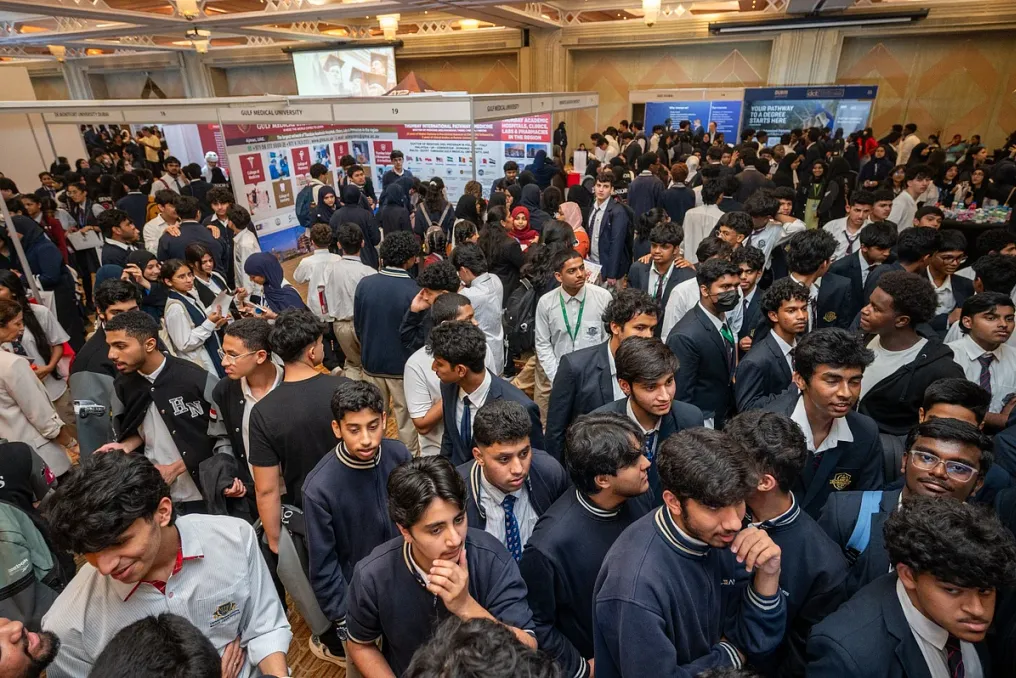
Meanwhile, universities use events like the Khaleej Times Uni Expo to gauge the demands of students and parents. Bhakti Rin, Head of Recruitment at De Montfort University, said the expo provided an excellent opportunity to communicate directly with families and education specialists. She called the event 'exciting and well-organized,' which helped showcase the university and establish meaningful connections.

Popular