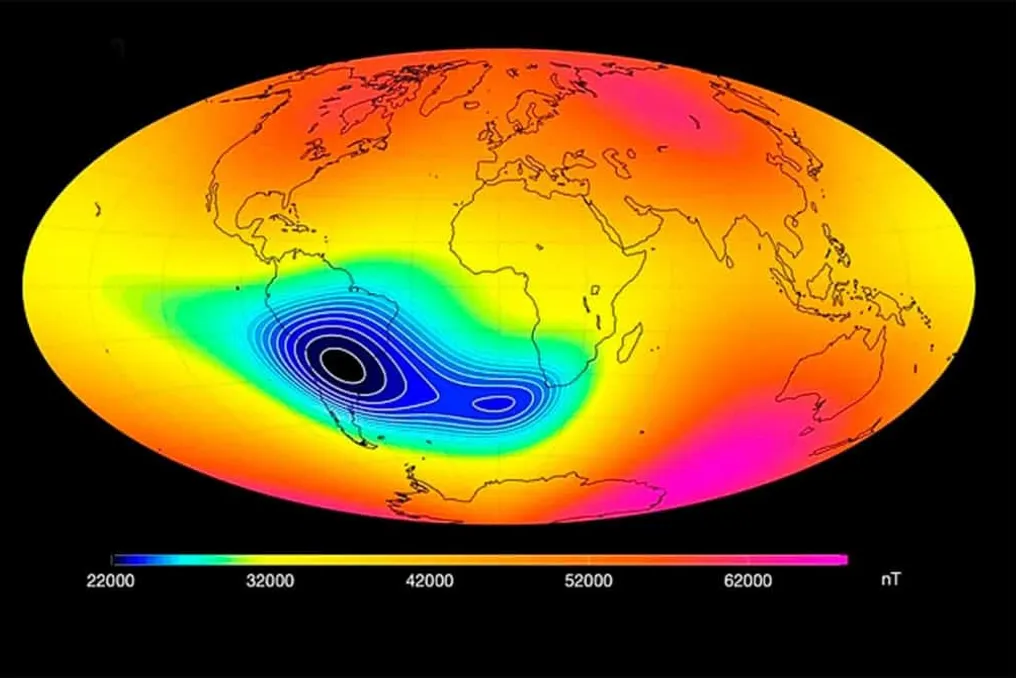
Researchers from the National Institute for Space Research (INPE) are working on developing new instruments intended for satellites. The purpose of these new devices is to conduct a detailed analysis of the South Atlantic Magnetic Anomaly (SAMA).
This vast area is characterized by a notable weakening of the Earth's magnetic shield, affecting Brazil, other nations in South America, the Atlantic Ocean, and the southern part of the African continent.
Details about Earth's magnetic protection
The magnetic field plays a crucial role as a protective barrier against the incessant flow of particles originating from the Sun. According to Gelvam André Hartmann, a professor at the Institute of Geosciences at the State University of Campinas (Unicamp), this field, together with the atmosphere, establishes the magnetosphere. The latter functions as a shield, deflecting a large part of these particles and reducing their direct interaction with the atmosphere.
In an interview given to Olhar Digital, the specialist, who holds a doctorate in geophysics, emphasized the importance of this defense for maintaining long-term environmental stability. He pointed out that this protection is vital because solar wind can interact with the upper layers of the atmosphere, contributing, over extended periods, to the loss of atmospheric particles into space. Thus, the magnetic field helps preserve the conditions that allow for the planet's habitability.
Hartmann also mentioned that terrestrial gravity and the properties of the atmosphere itself are essential to prevent an immediate collapse of planetary gases. However, in a hypothetical scenario of prolonged absence of the geomagnetic shield, continuous interaction with the solar wind would drastically increase particle loss into space. This process would result in a gradual modification of the Earth's atmospheric composition over vast geological timescales.
In addition to retaining the atmosphere over long timescales, the magnetic field reduces the exposure of space infrastructure to charged particles. However, this protection is not absolute; solar storm events can intensify the flow of energetic particles, causing changes in the space environment and impacting the operation of satellites and other technological systems.
Such occurrences also disturb the ionosphere, which is the electrified layer of the upper atmosphere responsible for enabling telecommunications and navigation. Fluctuations in the ionic layers affect radio signal transmission and systems like GPS, making precise route calculation difficult in ground receivers and generating operational failures in sectors dependent on this technology.
In the specific area of the magnetic anomaly, the vulnerability of the Earth's shield allows solar radiation to penetrate at lower altitudes. This increased exposure to magnetic bombardment constitutes a direct risk to satellite electronic components. For this reason, operators frequently implement safeguard measures, such as placing sensitive instruments in safe mode, depending on circumstances and mission.
Development of models and new sensors
Currently, INPE scientists are focused on creating reliable models to predict space weather and develop protection strategies for space equipment. The initiative aims to accurately monitor the frequency of precipitation, the amount of electrons, and the different types of emitted particles. The primary objective is to determine in detail how the dynamic behavior of geomagnetic storms modifies these falling trajectories over the affected territory.
Charged particles remain trapped around the Earth in the Van Allen radiation belts. In these belts, they can interact with electromagnetic waves known as whistler waves, which alters their trajectory and may facilitate the entry of some of these particles into the atmosphere. In the SAMA region, where the magnetic field is weaker, this mechanism allows particles to reach lower altitudes.
The INPE team plans new sensors designed to withstand the constant radiation of the zone under the influence of the anomaly. Since most low-altitude satellites carry only instruments for monitoring surface climate or vegetation imagery, it is necessary to design new technological tools from scratch. These devices will be responsible for the measurements required for the study of the anomaly.
The new devices will undergo rigorous testing in a laboratory environment before being sent into space. Hartmann clarifies that the instruments aim to measure the flow of charged particles, especially electrons, and points out that the INPE project is in its initial stage, focusing on preliminary calculations and simulations. He adds that the team is defining instrument requirements and executing calculations, simulations, and tests to validate their performance under detection, temperature, radiation, and electronic operating conditions; therefore, there is no established launch date yet.
Launch platforms and strategic importance
There are space missions already planned to transport the new Brazilian sensors into space. Among the main candidates are CBERS (Sino-Brazilian Satellite for Land Resources) and the Galileo mission, an INPE project submitted to the Brazilian Space Agency (AEB) to launch a solar observation telescope. Both platforms are being considered to test the equipment in orbit.
The development of this technology expands Brazil's capacity to directly investigate the phenomenon and create proprietary instruments for monitoring the space environment. Since the anomaly affects national territory, Hartmann emphasizes that the project gives Brazil a strategic opportunity to directly measure the space environment related to the phenomenon. This qualification reinforces the autonomy of researchers and complements data collected by international missions with measurements taken directly in the SAMA region.
The Earth's magnetic field is continuously generated by the movement of liquid iron in the planet's core, located about 2,900 kilometers deep. Hartmann explains that although the Earth's field can be simplified as a large dipole magnet, it has complex non-dipolar components that generate areas with behavior distinct from what is predicted internally.
He details that in the South Atlantic region, at the top of the core, there is a configuration of great relevance: extensive areas of magnetic flux with polarity opposite to that expected for the main field. These structures, located at the boundary between the outer core and the mantle, decrease the intensity of the magnetic field observed on the surface. The researcher warns that this phenomenon is not related to geological formations in the crust or continent, but rather to a deep characteristic of the outer core that accompanies geomagnetic dynamics. Therefore, the South Atlantic Magnetic Anomaly should not be interpreted as a 'hole' or failure of the Earth's magnetic field, but rather as a natural and dynamic characteristic of the geomagnetic field.
These zones of inverse magnetic flux do not remain fixed; they evolve and slowly migrate westward over the years, influencing the field's behavior up to Southern Africa. Due to this dynamism that keeps the anomaly constantly active, space weather monitoring requires continuity to protect orbital technological infrastructure. With the progress of studies and the advancement of sensors, Brazilian science seeks to understand how the South Atlantic Magnetic Anomaly evolves and impacts the space environment, allowing the data to help plan protections for satellites and expand knowledge about the effects of solar storms in the region.