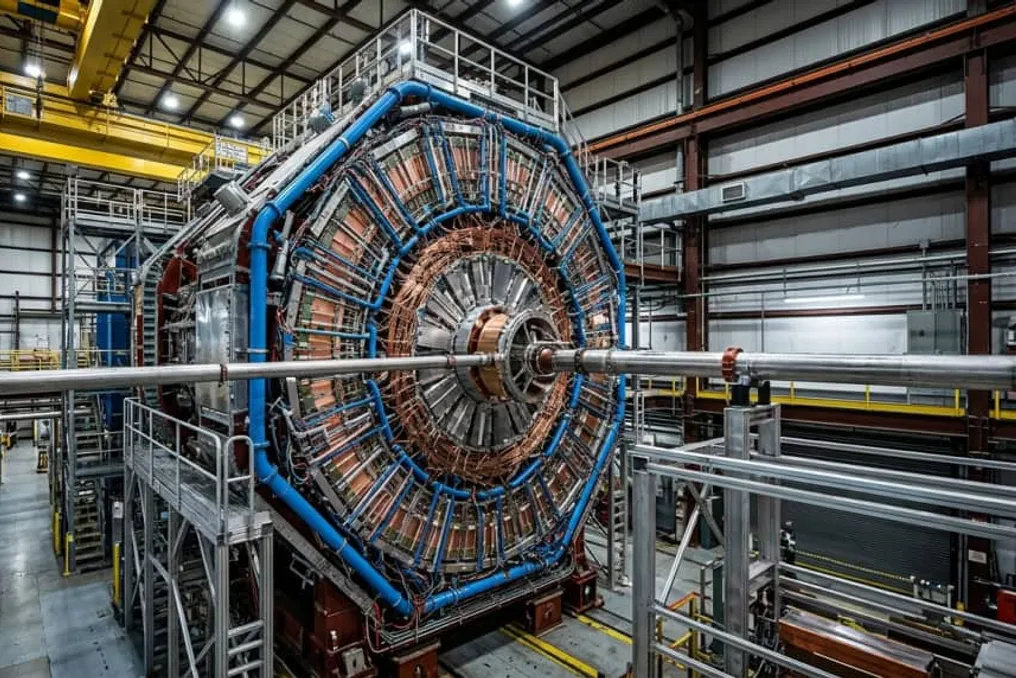
Experiment Recreates Early Universe Through Gold Nucleus Collisions
Read more
Olhar Digital
olhardigital.com.br

Experiment Recreates Early Universe Through Gold Nucleus Collisions

Physicists collided gold nuclei at very high speeds and discovered an unexpected pattern in the particles released as a result of the impact. This finding provides clues about how the primordial matter formed shortly after the Big Bang cooled down to form the protons and neutrons that constitute the matter of the modern universe.

The anomaly may indicate what is known as the 'critical point' of nuclear matter—a state where changing one state of matter into another alters its behavior, according to the study. The data were recorded by the STAR detector installed at the RHIC accelerator at Brookhaven National Laboratory in New York.

To reproduce conditions similar to those of the early universe, researchers from Brookhaven National Laboratory made gold nuclei collide at various energy levels. The team analyzed about a billion collisions in the range of 3 to 7.7 GeV, which is the lowest energy zone of RHIC.

At lower energy collisions, a fixed target system was used: a beam of gold struck a thin sheet of the same metal. This configuration allows for the production of the densest matter achieved by the accelerator.

After each impact, scientists observed with what intensity charged particles were ejected sideways. This measurement is known to physicists as transverse momentum. They also compared the movement of the particles to check whether they tended to be ejected together with greater or lesser force.

A gradual change was expected as the collision energy varied. However, the result was different: the effect decreased, reached its lowest point, and then began to rise again.

This difference was significant enough to be considered statistically very significant. The result reached 5 sigma, a level that physicists use to indicate that it is unlikely to be a coincidence. Calculations suggest that if the observed change were merely random, such a deviation would occur approximately once in 3.5 million attempts.

The observation helps scientists understand a kind of 'guidance' of matter under extreme conditions, called the equation of state. It describes how characteristics such as temperature, pressure, and density relate to each other.

Protons and neutrons are composed of even smaller particles—quarks. They remain bound by the strong interaction, one of the fundamental forces of nature. Under exposure to extreme temperatures or densities, protons and neutrons can transform into quark-gluon plasma—a kind of 'soup' of particles that is thought to have filled the universe in the first moments after the Big Bang.

"For water, this indicates when it freezes, boils, or expands," explained Rutik Manikandhan, a physics postdoc at the University of Ohio State. According to the researcher, for nuclear matter, the equation of state functions as a set of rules for understanding its behavior under the most extreme conditions of nature.

It is in this scenario that the so-called critical point appears. These are special conditions under which the way matter transitions from one state to another can change. Discovering this region would help physicists better understand how the quark-gluon plasma of the primordial universe turned into the matter we know.

The signal attracted attention because widely used simulations that do not account for the existence of a critical point reproduced the general trend of the data, but not the drop that was observed. However, in off-center collisions, the same effect appeared only weakly.

The researchers remain cautious. Other phenomena may alter the observed variations in particles, and it is yet to be determined how much they explain the registered behavior.

Additional Information

Manikandhan stated: "This result is indicative, not proof of the critical point."

The team now plans to calculate the specific heat capacity of the hot matter formed during the collisions and compare this result with models describing the behavior of quarks and gluons. Other measurements, such as changes in the number of produced protons, will also be analyzed.

The researcher concluded: "Only when different measurements agree can we confidently assert the existence of a critical point."

If the hypothesis is confirmed, the result could help clarify an important stage of the universe's evolution: the transition from quark-gluon plasma to matter composed of protons and neutrons.
Similar stories

Study of 1600 physicists shows no scientific consensus on fundamental questions of the Universe
Read more
olhardigital.com.br

Study of 1600 physicists shows no scientific consensus on fundamental questions of the Universe

A study involving over 1600 physicists demonstrated that some of the most basic questions about the Universe remain without a unified opinion among scientists. The most notable finding was that 68% of respondents do not believe that the Big Bang necessarily marked the beginning of time.

This survey, organized through an international open call in 2025, also revealed disagreements regarding cosmic inflation, dark matter, dark energy, black holes, and the nature of gravity itself. The study's authors emphasize that these results do not indicate a crisis, but rather point to areas where physics still faces open questions.

The common perception that the Big Bang was the moment everything began is widespread outside scientific circles. However, the theory itself only describes a Universe that arose from an extremely hot and dense state and began to expand, but it does not define whether time started at that precise moment.

This is where the main conclusion of the study emerges: for 68% of the participating physicists, the Big Bang does not necessarily have to be interpreted as the beginning of time. Another 20% believe that both a singularity and the beginning of time existed, while 5% advocate for the idea of time beginning without a singularity.

The discussion is not limited to this. One hypothesis explaining the apparent homogeneity of the Universe is cosmic inflation. According to this model, a fraction of a second after the Big Bang, the cosmos underwent extremely rapid expansion. Nevertheless, even this explanation is far from consensus: 51% of participants agreed with it, while the rest were divided between cyclic universe models and other options.

Doubts increase when physicists try to explain what cannot be observed directly. For example, dark matter is a hypothesis used to explain the behavior and distribution of galaxies. No dominant explanation emerged during the survey: 21% chose a combination of possible scenarios, 17% pointed to yet unknown particles, and 12% supported changes to the theory of gravity.

Dark energy shows a similar division. It is used to explain the accelerated expansion of the Universe. In this regard, 24% of researchers supported the concept of the cosmological constant, while 26% believed that this component could change over time.

Another issue is the Hubble tension, arising because different methods of measuring the current rate of the Universe's expansion yield diverging values. Answers were distributed among measurement problems, changes in dark energy, quantum gravity effects, and choosing no specific opinion.

A similar lack of agreement is observed when the research extends beyond space into the microscopic world. The Copenhagen interpretation, which views quantum nature as fundamentally probabilistic, received 36% of the responses.

More on black holes

Black holes also pose complex questions. For 41% of participants, matter falling into these objects compresses into a singularity at the core. Attempts to reconcile gravity with quantum mechanics lead to even more fragmented answers: 29% had no opinion, 19% cited string theory, 18% felt that gravity could not be integrated into quantum physics, and 13% chose loop quantum gravity.

The consensus, or lack thereof, shows where evidence seems established and where researchers see room for radically different ideas. Niayesh Afshordi, a physicist from the University of Waterloo and co-author of the study, noted in his note that the result helps identify those very points where there is still a lack of evidence capable of resolving major disputes. Afshordi summarized the situation bluntly: 'The interesting point is not that physicists are confused. But that the frontier is truly alive.'

Thus, the study shows that some of the greatest questions in physics remain open. And in this case, the absence of a single answer does not conclude the discussion; it precisely indicates where it is still ongoing.

Popular