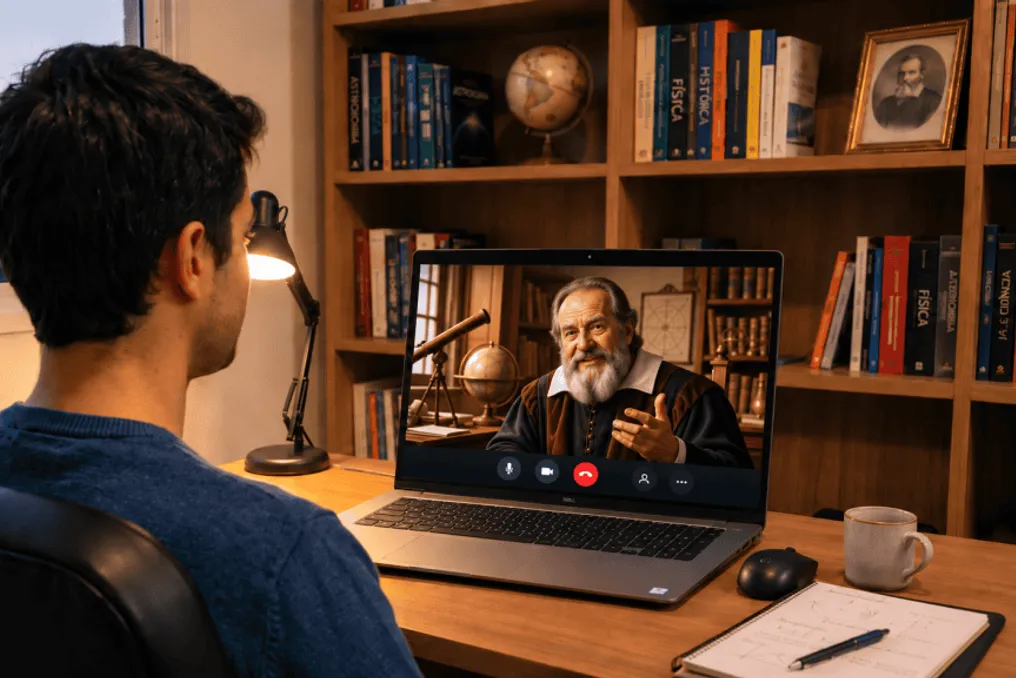
The application of artificial intelligence (AI) in education sparks active discussions, but a recent Brazilian initiative demonstrates how this technology can serve as a useful tool both for learning and for popularizing science.
Last Friday (the 2nd), the program Olhar Espacial highlighted the use of generative AI models to simulate conversations with outstanding historical figures in science. Astronomer host Marcelo Zurita interviewed Professor Ricardo Francisco Pereira from the Department of Physics at the State University of Maringá (UEM).
Pereira, who coordinates teacher professional development projects and is a researcher in physics and astronomy teaching, shared his experience, describing it in a two-part article for the journal Astronova. As part of the project, he used the AI tool Manus to create a fictional interview with the physicist and astronomer Galileo Galilei.
During the interview, Pereira detailed the process of developing this pedagogical experiment. He noted that the introduction of AI created a new challenge requiring the modernization and updating of educational approaches so that students do not limit themselves to simply submitting queries, copying, and pasting material for classroom presentations.
He explained that his task was to practically master AI in an educational environment. One of the activities he developed concerned the history of physics, and since Galileo Galilei is one of the most famous figures in this field, he devised the idea of interviewing him to test whether AI could provide an adequate response on behalf of the scientist himself.
Pereira specified that the procedure involved developing questions from the interviewer's perspective and feeding them to the AI to answer in the role of the physicist. He explained that he carefully formulated the questions and research topics, aiming to obtain not just a ready-made answer from the AI, but one that Galileo himself might have given. He emphasized that this differs from a direct question because the AI has access to a vast amount of material about Galileo. However, by asking a question, for example, about how he arrived at a certain conclusion, the AI is forced to generate a non-existent answer, which allows for the contextualization of the character.
Among the questions that stood out in the AI's responses were the motives that led him to point the telescope to the sky—an action that revolutionized astronomy in the early 17th century and made him the 'father of modern astronomy,' as well as the scientist's feelings when he had to renounce his discoveries before the Inquisition court.
During the Zurita program, he also demonstrated the technology live, launching an interactive chat for questions directed at representations of other scientific icons, such as Isaac Newton, Albert Einstein, and Cecilia Payne. The AI avatars answered questions sent by the public and the host, touching upon topics such as the limits of mathematics in the universe, the conceptual implications of general relativity, and the difficulties women faced in academic careers.
Despite the positive results and the playful nature of the experience, Pereira warned about significant limitations of the technology. He insisted that AI should be viewed strictly as an auxiliary didactic tool, not as a final source for historical reconstruction or a substitute for critical thinking.
The professor noted: 'I think we can get an idea of the context, but we will never know if Galileo would have answered exactly like that. That is impossible to know. We can only assess how close the answer is to what Galileo thought, based on his works and publications. Therefore, one must be very careful with this context and use it more as a didactic tool to better understand Galileo's case, his discoveries, and their consequences. Great caution must be exercised to avoid any historical deconstruction of the characters.'
In the professor's opinion, misuse of AI can lead to errors due to system 'hallucinations'—when the machine invents data or introduces anachronistic concepts—and undermine students' cognitive development if they simply delegate their intellectual tasks.
In conclusion, the guest speaker advocated for the necessity of conscious pedagogical adaptation from educators and students. In his view, teachers should change the dynamics of classroom lessons, encouraging the responsible use of artificial intelligence to stimulate curiosity and active learning, without abandoning their own reflection.