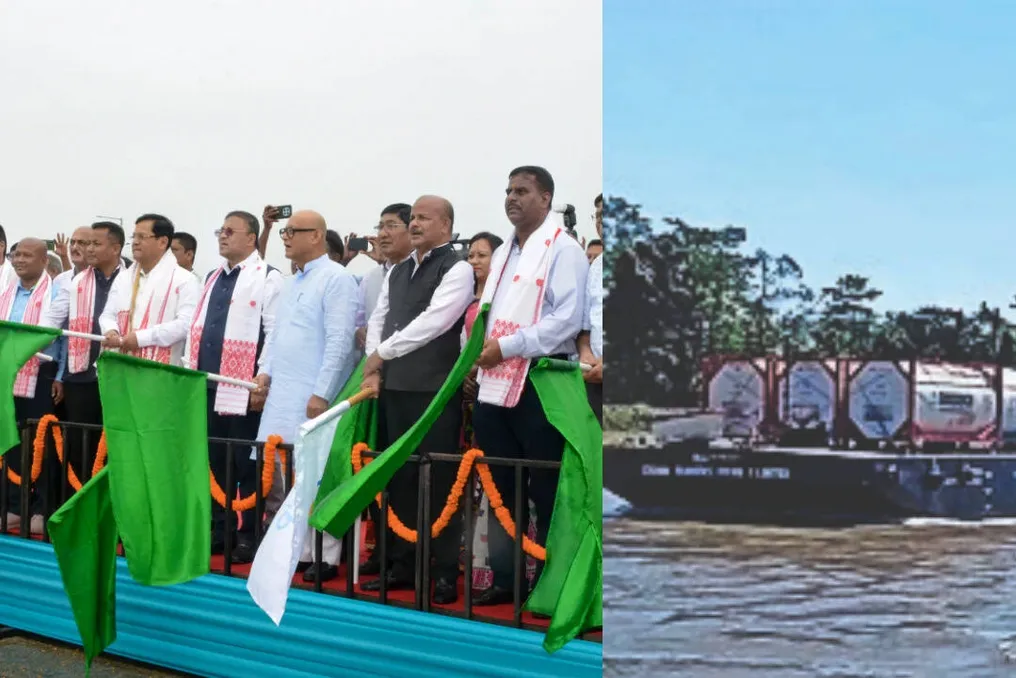
International river navigation resumed in Dibrugarh on Monday after nearly seven decades. Minister of Maritime Transport, Sarbananda Sonowal, ordered a barge carrying 540 metric tons of methanol from the Bogibilla terminal to Dhaka, marking the first cargo shipment from Upper Assam to a foreign port since gaining independence.
The methanol, produced by the state-owned company Assam Petro-Chemicals Ltd (APCL) at the Namrup plant, will travel approximately 768 kilometers along National Waterway-2 on the Brahmaputra River before reaching the border of India and Bangladesh and continuing via the India-Bangladesh Protocol Route. The journey from Bogibilla to Narayanganj in Bangladesh will cover about 1300 kilometers.
This consignment is viewed as a test of the Brahmaputra's potential as a commercially viable cargo corridor connecting the Northeast with global markets. Regular supply of methanol to Bangladesh is planned, made possible by the recently established customs and immigration facilities in Bogibilla and Dubri.
The resumption of river trade in Dibrugarh occurs almost 70 years after the closure of the historic river ghat. The ghat was closed in 1956 when tea cargo shifted to rail transport, ending regular river bookings from the city.
Sonowal noted that 'our grandparents grew up listening to the steam whistle in Dibrugarh Ghat. For 70 years, this whistle was silent, and ships stopped arriving. Today, a ship is leaving Dibrugarh for the world again. The river never let us down. What it lacked for decades was the will to revive it.'
The vessel DLB Patkai, towed by the tugboat Kushal Konwar, will deliver the cargo to the port of Pangon in Dhaka. The Chief Minister of Assam, Himanta Biswa Sarma, virtually attended the launch ceremony.
Sarma called this consignment an important moment for the state, stating: 'Assam's own product, manufactured in Namrup, is now heading to the international market via Assam's own river. The Northeast is no longer a border; it is India's gateway to the East.'
The revival of river connectivity in Dibrugarh is supported by the Bogibilla passenger and cargo terminal, which opened in February 2024, as well as customs and immigration infrastructure and the Jalvahak freight incentive program.
The route has shown growing activity in recent years. Tata Steel barges reached Pandu via Bangladesh in February 2022, and the river cruise liner MV Ganga Vilas traveled from Varanasi to Dibrugarh via Bangladesh in 2023.
The government is also aiming to expand inland waterways as an alternative freight network. According to the Ministry of Ports, Shipping and Waterways, the movement of goods through India's national waterways increased from 18 million metric tons in 2013-14 to 218 million metric tons in 2025-26.
Over 6800 crore rupees are being invested in waterways across the Northeast, including the development of National Waterway-2, the vessel repair base in Pandu, and the last-mile connectivity to the Pandu port.
Sonowal emphasized that the economic and environmental justification for using waterways is also significant. He stated: 'Every ton we transport by river means less fuel burned and fewer trucks on the highway.'
The government is collaborating with Bangladesh, Nepal, Bhutan, and Myanmar to develop regional river links, and the Dibrugarh-Dhaka supply chain could potentially open another cargo route for Northeast products to international markets.