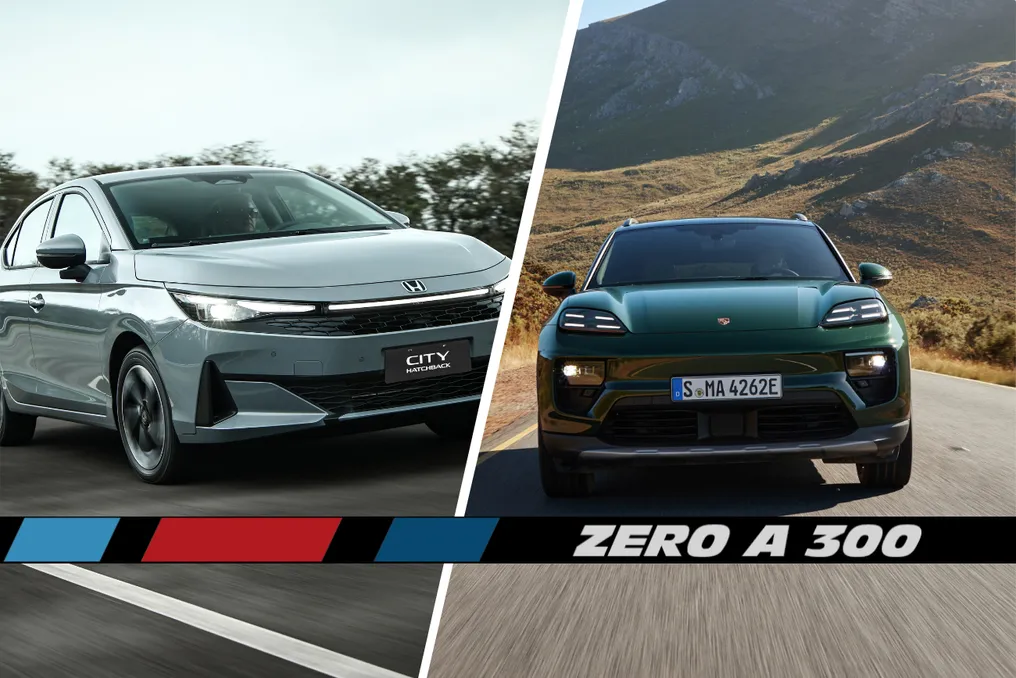
Honda has revealed the 2027 lineup of the City, which received a significant aesthetic update inspired by the Prelude coupe, in addition to a new top-tier RS version and subtle adjustments to various components. Visually, the design was modified to resemble the Prelude, notably in the shape of the headlights and grille, which now feature a cleaner and straighter look. The rear lights remain identical on both the sedan and the hatchback, with only the bumper updated to harmonize with the new front end; the sides remained unchanged.
Internal improvements focus on the ten-inch multimedia center, available in the Touring and newly launched RS configurations. The LX, EX, and EXL versions continue to use the eight-inch screen, but all support wireless mirroring for Apple CarPlay and Android Auto. Starting from the EXL version, the instrument panel becomes a seven-inch digital display, and the cabin is equipped with new Type C USB ports and wireless charging. In terms of safety, all models have six airbags, and the Honda Sensing package is available from the EX version.
The RS version, exclusive to the hatchback, replaces the old Touring Sport and emphasizes the sporty appeal, adding a gloss black roof, mirrors, and spoiler, darkened 16-inch wheels, a sporty exhaust outlet, and interior details with red stitching. Mechanically, there were no changes; the 2027 City maintains the 1.5 naturally aspirated flex engine with direct injection, capable of generating up to 126 hp and 15.8 kgfm of torque, coupled with a simulated seven-speed CVT automatic transmission. The hybrid i:HEV version, sold in Asia, will not be introduced in the national compact car at this time, expected to appear in Brazil only in 2028, in the new generation of the HR-V, maintaining the focus of the naturally aspirated model on low consumption, reaching up to 15.3 km/l on the highway with gasoline in the sedan and 15.1 km/l in the hatchback.
Pre-sales for the new Honda City begin on October 3rd, and the first 3,000 buyers (distributed equally between 1,500 hatchbacks and 1,500 sedans) will maintain the 2026 price list. Official prices range from R$ 117,700 for the entry-level LX version (same price for both body types) up to R$ 156,400 for the top-of-the-line RS version. Other configurations are: EX (R$ 137,400 for the hatchback and R$ 138,400 for the sedan), EXL (R$ 144,800 for the hatchback and R$ 145,800 for the sedan), and Touring (R$ 153,300 for the hatchback and R$ 154,300 for the sedan).
Ford discreetly introduced the Lariat version for the Maverick pickup, positioning it as a new entry option with a price of R$ 209,900, representing a reduction of R$ 10,000 compared to the Black version, which remains in the catalog. This strategy aims to compete directly with models such as Fiat Toro, RAM Rampage, Chevrolet Montana, Volkswagen Tukan, and BYD Mako.
Despite being a more affordable version, the Maverick Lariat offers a good set of standard equipment, including an electric sunroof, an eight-inch digital instrument panel, a SYNC 4 multimedia center with a 13.2-inch screen, an electrically adjustable driver's seat, wireless charging, an eight-speaker Bang & Olufsen sound system, and dual-zone digital air conditioning. Safety features include seven airbags, adaptive cruise control with Stop & Go function, lane keep assist, automatic emergency braking, blind spot monitoring, and a 360-degree external camera.
What defines the entry position of the Maverick Lariat is its more sober appearance, featuring 19-inch wheels with 225/55 tires, in contrast to the 17-inch set and mixed tires of the Black version, as well as the absence of decorations. Its mechanical setup is identical to that of the Black: a 2.0 EcoBoost turbocharged gasoline engine, delivering 253 hp at 5,500 rpm and 38.7 kgfm of torque at 3,000 rpm, combined with an eight-speed automatic transmission and all-wheel drive.
Porsche confirmed the return of the gasoline version of the Macan SUV. CEO Michael Leiters informed The Financial Times that the Macan will return to using an internal combustion engine starting in 2028. Previously, in early 2019, Porsche had announced that the new generation of the Macan would be exclusively electric, an initial step towards the model's total electrification, which occurred gradually, with the global discontinuation of the combustion engine model occurring in July of this year.
Leiters admitted that his reputation as a skeptic regarding electric vehicles is unfair, but justified that the fastest way to recover the company's profits, affected by falling sales in China, is by developing new combustion SUVs and sports cars. He believes that the resumption of the gasoline Macan version, one of its biggest successes since 2014, is the shortest path to this.
According to the executive, Porsche needs to rebalance its propulsion strategy, offering a more balanced portfolio between electric and combustion options. Recent data supports this decision: in the first half of 2026, electric version sales fell by 40% compared to the previous year, while the gasoline model registered a growth of 2% in the same period, even outside the European market. The new 2028 gasoline Macan will be marketed alongside the electric model, without replacing it. Meanwhile, Porsche continues the project for the fully electric fourth-generation 718, and Leiters reinforced that there are no plans for an electric 911.
A partial sales report released by Stellantis demonstrated the persistent demand for combustion engines, especially among enthusiasts. The data indicates that the remaining gasoline versions of the Dodge Charger were sold in significantly higher numbers than the electric variants: for every electric unit, fifteen gasoline units were sold.
Between July and September, the combustion engine Charger registered 3,446 units sold in the United States, a significant increase of 1,348% compared to the same period in 2025, when only 238 units were from the old stock. The current gasoline line is equipped with the 3.0L Hurricane biturbo inline six-cylinder engine, available in R/T and Scat Pack versions for coupe and sedan, deliveries of which began between late 2025 and early 2026.
In contrast, the electric Charger Daytona had only 233 registrations in the third quarter of 2026, representing a drop of 92% compared to the 2,776 sold in the same period in 2025. This disparity reflects the consumer rush in 2025 to take advantage of the federal tax incentive of US$ 7,500 before its expiration in September of that year, combined with the current North American market trend favoring combustion and hybrid cars.
Considering the period from January to September, the difference, although less drastic, remains clear: the gasoline Charger totaled 8,029 units (an increase of 330% over 2025), while the 100% electric version accumulated only 767 registrations (a decrease of 89%). Besides the resistance of purist audiences to full electrification, price also influences the choice, given that the gasoline Charger R/T starts at US$ 49,995 and the Scat Pack at US$ 54,995, values significantly lower than the US$ 59,995 of the electric Daytona Scat Pack. This reinforces Dodge's decision to relaunch the Charger with a V8 engine, expected in 2027 or 2028, accompanying the model's restyling, with the return of the Hellcat anticipated, driven by the success of RAM pickups with naturally aspirated and supercharged V8 engines in the United States.