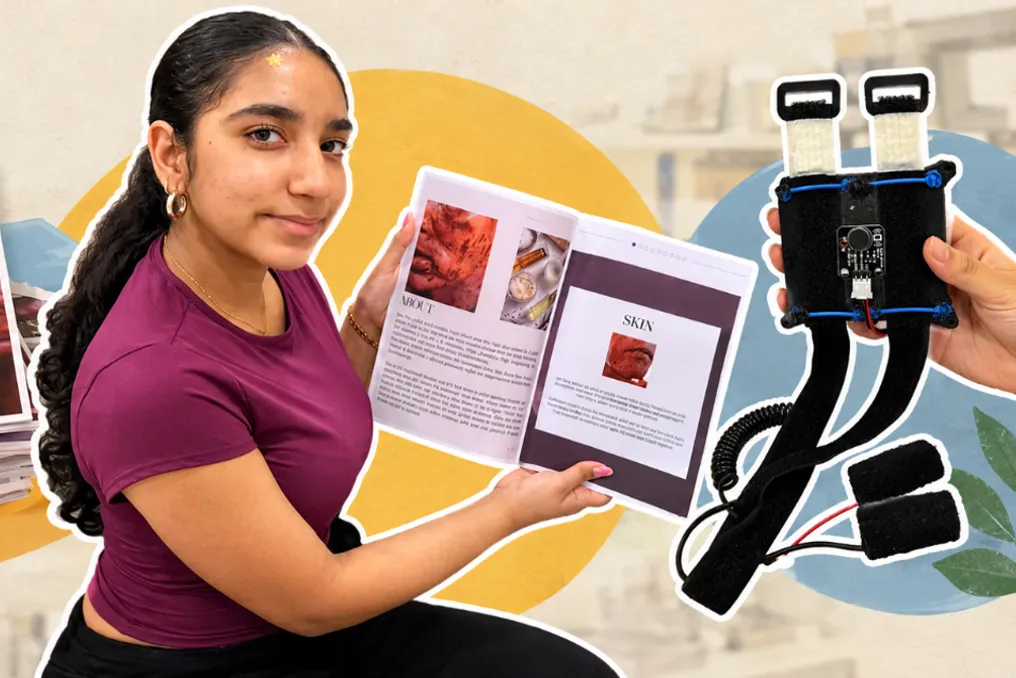
Sixteen-year-old student Sia Domkundwar from Pune developed a resource called The Glow Guide. This 60-page guide, based on a trauma-informed approach and created by survivors themselves, is intended for people who have experienced burns and acid attacks, helping them manage daily care after treatment concludes.
The project initially started as an internship under mentors. Now, The Glow Guide is distributed in hospitals across India. It is important to note that the guide does not prescribe or recommend medications; it serves as a supplementary manual for daily care during the recovery stage, complementing medical treatment.
The main focus is on practical issues arising after or alongside medical observation, such as skin care, clothing, hygiene, cosmetics, nutrition, hair and scalp care, nails and hands, and other aspects of life. The guide integrates information from three main categories: brands recommended by dermatologists and small-batch suppliers, as well as NGOs and hospital programs that may be useful to survivors.
Furthermore, the guide includes a trauma-therapy component, ensuring that the information is presented without pressuring survivors to 'fix' their appearance or adhere to a prescribed recovery schedule. The project has no commercial ties, and the guide is designed as a free and accessible resource, not a catalog of commercial products. It is currently available in English.
Another Kind of Care
Sia began working within the BuildUp internship program, where she met the Chhanv Foundation. This organization has been supporting survivors of acid attacks for many years, providing rehabilitation, social, and long-term assistance. For Sia, this connection opened up a world she did not fully understand.
She started speaking directly with survivors and conducted interviews with about eight people. Initially, Sia expected to hear stories about surgeries, scars, and pain. However, she found that the topics discussed were more complex to systematize. Survivors talked about sunlight, uncomfortable clothing, unpredictable reactions to skin grafts, and hair that no longer grew the same way. They also raised questions about which creams are safe, what fabric to wear, how to protect the skin, and whether makeup can cause irritation.
Sia realized that the medical system had done its job in saving lives, but daily life remained full of unresolved questions. As Sia notes: 'I noticed there was a gap in over-the-counter, non-medicinal daily care and products they need for their body.'
She discovered that most survivors relied on trial and error, and after trauma, trial and error can be extremely exhausting.
What Happens After Discharge?
This question remained on her mind. In many cases of burns and acid attacks, recovery can take years, including surgeries, transplants, medication, and regular medical check-ups. However, outside of clinical care, most of life becomes self-regulated. For many survivors, especially from rural areas, this means recreating a routine with minimal information.
The story of Anshu, one of the survivors Sia spoke with, helped her see the problem more clearly. In the early stages of recovery, doctors advised Anshu's family to keep the skin dry and avoid products that could cause infection. Later, recommendations appeared for using sunscreen and moisturizers, but guidance beyond that was scarce.
Anshu shares: 'Besides the doctor, no one guided us.'
Since she is from a village, her family lacked knowledge about skincare routines or ingredient safety, and they learned everything along the way. Her words: 'If this guide had been available when I was recovering, it would have made everything much easier' became one of the strongest validations of Sia's work.
The Glow Guide did not aim to replace medical advice; it tried to ease daily life.
Created Through Listening
Before this, Sia had been involved in product safety issues for many years. In primary school, she participated in a project studying ten harmful chemicals commonly found in cosmetics and their effects on the body and environment. At the time, it was a school assignment, but now the stakes were higher.
To create the guide, Sia spoke not only with survivors but also with specialists working with patients with burns and acid injuries. She gathered both medical knowledge and life experience. However, translating these conversations into a usable format proved more difficult than she expected.
Survivors often gave contradictory advice: what soothed one person irritated another; what worked for one body did not work for another. This inconsistency itself became part of the guide's design. Instead of prescribing, it informs; instead of asserting definitively, it offers direction.
More Than Skincare
The Glow Guide covers skin, hair and scalp care, nails, clothing, hygiene, nutrition, cosmetics, and recovery tools. It also includes an ingredient safety decoder and a 'Glow Directory'—a collection of products, specialists, and NGOs vetted by survivors.
But for Sia, the goal of this guide is broader than mere utility; it is a matter of agency. It is about helping survivors reclaim familiarity with themselves. In conversations, she found that many survivors do not try to 'hide' what happened. They dress, use makeup, and experiment with nail designs to express themselves. Sia notes: 'All the survivors said they love their faces and feel beautiful. But for them, the meaning of beauty has changed.'
In this context, beauty was not about appearance, but about self-discovery.
Anshu's Story
Sia met Anshu via video call. Anshu spoke about the violence associated with the attack and the years afterward. Sia noted how striking it was that life continued after the trauma. Sia recalls: 'She had so much joy. She didn't let the attack take that away from her.'
When Sia asked if she ever felt awkward, Anshu answered affirmatively. Initially, this feeling was inevitable, but over time, she began to understand herself outside the context of the attack. She wanted to continue living and eventually return to normal things like applying makeup, dressing, and self-care. Anshu says: 'Every girl wants to feel beautiful. And when you can put on makeup or take care of yourself, it gives confidence. That feeling matters.'
This phrase is now at the emotional core of The Glow Guide.
What's Next
Today, The Glow Guide has been handed over to the Chhanv Foundation and is being distributed in 10 hospitals across India. For example, Shrishankara Superspeciality Hospital in Nanded, Maharashtra, uses this guide. Plans are also underway to create a digital and social media presence to simplify access for survivors and caregivers.
Some survivors told Sia that the guide changed their view of recovery. They began to perceive it not as a list of restrictions, but as a process of restoration. Sia says: 'They said it helped them think not about what to take out of their lives, but about what to add.'
For survivors, recovery often carries the burden of loss: loss of skin, confidence, routine, sense of self.
Anushka Desai, a trauma therapist who assisted in developing The Glow Guide, believes this resource arose from a gap easily overlooked if recovery is viewed solely through a medical lens. In her interactions with survivors, she found that doctors often provide strong medical support. More complex questions arose when survivors had to return to daily life.
Desai asserts: 'When it comes to any medical treatment, they are so focused on the body. We try to treat the trauma, the bruise, the scar, the infection, or essentially anything that supports physical healing. But everyone knows that recovery doesn't actually end when you are just treated physically.'
She explains that their concerns were not necessarily about the adequacy of medical treatment. Many had supportive doctors and were confident that their physical injuries were being treated correctly. 'From a trauma perspective, healing is not always just related to your skin or scars. It is also related to a sense of safety in your own body, as well as a sense of safety in your surroundings, especially when something so terrible has happened.'
This understanding also influenced the design of The Glow Guide. She explains that immediately after violence, the survivor's choices are already taken away by the aggressor. Medical treatment can then include another series of decisions made on their behalf due to medical necessity.
Interestingly, she found that survivors did not always request extensive consultations on skincare or cosmetics. One survivor, she recalls, particularly enjoyed doing manicures and liked wearing long red nails. 'It was very connected to reclaiming part of their old identity that existed before this attack.'
Respecting the Survivor's Journey
Not all of them were victims of intentional attacks. One of the survivors the team worked with suffered burns in a gas accident, while others were subjected to assault. For Desai, this reinforced the need for a resource that does not assume every survivor will follow the same path.
She says: 'I really liked Sia's approach because we weren't trying to prescribe a path to recovery.'
For Desai, this possibility of choice might seem minor externally, but after trauma, it can be immensely significant. 'Once you give people this choice, even in small things, it is truly important. This goes far beyond survivors of acid attacks or burns. It applies to anyone who has experienced any kind of trauma or violence.'
The Glow Directory is not a list of product recommendations. The survivors' experiences were particularly vital, as skin reactions and daily needs can vary significantly from person to person. Therefore, the guide presents no product as universally suitable or as a medical solution.
}} , 1.