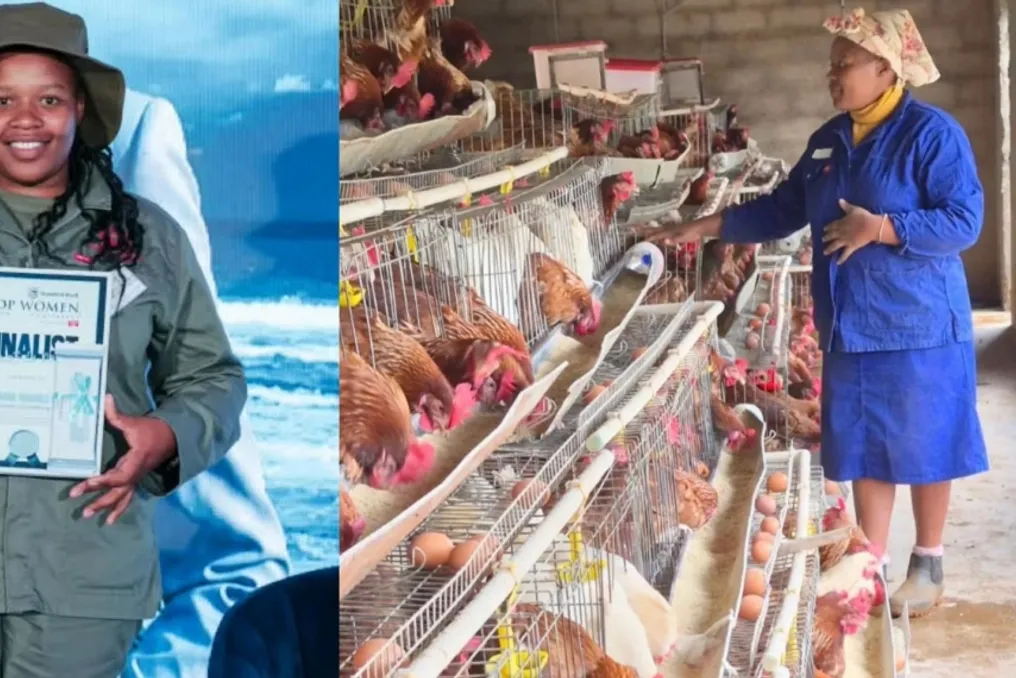
Sinetemba Nkobile Gebashe, founder and managing director of Ithuba Lamahlavula Farming, is building a sustainable agricultural enterprise in KwaZulu-Natal, driven by a desire to ensure food security and uplift her hometown. Her inspiration comes from her mother, Kabangani Gebashe, who farmed to provide for the family.
Gebashe recalls that her mother's dedication to agriculture inspired her to love the agro-sector and begin her own farming journey. 'My mother's farming experience taught me the importance of food security, hard work, and self-sufficiency,' she shares.
Gebashe grew up in the village of Kwangwenda, which is part of the Umzumbe Municipality. She completed primary school at Gebers CP School and later attended Bhanoyi High School, graduating in 2009. Instead of immediately engaging in commercial production, she first laid a strong academic foundation.
She studied basic agriculture at Coastal KZN FET College, obtaining NQF Levels 2, 3, and 4 qualifications by 2012. She then enrolled at the University of South Africa (Unisa), earning a national diploma in agricultural management in 2018, and completing her studies in the same field with a BTech degree in 2024.
Alongside her studies, Gebashe gained extensive community-focused practical experience. From 2019 to 2021, she participated in the Casp alumni program at the Siyavuna Abalimi Development Centre. She later worked as an extension specialist assistant for the Department of Agriculture, Land Reform and Rural Development in Umzumbe, and subsequently served as a disability education facilitator for the Independent Electoral Commission (IEC).
Gebashe's operational activities began in October 2011 while she was finishing her final year of college. She used savings from pocket money received from her father, Bhekisigcino Gebashe, to build a modest brick chicken coop. Her parents also provided her with two hectares of family land to start projects, where she began by raising 50-day-old broilers.
In 2012, she officially registered her enterprise as Ithuba Lamahlavula Farming. However, disaster struck the following year: heavy rains destroyed her structure, and she lost her entire flock of broilers. Undeterred by the loss, Gebashe accumulated money from early earnings to construct a sturdy broiler house measuring 10x5 meters.
She explains that her initial goal was to establish a laying hen project, but due to lack of funds, she continued broiler production. Thanks to Gebashe's persistence, she soon received support from the municipality and province. Through the Umzumbe Municipality's LED Asset Assistance Program, she received funding to purchase the first 500 laying hens, officially transitioning the business into egg production.
Recognizing her achievements, the KZN Department of Agriculture and Rural Development supported her efforts by providing R400,000. This influx of capital allowed her to increase the flock to 1,000 laying hens while modernizing poultry infrastructure, feed supply, and operational equipment.
Today, Ithuba Lamahlavula Farming supplies wholesale eggs to major commercial partners and local distributors, including Mandate Food Company, PCK Distributors, Turton Wholesale, and Mthwalume Wholesale, while also selling select poultry to local residents. The farm employs two permanent and two temporary workers, and it takes on two agricultural graduates from the department to assist with daily management, egg sorting, packaging, and local delivery.
Like many emerging poultry producers, Gebashe faces constant commercial pressure due to high chicken feed prices, disease risks, limited capacity, and transportation logistics. To protect her profit margins, she prioritizes biosecurity and meticulous operational planning.
She notes: 'We mitigate these challenges by controlling bird health, maintaining proper hygiene, managing feed carefully, planning production, and building relationships with reliable wholesale clients.' Furthermore, they are seeking funding and business support to expand laying hen capacity and improve farm infrastructure.
In Ithuba Lamahlavula Farming's plans, Gebashe is focused on increasing production volumes and closed-loop utilization of farm waste. Her goal is to expand the enterprise to 5,000 laying hens within the next three years. 'I want to increase egg production, supply more wholesalers and large buyers, create employment opportunities for the local community, and contribute to food security in the rural community,' she says. She also plans to use chicken manure to support local crop farming and promote environmentally responsible agriculture.'
For aspiring rural farmers, Gebashe emphasizes the importance of discipline over quick profits. She advises: 'Start small, be dedicated to the work, and keep learning. Farming requires patience, hard work, proper planning, and good financial management. It is important to understand your market, control production costs, maintain good animal health, and build client relationships. Do not give up when difficulties arise; instead, learn from your experience and seek opportunities to improve and grow your farming business.'