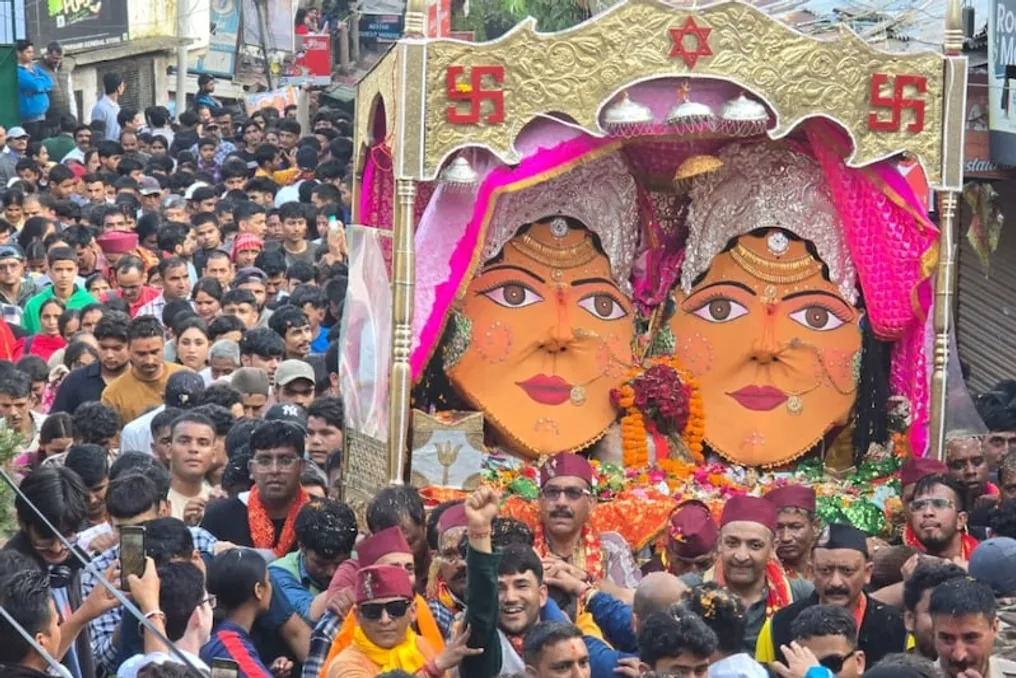
The town of Nainital in the state of Uttarakhand awaited the day when its streets would fill with cheers in honor of the goddesses Nanda and Sunanda. On Wednesday, during a procession as part of the 124th Shri Nanda Devi festival, thousands of pilgrims walked with processions, demonstrating deep faith. Despite the drizzling rain, the enthusiasm of the devotees remained unchanged.
After conducting ritual ceremonies at the Nayana Devi temple, the procession with goddesses Nanda and Sunanda left for the city. A shower of flowers descended upon the chariot. Following this, crowds of pilgrims rushed to the temple to see and receive blessings from the goddesses. The procession followed a route that included the DSA fields, the mosque, Sharda Sang, and Mal Road, moving towards Tallital.
Along the entire route, people stood with folded hands, awaiting the opportunity to see the goddesses. As the procession advanced, the excitement of the pilgrims grew. Representatives of all age groups participated in the procession—women, children, the elderly, and youth. Aarti and flower showers were held at different points. The sound of drums, brass bands, and traditional musical instruments added even greater religiosity to the atmosphere.
During the city procession, local traditional artists presented the cultural heritage of Kumaon, showcasing elements of local culture. The rain continued, but the pilgrims did not stop. The streets and hills of Nainital filled with cheers in honor of goddesses Nanda and Sunanda, coloring the entire city with the colors of religious faith and folk traditions.
For the pilgrims accompanying the procession, various services were organized in the city. Free meals (bhandaras) were arranged in different places, distributing halwa-puri, water, fruit juices, and sacred offerings. Despite the rain, the spirit of service among the locals and volunteers remained; some distributed food, while others offered water to the pilgrims.
On Wednesday, the streets of Nainital featured not only the chariot with goddesses Nanda and Sunanda but also the entire culture of faith, tradition, and service. Crowds of pilgrims were visible from Mal Road to Tallital. A single call echoed around: 'Jai Maa Nanda, Jai Maa Sunanda.'
This city procession became not just a religious event, but a living reflection of centuries-old faith, folk traditions, and the cultural heritage of Kumaon. Joy shone on the faces of the pilgrims upon meeting the goddesses, and sadness in their eyes upon bidding farewell. Every step taken with the procession was filled with reverence and faith in the goddesses.
After arriving in Tallital, the procession with goddesses Nanda and Sunanda will be moved towards Mallital. Later in the evening, near the Golu Devata temple on the wet street, the procession will be immersed in Nainital Lake.
With this conclusion, goddesses Nanda and Sunanda will depart from their home in Nainital for Kailash. At this touching moment of farewell, thousands of pilgrims will shed tears. Cheers in honor of the goddesses will once again resound in the atmosphere of Nainital, and the pilgrims will sadly bid farewell to Nanda and Sunanda before their departure to Kailash.