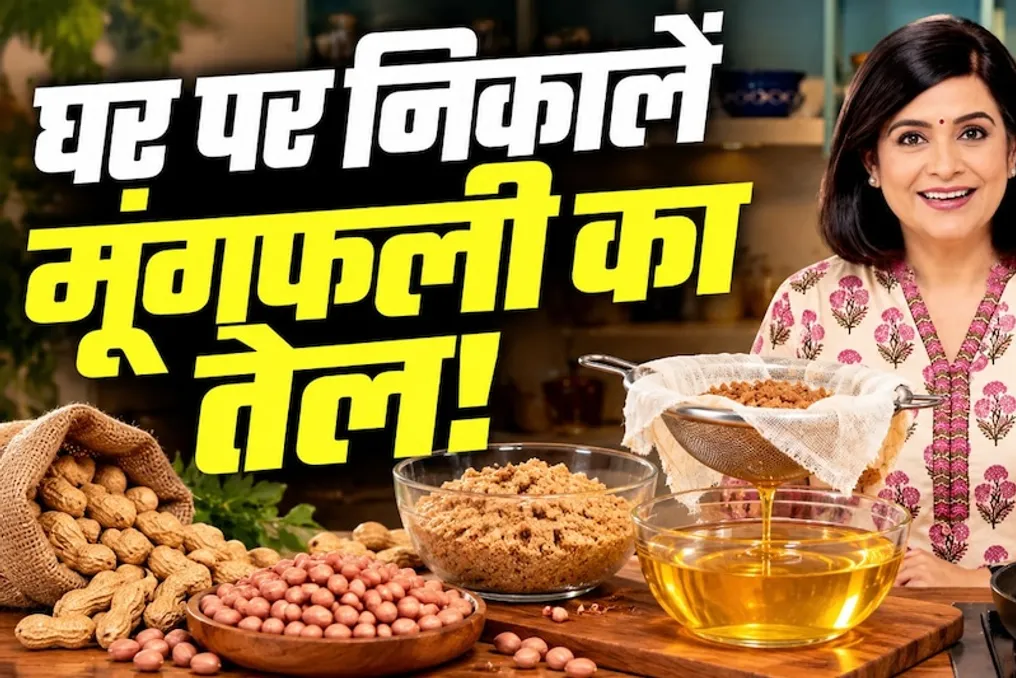
In anticipation of Sharadiya Navratri, during which religious rituals and worship of the goddess are held for nine days, many people observe a fast. During such fasts, sattvic foods are consumed while avoiding grains. Special oils are often used during this period, among which peanut oil is popular for preparing fasting dishes such as Kuttu Puri and Rajgira Paratha.
If you are concerned about the purity of store-bought oils, you can make peanut oil yourself at home. Notably, this process does not require any oil pressing machines or equipment. Chef Pankaj Bhadauria has shared a simple method for extracting oil from peanuts at home. The advantage of this method is not only obtaining homemade oil but also that the leftover peanut shells will not be thrown away; they can be used to prepare high-protein parathas or delicious laddus.
Ingredients
Pankaj Bhadauria explained that peanut oil can be obtained without using oil presses or machines. For this, you will need:
Selection of Raw Material
The quality of the peanuts is critically important for obtaining the oil. The peanuts must be fresh and high quality. According to Pankaj Bhadauria, one should choose peanuts with a light pink shell and dense kernels. When grinding, the shell should not easily separate. If the shell is too loose or if there is the slightest smell of staleness or mold in the peanuts, they cannot be used, as the oil obtained from spoiled peanuts may have a bitter taste.
Method of Extracting Peanut Oil
1. Take about 500 grams of raw peanuts. Clean them and place them in a thick-bottomed pot. Stir constantly over medium or low heat for approximately 8–12 minutes.
2. When the peanut shell turns golden and begins to separate easily, it means it is well roasted. It is important not to overcook the peanuts to avoid a burnt smell in the oil. If the peanuts are not roasted enough, the oil will retain a raw taste.
3. After roasting, turn off the heat and let the peanuts cool completely. Then, place them in a cloth and gently rub them to easily remove the shells.
4. After removing the shell, place the peanuts in a blender jar. Do not blend continuously; use the pulse setting, making short intervals of 30 seconds. This prevents the mixture from overheating.
5. As the peanuts are ground, they will turn into a slightly glossy paste, indicating the beginning of oil extraction.
6. Transfer the peanut paste onto a large plate or bowl and mix thoroughly. Then, gradually, one tablespoon at a time, add warm water and begin kneading by hand, like dough.
7. Care must be taken not to add water too quickly. After adding about 3–4 tablespoons of warm water, knead the dough by hand. Constant squeezing and rubbing will cause the peanut oil to start separating.
8. After about 7–8 minutes of kneading, the oil will begin to actively separate. Strain the collected oil through a sieve and collect it in a clean container.
9. Wrap the remaining peanut mixture in cheesecloth and squeeze it thoroughly. Continue squeezing until the oil extraction stops.
10. Then, pour the oil into a clean glass bottle. Initially, the oil may look slightly cloudy, but this is normal. Leave it undisturbed for 2–3 hours to allow fine particles to settle at the bottom. After this, re-strain the top layer of oil through cheesecloth. The oil prepared using Pankaj Bhadauria's method can be stored in a clean, dry, and cool place.
Using Shells Instead of Throwing Them Away
1. The remaining peanut shells contain a lot of protein. Instead of throwing them away, they can be mixed with flour to make high-protein parathas.
2. Furthermore, laddus can be made from them by adding palm powder and roasted sesame seeds. Thus, no part of the peanut goes to waste, and you can prepare a tasty snack along with the oil.
Note: When making oil at home, attention must be paid to cleanliness and storage rules. If you notice any changes in taste, smell, or the appearance of mold, do not use the oil.