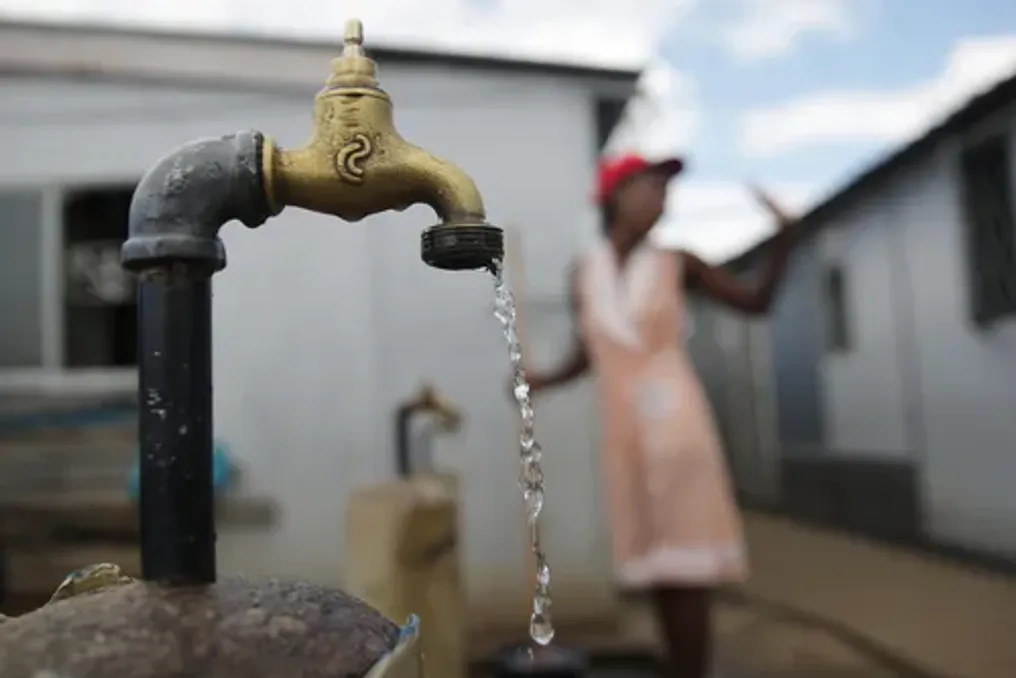
Faulty infrastructure and massive water losses place South Africans in front of a basic necessity, despite the country's reservoirs being largely full. The problem is not the absence of drinking or domestic water, but the malfunctioning of plumbing, such as a toilet cistern failing to refill after one flush.
By the third day, residents discover several facts they were previously unaware of, including that water is significantly heavier than it seems when it has to be carried over a distance. They also face the reality that municipal promises to solve the problem can repeat for weeks without visible results.
This situation is not dramatic, which explains why little is written about it. It is a slow realization of how much everyday life depended on the assumption that the tap would work, and how little this can be replaced independently.
More than a decade and a half ago, people learned to live without electricity. It is important to note how, as this explains why the water problem will be more complex. Those who could afford it opted out of the centralized grid by installing solar panels, inverters, and batteries. Over a million households did this, creating a powerful power station on the country's rooftops, but they did not reduce their dependence on Eskom, they eliminated it entirely.
The rest managed with candles, gas burners, or neighbors' generators. It was difficult and uneven, but survivable because there are substitutes for electricity: coal, gas, nuclear, wind, solar energy—one replaces another.
Water has no analogues. It can be moved, stored, purified, or pumped from the ground at great cost, but it cannot be replaced. Even having a reserve tank for some people is only a temporary reprieve, as it will eventually run dry, and the person will be in the same situation as a neighbor without such a tank.
There is also an aspect that has no private solutions. One can generate electricity independently, but one cannot maintain their own sewage system. This requires working pipes, pumps, and treatment facilities. Nearly half of the treatment facilities assessed nationwide are classified as critical.
Thus, a household with a tank buys itself a few days, while a household without one must wait for a water tanker. And a tanker is not a service, but a random event. It arrives in a specific area at an unpredictable time and stays until completely emptied. Information about its arrival can only be obtained from neighbors or through group messages on WhatsApp, and one must come prepared with what they can carry.
This is manageable for a young and healthy person, but completely unbearable for an 80-year-old, sick person using a walker, a single parent, or a shift worker whose job ends after the tanker leaves.
Those who need reliable water the most are the people least able to stand in line and carry water home.
The most alarming thing is that at the end of August, the country's reservoirs were filled over 95%, which is the average across more than 200 reservoirs. Yet, over 45% of the country's treated water never reaches consumers. It is lost in the ground, passes through unregistered connections, leaks through non-functional meters, or is delivered but not billed.
Approximately two-thirds of these losses are physical—related to pipes. The remainder is a management problem disguised as an engineering one. It is not a deficit. It rained, reservoirs filled up, treatment plants produced water, but then half of that water was lost somewhere between the treatment plant and the person.
The department measuring these losses estimates the damage at approximately 26 billion rand annually. About 90 billion rand is required for network repair and maintenance, but only about 17 billion is spent. Any business improvement starts with stopping losses before raising prices. No one agrees with a factory that loses half its production between the production line and the loading dock.
Nevertheless, this is what happens. Tariffs are increased for households that still pay. Thus, the payer bears a triple burden: once for the water that reached the house; a second time, included in the tariff, for water that went to no one; and a third time for the costs caused by this failure, which no one bills.
These hidden costs manifest as a lost workday waiting for a tanker, lost daily wages, a child left behind at school, or a visit to a clinic where unclean water was brought. This third cost item hits hardest on households least able to absorb them.
Water supply is provided not by Pretoria, but by municipal services, and in a few weeks, the country will hold council elections that govern them. The issue of the condition of pipes under the road will be on the ballot alongside everything else. Therefore, one should ask those who come knocking on doors before November 4th: what percentage of municipal water is lost before reaching the customer, and what is being done to solve this problem? A councilor who cannot answer has answered for themselves.
Tomorrow morning, the tap will be turned on, and water will flow. They will not experience water shortages. It fell as rain, it is behind a wall several hours away, it was treated and pumped towards them, and then it went into the ground under the road that has not yet been investigated. This is not a drought. Drought is weather, and no one votes on the weather. It is a series of decisions, each seemingly small enough for defense at the time of making, but in a few weeks, the people who made those decisions will ask for your vote.