As part of National Wildlife Week, various ways in which human choices influence relationships with wildlife are being examined, including what we grow, what we believe, what we consume, and how we understand animals. A series of four stories explores daily conflicts and connections, as well as people who find more thoughtful ways to coexist with wild animals.
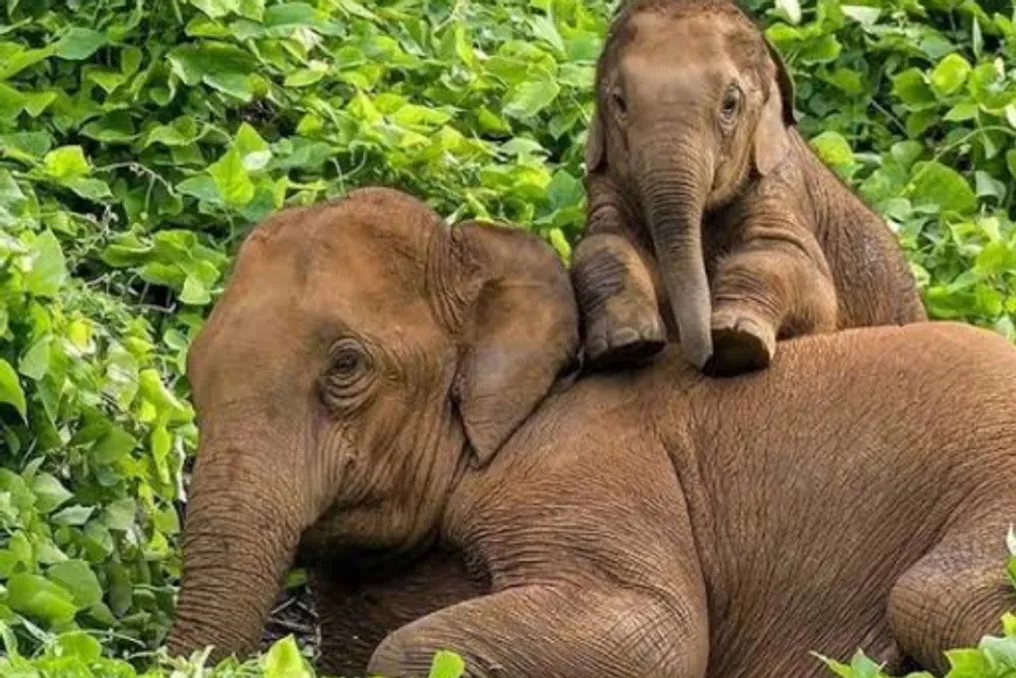
Elephants learn about the world much like children learn a new place: they follow someone, observe their steps, and gradually master the route. Their classroom is a forest spanning two countries, and the teacher is often the oldest female in the family, who traversed this path decades ago.
Before dawn, the elephant herd begins to move. The oldest female leads, moving confidently without stopping to search for the way forward or hesitating at junctions. Her guide is memory—her own and that of her mother.
Behind her, the rest of the herd follows in a line. Mothers keep their calves close. It is an impressive sight when a herd of about 60 elephants crosses railway tracks between Habaipur and Lamsakhang on October 16, thanks to the heroic actions of Loko Pilot Das and Assistant Loko Pilot Umesh Kumar.
None of the calves have ever made this journey, yet by the end of the day, they will cross the river, enter another country, and reach the forests. Along the Terai Arc landscape, the herds travel back and forth between the Katarnigat reserve in Uttar Pradesh and Bardia National Park in Nepal, using the same forest corridors their families have used for generations.
Elephants possess culture, and every journey serves as a means of transmitting this culture. The answer to the significance of culture for an elephant begins at the river.
Lessons in Motion
When the herd reaches the Gerua River, the current is strong after the rains, but the matriarch enters first. Younger females follow her, and the youngest calves stop on the bank, placing their feet exactly where their mothers stood previously. Adults instinctively close ranks, forming a loose circle around the youngest family members during the river crossing.
Conservationists note that upon closer inspection, this does not look like just an ordinary river crossing. According to Apurva Dikshit, an Indian Forest Service employee and Divisional Forest Inspector of the Katarnigat division, elephants continue to return because the Terai still provides a connected habitat with abundant water and food resources. He notes that the Terai region has plenty of water, extensive sugarcane cultivation, and suitable habitat, although habitat fragmentation elsewhere can affect their behavior.
Dikshit also believes that changes in parts of the Nepali landscape may shape how herds use the corridor today, making the connected forests in the Indian Terai increasingly vital. However, he is most struck by the river crossing itself. He says it is one of the most beautiful sights to witness—entire herds crossing together, with calves often stopping to play in the water or try to swim while adults wait, demonstrating their deep sociality.
These moments are difficult to quantify with numbers. Calves learn where the river is shallow enough to cross, how to move with the current, when to wait, and when to follow. No one gives them instructions; they learn simply by being near, much like a child learning to cross a busy road while holding a parent's hand and copying their movements.
In biology, culture is defined as knowledge and behavior acquired socially and passed down through generations, rather than inherited genetically. For elephants, this includes migration routes, feeding grounds, communication, reaction to danger, and even seasonal movement timings. Their world is built not only on instincts but also on memory.
Now Even the Law is Catching Up
On August 17, 2026, the Supreme Court intervened to protect these ancient paths, clearly stating that elephants should not be stopped merely because their journey crosses farms or settlements. In a hearing regarding the protection of wildlife ecological corridors, the three-judge bench led by the Chief Justice of India, Surya Kant, ruled: 'We clearly understand that there should be no obstacles on wildlife routes. Elephant herds have the practice of long-distance travel.'
The court directed the Centre to conduct a new nationwide review of elephant corridors and identify obstacles, emphasizing that crop damage cannot justify blocking traditional routes.
The Herd's Living Library
At the center of this system is the matriarch. Unlike species where leadership depends on physical strength, elephants are guided by experience. The oldest female carries decades of knowledge accumulated from repeated journeys through forests, rivers, and grasslands. She remembers which watering holes survive the driest summers, knows where bamboo regrows after the rains, and where mineral-rich salt licks are hidden. She recognizes safe places to cross rivers and understands which routes have become more difficult due to landscape changes.
Her memory becomes the herd's map. Sometimes this map determines who survives. Researchers studying African elephants in Tanzania during a severe drought found a striking fact: families led by older matriarchs who remembered previous droughts and knew where else to find water lost significantly fewer calves than families led by younger females.
Thus, migration is much more than just moving between two points.
Why Elephants Return
Across India, from the Nilgiri Biosphere Reserve in the south to the forests of Assam, Odisha, northern West Bengal, and the Terai, herds continue to follow ancient paths now recognized as elephant corridors. GPS tracking has shown that elephants repeatedly return to the same river crossings, forest clearings, and seasonal feeding grounds with astonishing accuracy. They are not wandering in search of habitat; they are repeating routes learned by previous generations.
The Katarnigat elephant corridor is one of the clearest examples of this continuity. Spanning across India and Nepal, it connects the Katarnigat reserve with Bardia National Park, allowing elephants, tigers, and rhinos to move freely across an ecological landscape that existed before political borders. Before the international border divided the two countries, these forests constituted a single ecosystem, and the elephants behave as if it still does.
Sitanshu Das, Assistant Project Manager (Biodiversity) at the Nature and Wildlife Society (NEWS), notes: 'The presence of natural barriers, such as rivers, is not the problem. Poorly planned development leading to forest loss and fragmentation affects elephant movement across landscapes and hinders connectivity.' He adds that when corridors disappear, elephants risk losing the ability to transmit knowledge accumulated over generations. A calf prevented from following a traditional route cannot learn it, and if enough generations miss this journey, the entire migratory tradition could vanish.
Understanding this changes the approach to conservation in landscapes like Katarnigat. Since October 2023, the Gajamitra (Elephant Friend) program has placed local communities at the center of these efforts. Residents trained under this initiative monitor elephant movements, warn nearby villages, patrol forest boundaries, and help safely guide herds without causing harm.
Ajanta Dey, Deputy Secretary and Program Director at NEWS, states: 'Our goal is not only to reduce crop losses or property damage but also to create an environment where humans and elephants can coexist safely and sustainably.' He emphasizes that NEWS's future for conservation lies in combining science, community management, and strong institutional partnerships.
For forest officials, these crossings serve as a reminder of how deeply rooted these traditions are. Thus, a calf splashing in the Gerua River is doing more than just playing; it is rehearsing a journey it will repeat throughout its life. Years from now, one of these calves will become a matriarch. She will lead the next generation through the same forests, stop at familiar river bends, and choose the paths she first learned by walking alongside her mother. This is how their culture survives.