Ramsetu: Religious Beliefs Versus Scientific Data on the Origin of the Bridge Between India and Sri Lanka
Read more
Aaj Tak
www.aajtak.in

Ramsetu: Religious Beliefs Versus Scientific Data on the Origin of the Bridge Between India and Sri Lanka

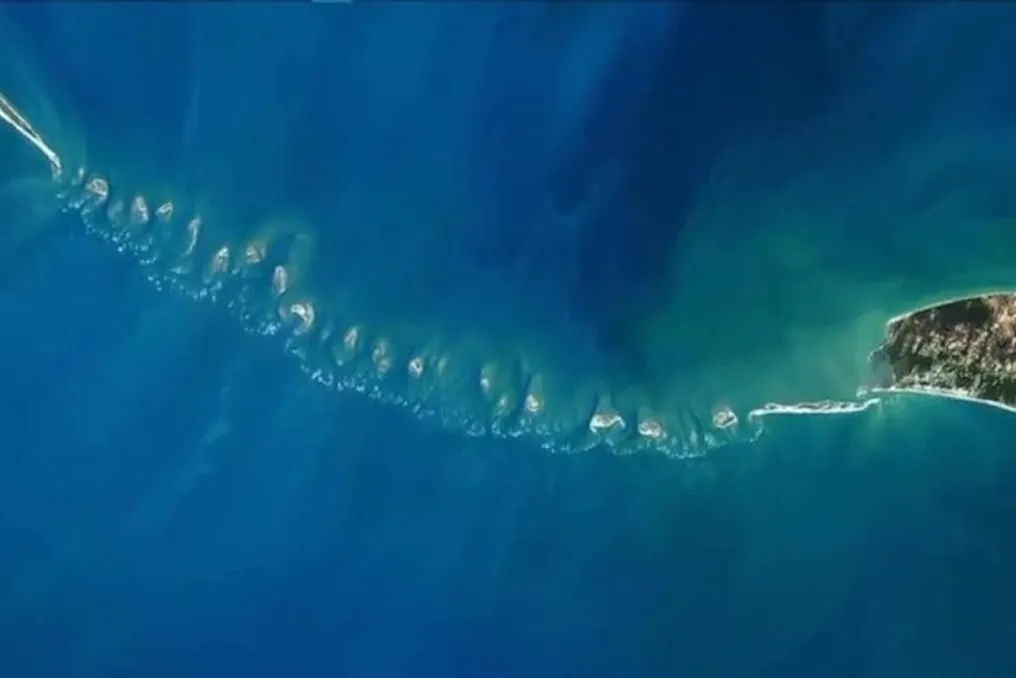
A long chain of rocks and stones lies in the sea between Rameshwaram in India and Mannar Island in Sri Lanka. Millennia-old religious traditions refer to this place as Ramsetu, while modern geography identifies it as Adam's Bridge.

There is a belief that during Lord Rama's journey with an army of monkeys to bring Mother Sita back from Lanka, they built this sea route. However, science views this object differently: is it a man-made bridge or a unique structure formed by natural marine processes?

NASA images also became central to the debate, sparking widespread discussion globally and nationally in 2007. An assertion circulated online claiming that NASA proved Ramsetu was built by humans. Nevertheless, it is necessary to clarify what NASA actually stated.

Mythological History of Ramsetu's Construction

According to Valmiki's Ramayana, when Lord Rama headed towards Lanka to rescue Mother Sita from Ravana's captivity, his army reached the seashore. Since crossing the vast ocean was critically necessary, the construction of a bridge began. According to legend, there was a skilled commander in the monkey army named Nal, who is considered the son of Vishwakarma and a master builder. Under Nal's leadership, the army began erecting the bridge using large stones, rocks, and trees brought into the sea to create a passage. The Ramayana also describes the miraculous speed of this construction; according to some details, it was completed in just five days, transforming the history of Ramsetu from simple construction into a narrative connected with faith and miracle.

The Legend of Floating Stones

One of the most well-known beliefs associated with Ramsetu is that Lord Rama's army inscribed the name 'Ram' on the stones before throwing them into the sea. It is said that these stones did not sink but remained floating. However, it is important to understand that the story of stones inscribed with the name 'Ram' belongs to religious and folk traditions and cannot be presented as modern scientific proof. Furthermore, there are discrepancies in the accounts of Ramsetu across various versions of the Ramayana and subsequent folk tales, making it appropriate to consider religious beliefs and original source descriptions in different contexts.

The Story of the Squirrel in Ramsetu

Another popular legend associated with Ramsetu involves a small squirrel. As the monkey army constructed the bridge from huge stones and rocks, a small squirrel also participated in the work. It ran on the sand near the sea, then approached the bridge and shook off sand with its body. The monkeys considered its efforts insignificant and amusing, but Lord Rama understood its intention. According to folk beliefs, Lord Rama gently stroked the squirrel's back, causing three stripes to appear on it, which are still associated with the squirrel's appearance. This story conveys a beautiful message that the value of a contribution is determined not by its size, but by its sincerity.

What Is This Structure in the Sea?

Now let us examine the area where religion and science are in direct contradiction. Between Rameshwaram in India and Mannar in Sri Lanka, a chain of shallow structures made of sand and limestone is visible. In the international scientific and geographical context, this is called Adam's Bridge. In NASA images, this structure is described as a chain of limestone shoals approximately 48 kilometers long. NASA materials indicate a disputed geological origin for this structure, meaning the structure itself exists and is clearly visible in satellite imagery.

However, the main question remains open: who built it? A major misconception arose regarding the claim that NASA proved Ramsetu was created by humans. Around 2007, satellite images of Ramsetu rapidly spread online. Along with these images, it was asserted that NASA itself confirmed that this structure between India and Sri Lanka is a man-made bridge. But no single satellite image can prove that any structure was created by humans.

A satellite image can show the landscape, but based on one image, one cannot determine the age of the structure, who built it, or whether it is entirely natural or shows signs of human intervention. Therefore, the statement 'NASA proved that Ramsetu is man-made' is incorrect. NASA's own publications also register this structure as Adam's Bridge and note the controversy surrounding its geological origin.
Similar stories

Family from Pilibit Adopts Hinduism After Ritual in Ganges in Haridwar
Read more
www.aajtak.in

Family from Pilibit Adopts Hinduism After Ritual in Ganges in Haridwar

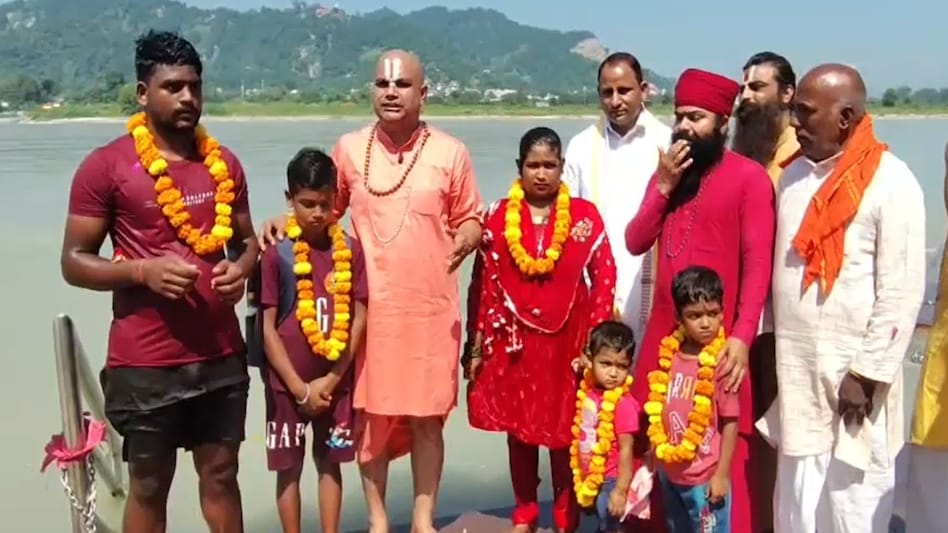
A family from Pilibit announced their conversion to Hinduism after performing a worship and bathing ritual on the banks of the Ganges River in Chandi Ghat, Haridwar. The family members included the couple and their three children. They decided to return to Hinduism under the influence of faith and the generosity of the spiritual religion.

The group that made the transition included Mahid from Pilibit, his wife Shabina, and their three children. The children were named Rihan and Arav (boys) and Inaya (girl). Mahid traveled to Haridwar inspired by Sant Ramvishal Das of Shri Tirth Seva Nyas. At Chandi Ghat on the banks of Mother Ganga, a Ganga Puja was performed, followed by a Havan ritual, and the family bathed in Mother Ganga, completing the process of adopting Hinduism.

After changing religions, Mahid, who now goes by the name Mohit, shared his thoughts on his decision. He stated that he liked Hinduism, which led him to join this faith. According to him, this religion embodies respect and compassion for society, prompting him to choose Hinduism. Mohit emphasized that he made this decision of his own free will, and no one pressured or coerced him. He specified that he resides in the Pilibit district, and his address is Rajiv Colony, Bara Gram, near Pappu Dari.

Mohit also provided information about his children: there are three of them, and their names are Rihan, Arav, and Inaya. He mentioned that his wife's name is Khishi, and his is Mohit. Mohit reiterated that he made this decision voluntarily, without any pressure.

Mohit's wife, Shabina, who has now been given the name Khishi, also spoke about the religious change. She reported that she did not like her previous religion and had long been connected to Hinduism. Khishi recounted that she had long celebrated Hindu festivals and engaged in other activities related to this religion, leading her to decide to fully embrace Hinduism. She mentioned the need to change her name on identification documents because, despite her long association with this religion, changes in her documents had not occurred.

Khishi also spoke about their children, noting that the children know about Hinduism and are familiar with names associated with this religion. She mentioned that they have three children—two boys and one girl. However, she named the children slightly differently than the head of the family, Mohit, who named them Rihan, Arav, and Inaya.

Ramvishal Das himself, the head of Shri Tirth Seva Nyas, announced the return of an entire family. He named the family members as Mahid and his wife Shabina. He added that the family is from Pilibit and has three children. According to Ramvishal Das, the family had long tried to learn about their original religion. He asserted that the family learned about their ancestors and concluded that some of their past generations were Hindus.

In his statement, Ramvishal Das also mentioned Aurangzeb, asserting that the family's ancestors faced persecution and were forced to become Muslims in early centuries. This is what generated the family's desire to learn about their true religion. He explained that the family studied this topic for a long time, reading books and discussing it with various people. At their request, he noted that they wished to return to Sanatana Dharma.

Ramvishal Das also stated that in Haridwar, the family performed a Ganga Snan on the banks of the Ganges, followed by a Havan, and a naming ceremony was supposed to take place. He confirmed that the family had returned to Hinduism. He emphasized that the family members are from Pilibit, and they came to Sanatana Dharma because they were experiencing difficulties in their former religion. Ramvishal Das assured that after converting to Hinduism, the family would receive respect and hospitality. He added that people would cooperate to maintain love and harmony with the family. He also mentioned that individuals such as Satyapal Malik already support the family and assist with their needs, and that further assistance to the family would be provided as per capabilities.

Thus, the family from Pilibit reached Haridwar, where they announced their adoption of Hinduism after religious procedures. According to the family, this decision was made of their own free will, without any pressure. After the Ganga Puja, Havan, and Ganga Snan, they returned to their traditional faith. The head of the family, Mahid, became Mohit, and his wife, Shabina, became Khishi. Their three children are named Rihan, Arav, and Inaya. Shri Tirth Seva Nyas...

The Mahabharata: Five Unsolved Mysteries Described in Sacred Scriptures
Read more
www.aajtak.in

The Mahabharata: Five Unsolved Mysteries Described in Sacred Scriptures

We all hear many fascinating stories from the Mahabharata since childhood. These tales contain important lessons concerning humanity, religion, relationships, and life. However, many wonder why the war in the Mahabharata occurred and what events turned the growing conflict between the Kauravas and the Pandavas into a devastating war.

Below is the complete story of the war in the Mahabharata. It recounts how Duryodhana's jealousy of Indraprastha's splendor, how a game of dice led the Pandavas into exile, and how ultimately Duryodhana's stubbornness pushed all of Kuruvandha toward war.

Duryodhana's Envy of Indraprastha's Splendor

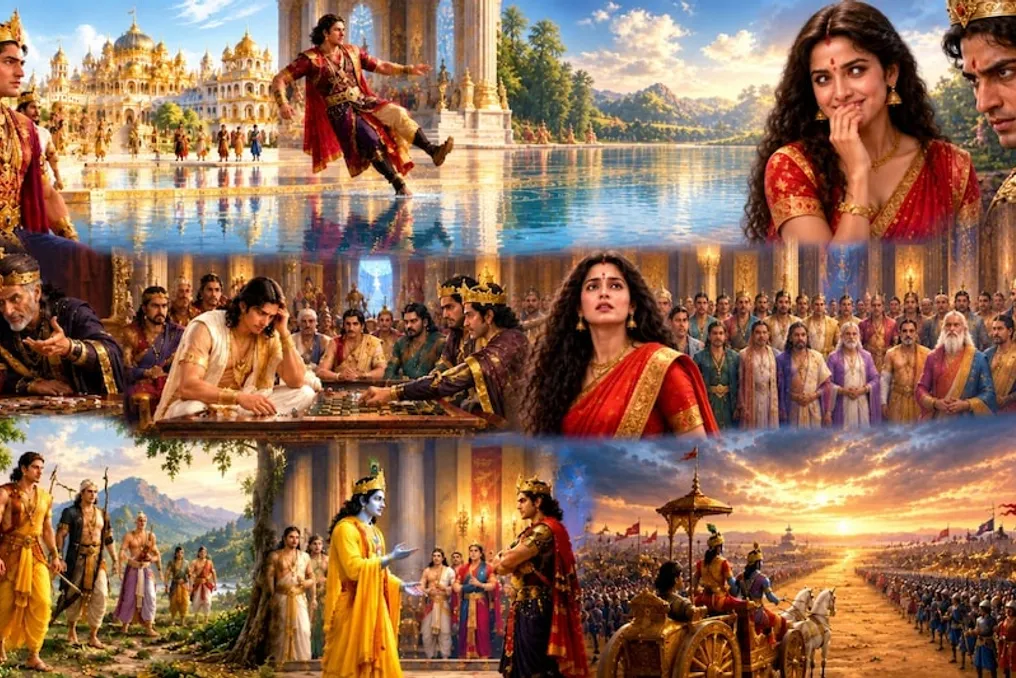
The story unfolds during the time when the Pandavas organized the Rajasuya sacrifice in Indraprastha and invited many to it, including Duryodhana from Hastinapura. Duryodhana arrived in Indraprastha and was struck by its luxury and grandeur. The royal palace of Indraprastha was incredible; its construction was such that in some places where water was visible, there was actually a transparent floor, and where the floor was visible, there was a pond with water.

It is said that while walking through the palace, Duryodhana reached a place where he saw a floor resembling water. He tried to walk through it, mistaking it for a floor, and moved forward. Then a real body of water appeared on the path, but Duryodhana again mistook it for a floor and fell into the water as soon as he stepped forward.

Seeing this, Draupadi and some other people present laughed. This situation caused Duryodhana intense feelings of humiliation. His existing envy towards the Pandavas intensified. Seeing the prosperity of Indraprastha and the growing fame of the Pandavas, the thought solidified in Duryodhana's mind that the Pandavas had surpassed him. He could not accept this situation.

Duryodhana's Plan for Revenge Against the Pandavas

Returning from Indraprastha to Hastinapura, Duryodhana began to devise a plan for revenge against the Pandavas. Duryodhana understood that defeating the Pandavas in open warfare would be difficult. Therefore, he enlisted the help of his uncle Shakuni.

Shakuni devised a plan to gather the Pandavas for a game of dice. At that time, an invitation to a game of dice among kings and Kshatriyas was considered a common tradition. Furthermore, Yudhisthira was particularly drawn to the game of dice, while Shakuni was considered very skilled at it. The goal of Duryodhana and Shakuni was to dispossess the Pandavas of their kingdom and property through the game of dice.

Yudhisthira Loses at the Game of Dice

The Pandavas arrived in Hastinapura at Duryodhana's invitation. After this, a game of dice began between Yudhisthira and Shakuni. During the game, Yudhisthira successively lost his possessions, money, and jewelry. Then he bet his kingdom and lost it. Shakuni and Duryodhana constantly pushed him to increase the stakes. Yudhisthira then bet his brothers, and they also lost one by one. Then he bet himself and lost that too.

But the game of dice did not end there. Then it was proposed to bet Draupadi. Yudhisthira bet Draupadi and lost her. After this, the Kauravas declared that the Pandavas and Draupadi were now their slaves.

Draupadi's Humiliation in the Assembly

Duryodhana ordered Draupadi to be brought to the assembly. A messenger delivered the message to Draupadi, informing her that Yudhisthira had lost her in the game. Hearing this, Draupadi asked: by what right could they bet Draupadi if Yudhisthira had already bet himself? Draupadi refused to come to the assembly.

After this, the Kaurava brothers, Dushasana, forcibly brought Draupadi to the assembly. In the assembly, Draupadi spoke out against the injustice done to her and demanded an answer from all the elders and kings present based on Dharma. A serious debate arose in the assembly regarding this matter. The situation of Draupadi's humiliation became even more terrible when attempts were made to strip her.

Feeling helpless, Draupadi remembered Lord Krishna. According to religious narrative, after this, when Dushasana pulled Draupadi's sari, the sari continued to grow. He could not finish dressing Draupadi and eventually tired and sat down. After this incident in the assembly, a strong tension arose.

Exile of the Pandavas

Finally, Dhritarashtra restored the situation, returning the rights to the Pandavas and Draupadi. But then a game of dice took place again. This time, the condition was that the losing side must spend 12 years in exile, followed by one year in obscurity. If their location was revealed during the period of obscurity, they would have to spend another 12 years in exile.

Yudhisthira lost in this game as well. After this, the Pandavas had to go into 12 years of exile and one year of obscurity. The Pandavas served the prescribed time.

Who is Kalki and when will his appearance occur according to Hindu beliefs
Read more
www.aajtak.in

Who is Kalki and when will his appearance occur according to Hindu beliefs

The texts of Hinduism describe various incarnations of the God Vishnu. According to beliefs, whenever lawlessness increases and righteousness weakens on Earth, God takes some incarnation to restore Dharma. Scriptures and religious traditions mention avatars of Vishnu such as Matsya, Kurma, Varaha, Narasimha, Vamana, Parashurama, Rama, Krishna, and Buddha. Following these, the Tenth and final avatar—the avatar of Kalki—is mentioned.

There is a belief that in the final phase of Kali Yuga, when lawlessness reaches its peak, God Vishnu will appear in the form of Kalki and restore Dharma. However, people's minds still hold curiosity about when and where God Kalki will be born, who his parents will be, and what his appearance will be like. The following examines the main religious concepts regarding such an avatar and its description as laid out in the Puranas.

God Incarnates to Establish Dharma

In the Bhagavad Gita, Krishna asserts that whenever Dharma declines and lawlessness increases, He takes an incarnation to restore it. This idea is connected to the tradition of various avatars of God Vishnu. The avatar of Kalki is considered the future incarnation in this sequence. The description of the Kalki avatar is contained in the XII Skanda of the Shrimad Bhagavatam Mahapurana. According to this text, the appearance of God Kalki will happen in the last stage of Kali Yuga.

Where Will God Kalki Be Born?

The Shrimad Bhagavatam Mahapurana indicates that God Kalki will be born in the house of a Brahmin named Vishnuya in the village of Shambhal. The same text states that God Kalki will appear in the house of the eminent Brahmin Vishnuyasha in Shambhal. Thus, the religious scriptures mention Shambhal as the birthplace of God Kalki. Nevertheless, there are differing opinions among religious and scholarly traditions regarding the geographical identification of Shambhal.

What Will God Kalki Look Like?

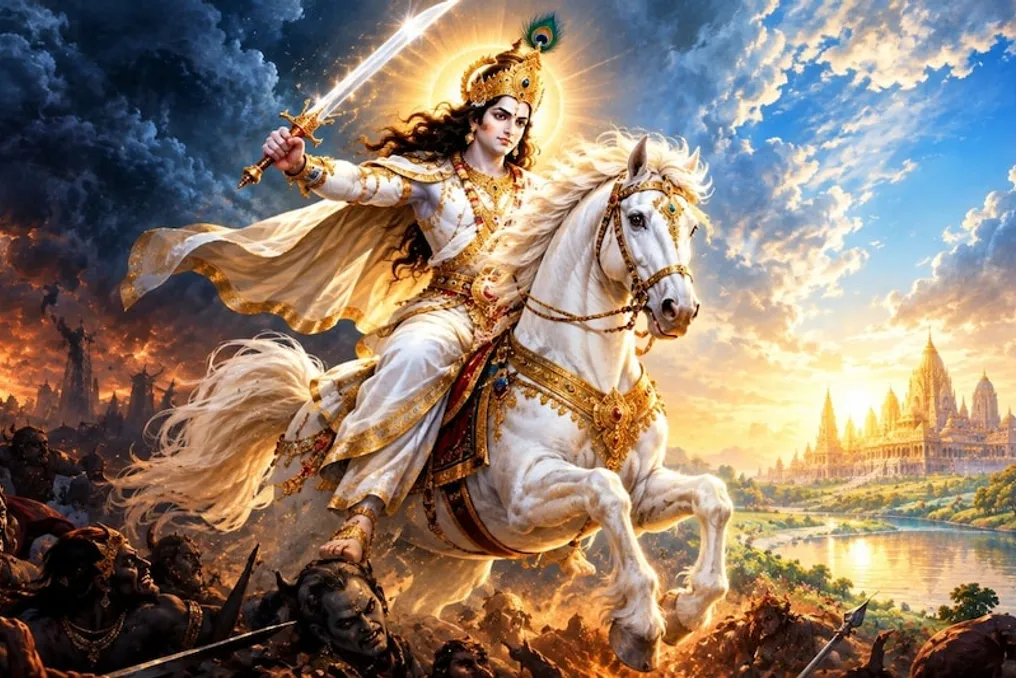
According to religious beliefs, God Kalki will appear as a divine warrior. He is described as a rider on a horse, holding a sword in his hand. In the Puranic descriptions, his mount is named Devadatta, a divine horse. It is believed that in the last stage of Kali Yuga, God Kalki, on this horse, will end lawlessness and tyranny. After this, the restoration of Dharma will occur, and the process of epoch change will begin.

Who Will Be God Kalki's Mother Named?

In mythological traditions, the father of God Kalki is named Vishnuyasha, and the mother is Sumati. It is in this family that the religious concept of God Kalki's appearance exists. Detailed stories related to the Kalki avatar are found not only in the Shrimad Bhagavatam Purana but also in other texts and Puranic traditions. Therefore, differences may be observed in the descriptions of his family, marriage, and other details depending on the source.

Who Will Be God Kalki's Teacher?

In the Puranic tales associated with the Kalki avatar, special mention is given to Parashurama. It is believed that Parashurama will teach Kalki military arts and weaponry. For this reason, the connection between Kalki and Parashurama is considered special in the Hindu religious tradition.

When Will the Kalki Avatar Occur?

The most important question is when exactly the avatar of God Kalki will occur. In religious texts, the Kalki avatar is linked to the last stage of Kali Yuga. According to Hindu chronology, the period of Kali Yuga is considered very long, and according to religious beliefs, there is still much time left until then. Consequently, the scriptures do not establish any specific date or year for the appearance of God Kalki at present.

The Kalki avatar is viewed as a future event that will happen when Kali Yuga reaches its conclusion, and God Vishnu will appear in the form of Kalki to restore Dharma.

What Will Happen After the Kalki Avatar?

According to Puranic beliefs, when lawlessness, injustice, and chaos reach their limit in the last stage of Kali Yuga, the appearance of God Kalki will take place. He will put an end to lawlessness and restore Dharma. After this, the process of epoch change will begin, and there is a religious belief in the revival of Satya Yuga.

Thus, the Kalki avatar is not just a story about the last incarnation of God Vishnu, but an important Puranic concept related to the restoration of Dharma and the change of epochs. However, the time of God Kalki's appearance relates to religious questions of the future, so establishing an exact date for his avatar does not align with the teachings at present.

Popular