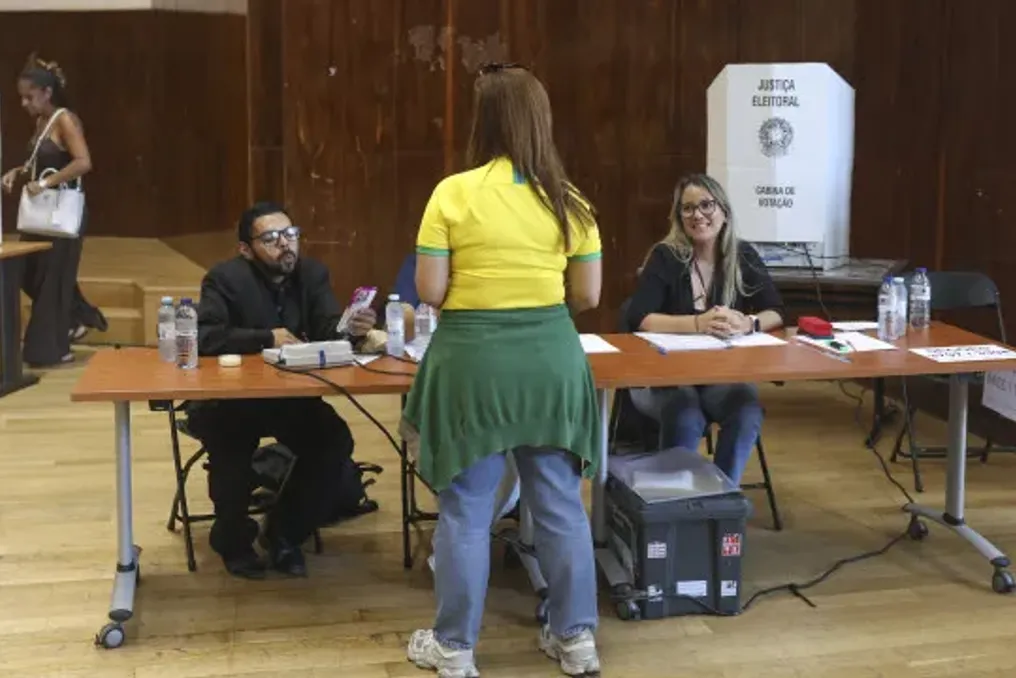
The Brazilian Consul General in Lisbon informed journalists at an event held at the University City, in front of the Rector's building, that the electoral process proceeded calmly and without serious incidents, although the estimated turnout was between 30% and 31%.
The diplomat emphasized that these figures have not yet been finalized, as the ballot boxes will subsequently be sent to the counting and data transmission centers, following standard procedure.
Alessandro Candeas expressed concern over the reduction in the number of voters who appeared at the polls in Lisbon compared to the previous election in 2022. The consul mentioned that this current estimate is lower than what occurred in 2022 and below the traditional average abroad, which approaches 50%, suggesting that factors such as the next day's holiday may be responsible for this decrease.
When questioned about incidents, he guaranteed that, fortunately, only two cases classified as 'anecdotal' occurred: one related to the price of drinks at a nearby kiosk and another involving the report of three police officers entering the Faculty of Law at the University of Lisbon, but who were actually just going to the restroom.
He concluded that the process took place in the 'calmest, most harmonious, and democratic way possible,' stating that all electronic ballot boxes functioned perfectly, without the need for replacement.
In parallel, Kátia Gilaberte, Consul General of Brazil in Faro, communicated via CNN that the voting process in her jurisdiction also proceeded without problems, but she does not yet have participation estimates.
Currently, more than 158 million Brazilians are called to the general elections of the country, where there will be a contest for the next President in a highly polarized political scenario between Lula da Silva and Flávio Bolsonaro.
The elections, which are mandatory for literate citizens between 18 and 70 years old in Brazil, aim to elect governors, senators, and federal, state, and district deputies, as well as the future head of state.
Luiz Inácio Lula da Silva seeks re-election for his fourth term at age 80, while Flávio Bolsonaro, son of former President Jair Bolsonaro, tries to strengthen the Bolsonaro camp, four years after his father's defeat by the same opponent. Despite this, polls indicate a technical tie between the candidates.
If no candidate reaches more than 50% of the valid votes in the first round, a second round is scheduled for October 25, as established by the Superior Electoral Court (TSE).
In Portugal, there are more than 134,000 registered Brazilians, but only they will participate in the presidential and vice-presidential election. The polling stations closed at 5:00 PM.
In Lisbon, due to the large volume of voters, voting was distributed across three locations: the Rectorate of the University of Lisbon, the Faculty of Law of the University of Lisbon, and the Faculty of Letters of the University of Lisbon. In Porto, the stations operated at the Institute of Higher Engineering of Porto (ISEP). In Faro, the vote took place at the consulate headquarters.
Approximately 79,000 voters were registered in the Portuguese capital, more than 47,000 in Porto, and approximately 9,000 in Faro. Portugal represents the second largest Brazilian electorate abroad, behind only the United States of America.