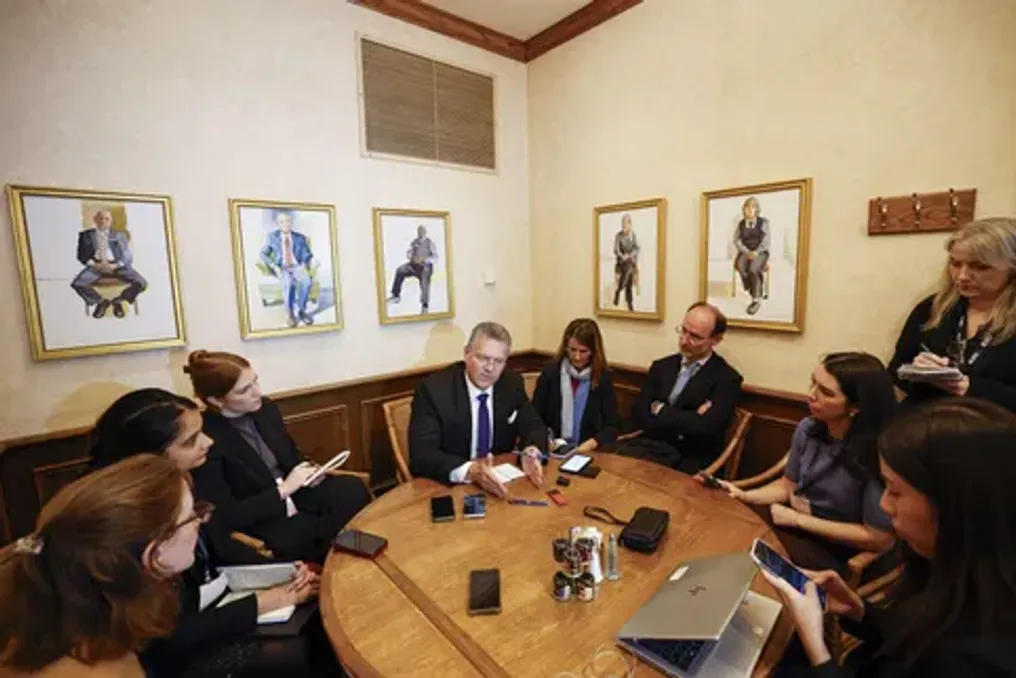
Trade ministers from G20 countries encountered a deadlock regarding countermeasures against excess industrial capacity, which, according to a high-ranking US official, is often directed against China, a country that rejects such accusations. These statements were made during the second day of the G20 Trade Ministerial Conference in Milwaukee, Wisconsin, where the United States holds the presidency for the current year.
According to Jamison Green, a senior US trade official, the ministers could not reach an agreement among participants regarding excess capacity, which is believed to lead to unfair price reductions, nor on the issue of eliminating forced labor in supply chains.
Green stated at a press conference that almost all countries recognized the problem requiring action. He did not comment on whether this was related to China's objections. Furthermore, he noted that the existing system of trade or retaliatory measures is insufficient to solve this problem, which, in his view, justifies unilateral actions by the US.
The US is currently investigating 16 economies regarding excess capacity, including China, the European Union, Japan, India, and others. Green warned that countries producing in excess risk creating an economy based on a house of cards.
Recently, Trump also imposed tariffs on 60 trading partners due to alleged forced labor issues—another issue on which the G20 failed to reach an agreement.
Unacceptability of Using Food as a Weapon
Nevertheless, G20 countries reached a consensus against 'using food as a weapon through coercive trade actions.' Tension rose during the two-day event due to criticism from European officials of Russian attacks affecting Ukrainian grain exports.
Moscow and Kyiv have been at war since Russia's invasion in 2022. Russian and Ukrainian strikes on Black Sea ports are destroying and disabling agricultural export capacity faster than trade flows can recover.
Nicolas Forisse, France's delegate for international trade, told AFP on Thursday that European officials, including himself, as well as representatives from Germany and the UK in the G20, criticized Russia on this matter. He emphasized the need to express opinions, especially concerning the 'use of food as a weapon.'
Forisse added that the comments by European leaders regarding 'Russia's aggression in Ukraine' concerning food exports are simply 'the truth.' However, he clarified that this does not mean the atmosphere at the G20 negotiations was negative, noting that discussions were, on the contrary, very constructive. He concluded that there is a consensus that it is unacceptable to use food and agriculture as a weapon.
Maxim Reshetnikhov, the Minister of Economic Development, represents Russia at the meeting this week. According to the state-controlled network Russia Today, he criticized European leaders on Wednesday for using political slogans.
Expansion of Trade Ties
Trade ministers from several G20 countries are also seeking to expand trade negotiations beyond the host country of the US this week. For example, Canada's Minister of International Trade, Maninder Sidhu, told reporters on Thursday that Canada is seeking bilateral trade agreements with India, Turkey, Saudi Arabia, and the European Union in the field of digital trade.
Sidhu noted that Canada and India expect to conclude negotiations 'in the coming months.' Furthermore, Sidhu met with Greer on the sidelines of the G20, telling AFP that both sides discussed further cooperation between Canada and the US on various issues.
Countries are also looking for cooperation with Washington to reduce tariffs. A Mexican official stated on Thursday that the country is making 'steady progress' toward a tariff agreement with the US. He added that he expects some reduction in tariffs on steel, automobiles, and aluminum, but stressed that Mexico is not rushing negotiations when asked if an agreement would be reached before key midterm elections in the US.