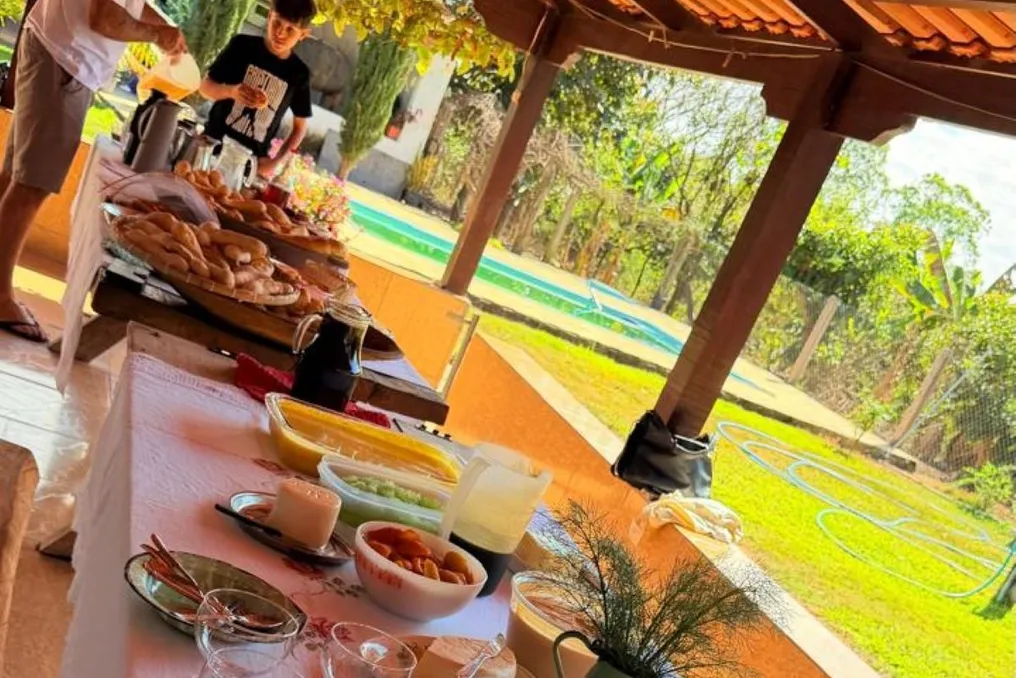
At Fazenda Laranjo, located in Itapecerica, the process of transforming earth products into meals is quite straightforward. Ingredients such as cassava, which can be processed into flour and starch, cow's milk that becomes cheese, chicken eggs, and vegetables are harvested and used on the property. The family members themselves also participate in making sweets and baked goods.
This story is part of the eighth special report in the series 'Itapecerica: Flavors, Sounds and Memories,' which documents the traditions, characters, and flavors that define Itapecerica's identity. The series, broadcast by g1, highlights places and individuals who preserve knowledge passed down through generations. Currently, the focus is on Fazenda Laranjo, where the connection to the land results in food, income generation, and fundamentally, memory.
Cycle Starting in the Field
This production cycle begins in the field and recently found a new point of sale in the Center of Itapecerica, specifically at Empório Iguarias de Minas. Fazenda Laranjo is located approximately 22 kilometers from the municipal center. Residing and working there are Imaculada Conceição Mendonça, 69 years old, and Sebastião Leogino Mendonça, 70 years old. Married for half a century, they, along with their children, daughters-in-law, and grandchildren, maintain a routine that combines agricultural activities, animal husbandry, and artisanal food production.
The trajectory of this family reflects a bountiful table, with products such as cheeses, sweets, flours, cakes, biscuits, and other delicacies made from the natural resources of the farm. More than just producing food, this practice serves as a method to preserve a traditional way of life.
What is Born on the Farm
At Fazenda Laranjo, the production process does not end after the harvest; often, it is at this moment that a new phase begins. Sebastião explains that cassava, for example, can go through several stages before reaching the table, being transformed on the farm into flour and starch. Furthermore, the cows' milk is turned into cheese, and free-range eggs are incorporated into recipes like cheese bread, broas, or rolls.
One of the most emblematic products of the property is cheese bread, made with ingredients grown on the farm itself and baked in a clay oven. Its recipe combines starch derived from locally grown cassava, free-range eggs, cheese made from cow's milk, and pork butter. g1 had previously presented this artisanal preparation in another report. This cheese bread symbolizes the family operation, showing how what comes from the land passes through the hands of the residents and reaches the consumer carrying the history of the place.
Imaculada adds, saying that 'we do everything together, but without many rules. Some weeks we spend all day making flour, then the cheeses and the other things we produce. We do everything with a lot of love, with great taste.'
An Entire Family in Production
Imaculada and Sebastião do not carry out this work in isolation. The farm's routine includes their children Kênio, Cleiton, Lidiane, and Leandro, as well as their daughters-in-law and eleven grandchildren, all participating in different ways in the production and its derived projects.
Lidiane Mendonça, who has a background in nutrition, developed a strategy to expand the reach of the products. She manages the Empório Iguarias de Minas in the Center of Itapecerica, where items from Fazenda Laranjo and other rural properties are sold. According to her, 'the idea of the empório was born precisely to bring the city closer to what is produced in the countryside. It is a way to value the work in the field, show the quality of what is made there, and make these flavors reach further and further.'
The Farm That Became an Opportunity
The empório also represents a new avenue of opportunities for rural agriculture. What was previously cultivated primarily for the family's internal consumption now has an expanded commercial channel. The farm's production reaches more people without the family having to renounce its artisanal manufacturing method.
This development dialogues with a broader change observed in Itapecerica. A study on Gastronomic Identity, conducted by Sebrae Minas in collaboration with the City Hall and Sicoob Crediverde, recognized the potential of rural cuisine as cultural heritage and a source of income, valuing traditional knowledge, recipes, and ingredients.
At Fazenda Laranjo, this transition occurs tangibly: cassava continues to be planted, milk is milked, chickens remain free in the yard, the garden provides vegetables, sweets are prepared, and baked goods come out of the oven. However, now all of this can go beyond the property limits and reach the city. There is also an aspect of continuity, as the knowledge accumulated by Imaculada and Sebastião is not limited to them, manifesting in the recipes, the preparation technique, the care for inputs, and the participation of their descendants.
This transmission occurs naturally, without major formalities: while one works in the field, another assists in the kitchen; while one recipe is executed, a new generation learns. Thus, Fazenda Laranjo has established an identity that transcends mere agricultural activity. Perhaps the most beautiful aspect of this narrative is observing that the food that reaches the empório retains its origin, carrying the aroma of the earth, the effort of the family, and the memory of a kitchen where almost everything begins long before reaching the plate.