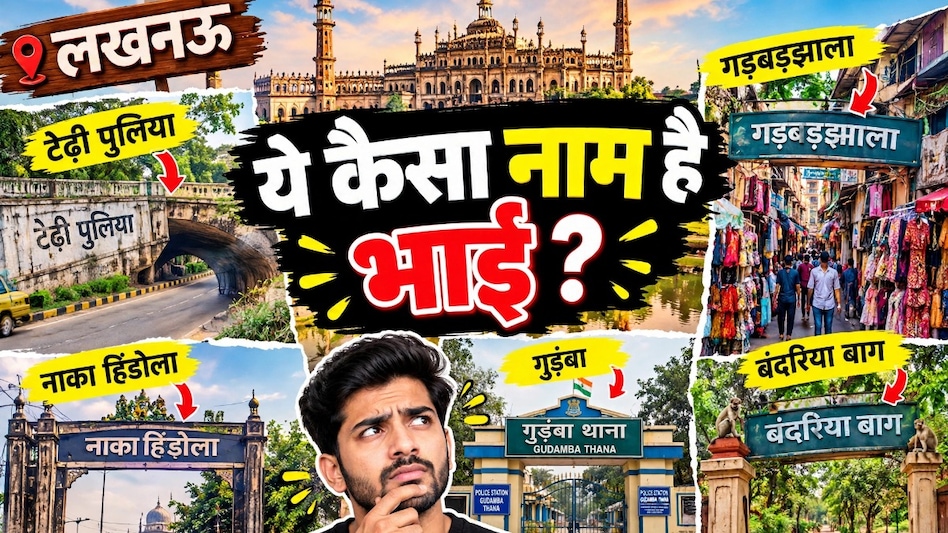
When people hear the name Lukkov, they first think of Navabs, Kababs, Chikankari, and Tahzeeb. However, there are also places in this city with very peculiar names that make one wonder about the origin of these toponyms. For example, if someone suggests going to 'Tedhi Pulia' or 'Gadabdhala,' a natural question arises about the reason for such a name.
Furthermore, Lukkov features names such as 'Naka Hindola,' 'Bhutnat,' and 'Bandiria Bagh.' Some of these names bring a smile, others surprise, and a third hold stories of the old urban past and local identity. It is noteworthy that many of these places retain their significance in the modern identity of Lukkov.
Mentioning Tedhi Pulia inevitably raises the question of why the bridge received this name. Today, Tedhi Pulia is not just an old bridge but a well-known intersection and neighborhood in the northern part of the city. Its name is connected to a formerly existing curved or crooked pavement, which was a characteristic feature of this location. Although the surrounding area has changed greatly over time, the name remains the same, preserving the memory of its original appearance.
As for Gadabdhala, whose name can be amusing in itself, its history is different. The Gadabdhala market in Aminabad is still operational. This area is known for its narrow and winding streets where numerous shops are located, especially those selling artificial jewelry and small items. It is assumed that the tangled network of streets and stalls gave this place the name Gadabdhala, which largely corresponds to the image painted by the name.
Naka Hindola is also of great interest from the perspective of its name. The word 'Hindola' itself arouses curiosity. According to local history, in ancient times, people who made and managed traditional swings were present in this area. These swings played an important role in festivals and fairs, which formed the recognition of the area as Naka Hindola. Although the old swings may be absent today, the name Naka Hindola continues to be used in the city, and the historical Gurdwara is also an important part of this location.
The name Bhutnat might suggest some gloomy place, but this is not the case. In Indira Nagar, Lukkov, there is the Bhutnat market and temple. This name comes from one of the names of Lord Shiva—Bhutnat, and has no relation to mystical stories. Today, this place combines market activity and religious significance, and the Lukkov metro station is also named after it, turning a religious name into part of daily urban life.
Bandiria Bagh is also among the interesting names of Lukkov. The name evokes associations with monkeys and an old garden. Information about the old districts of Lukkov links this name to the nearby zoo and the monkeys living there. Due to widespread use in local speech, 'Bandiria Bagh' has become a recognizable feature of this area, reflecting the characteristics of Lukkov itself.
The history of these places shows that the true essence of the city is determined not only by large buildings and monuments but also by the names of its streets, markets, and quarters. Tedhi Pulia reminds of the old bridge, Gadabdhala—of the tangled alleys of the market, Naka Hindola—of the ancient swings, and Bhutnat—of religious traditions. Although the external appearance of many of these places has changed, their old names remain known to the residents.
Thus, the next time someone asks to go to 'Gadabdhala' or 'Tedhi Pulia,' one should understand that behind these unusual names lies the own history of this old city.