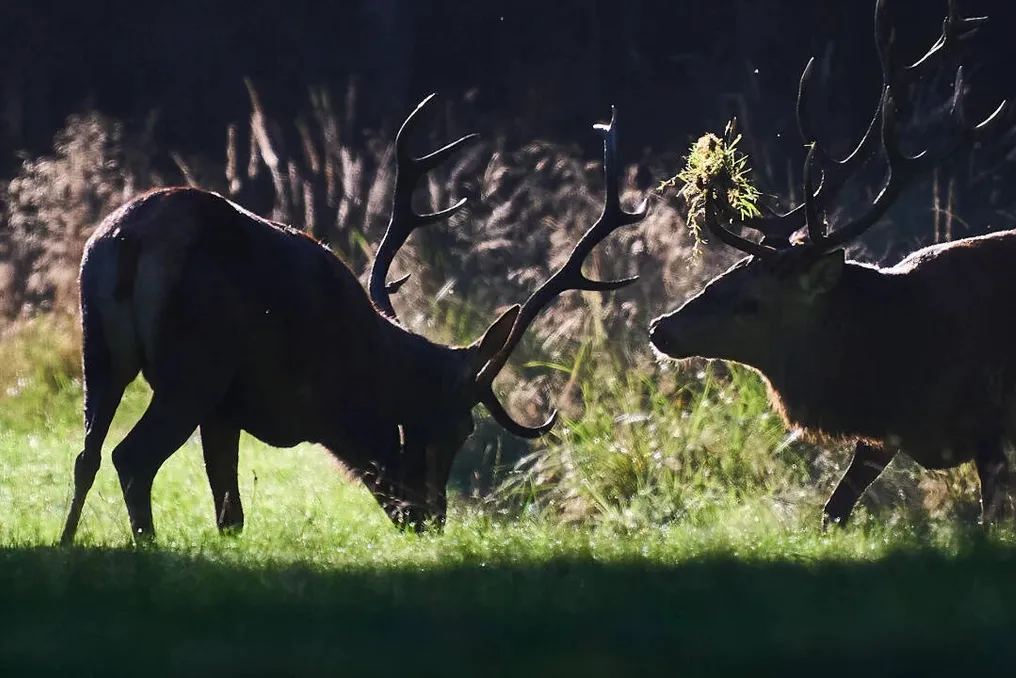
According to the WWF's Living Planet Report 2024, the average size of wild populations tracked globally has decreased by 73 percent over the last fifty years. The primary driver causing habitat loss and degradation is the way food is produced worldwide.
When animals lose the land, water, and forests they depend on, a serious problem arises. Habitat rarely disappears completely; instead, it becomes fragmented by farms, roads, canals, railway lines, power lines, and growing settlements. Although each fragment may retain trees and water, it supports fewer animals than the original contiguous territory.
It is important to note that the 73 percent figure reflects the average change among thousands of monitored populations and does not mean that three-quarters of the world's animals have disappeared or that three-quarters of species have gone extinct. It indicates a gradual thinning, which serves as an early warning of increased risk to ecosystems and species. The report also notes that in areas where conservation efforts were conducted, some populations have either stabilized or recovered.
Daudy Samba, WWF's Chief Conservation Officer, emphasized that this concerns not only wildlife but also vital ecosystems that sustain human life.
The consequences of space loss typically manifest in a certain sequence. Animals find it harder to find food and water, forcing them to travel longer distances. Their routes cross fields, highways, and railway tracks. Animals with large ranges, such as elephants and large cats, suffer the most because they require the most space.
Smaller populations face the issue more slowly. When patches of forest are isolated from each other, animals cannot move between them to find mates. Over time, a small, isolated group becomes more vulnerable to diseases and sudden shocks such as drought or fire. Where forest borders agricultural land or settlements, encounters between animals and humans happen more frequently, and this is not always safe.
The case of Indian elephants demonstrates this situation. India accounts for approximately 60 percent of the world's Asian elephants, according to the 2017 census. Most of them live outside protected areas, with government and public data indicating about 80 percent of the population is outside reserves. This percentage is critical for subsequent events.
For these herds, travel between feeding grounds can pass through rice paddies, village roads, railway lines, and power lines. Official data presented to Parliament in 2024 shows that electrocution was the leading cause of unnatural elephant deaths over the five-year period, surpassing railway accidents, poaching, and poisoning. The highest number of electrocution deaths was recorded in the states of Odisha, Assam, Karnataka, and Tamil Nadu.
In response, the government has taken steps: about 150 corridors used by elephant herds have been identified and ground-verified. Furthermore, the Ministries of Railways and Environment have established a permanent committee to reduce fatalities on the tracks.
The story of tigers is more encouraging, but with a caveat. According to 2022 estimates, there were at least 3,682 tigers in India, a record high distributed across 53 tiger reserves. These reserves are among the best-protected forests in the country.
However, the same estimate reveals the limits of protection. Approximately one-third of the reserves need enhanced protection, habitat restoration, or increased prey base for tigers. In several reserves in Mizoram, Nagaland, and Jharkhand, tigers are barely found. The report reviews also describe many reserves as small forest islands connected by a limited number of corridors. A reserve with a healthy tiger population can release young animals to search for their own territory, and many of them end up in unprotected lands among farms and villages.
The record number and weak reserves must be considered together. Conservation works where it is applied effectively, and gaps appear where it is not.
Conservation in Kaziranga is not limited to park boundaries, and a new proposal from the Assam government calls this line into question. The state intends to replace the standard 10 km radius Eco-Sensitive Zone (ESZ) around the Kaziranga National Park and Tiger Reserve with a site-specific zone ranging from one to three kilometers. An ESZ is a regulatory buffer declared by the Ministry of Environment based on a state proposal. This is not a complete ban: depending on the notification, activities in this zone may be prohibited, regulated, or permitted, with mining being one of the most strictly restricted.
Chief Minister Himanta Biswa Sarma argues that the 10 km restriction only applies because Kaziranga has not yet received final notification. He believes it restricts settlements like Kaliabor, Doboka, and Jakhalabandha, and hinders civil projects such as the proposed stadium in Bokakhat. The state states that the park's boundaries and its status as a UNESCO World Heritage site will not change, and the 10 km zone remains in effect until a new one is announced.
Some residents agree with this. Hundreds of people supported the proposal on August 18, stating that current restrictions hinder housing construction and basic infrastructure.
Opponents and environmental activists are unconvinced. Congress President Gaurav Gogoi led a protest in the Kohora area, stating that the change could provide legal cover for mining. The state government rejects this accusation. Environmentalists such as Jadhav Paieng and Kavita Ashok point to annual floods when rhinos, deer, and elephants migrate to uplands outside the park. They warn that a smaller zone could block these routes.
A 2025 conservation assessment notes that a smaller zone is not necessarily weaker if it is designed to protect the most sensitive areas. Whether this will be the case depends on the final notification, which will determine whether wildlife corridors, flood evacuation routes, and wetlands are included in the zone.
Space is not just forest. According to the WWF report, freshwater species have experienced the sharpest declines globally, and wetlands are often among the first places to be drained or built upon.
The report points to Chennai, where rapid urban growth has led to significant wetland loss. Wetlands serve as a refuge for birds, fish, and amphibians, and they absorb floodwaters for the surrounding city. When they disappear, wildlife loses its home, and people lose a protective barrier.
When space runs out, people pay the price too. Government data presented to Parliament showed that elephants killed 2,853 people in India over five years, with the highest number of victims in 2023. Many of these deaths occurred in areas where farms, villages, and elephant routes intersect. Elephant deaths and human casualties occur in the same areas where both now depend.
The Ministry of Environment has issued guidelines for managing human-elephant conflict, stating that compensation is provided for losses. These measures react to damage after it has been caused. They themselves do not restore the space lost by animals.
Some efforts are aimed at addressing the root cause. West Bengal launched a community program called Gajamitra, or Elephant Friends, in which local residents participate in conflict reduction. Conservation scientists have also suggested low-cost methods for farmers, such as planting chili, ginger, or citrus around fields that elephants tend to avoid, or placing beehives at the edges of fields.
The WWF report also records progress in India, noting that some wildlife populations have stabilized or recovered. It attributes this to government initiatives, careful habitat management, scientific monitoring, and public participation. Globally, the report calls for more effective conservation alongside changes in food production, energy, and financial systems.
The conclusions drawn from the evidence show that the picture in India and globally is similar: animals do not simply leave when their habitat shrinks. Their numbers thin out, they wander in danger, come into conflict with humans, or disappear from the places they previously occupied. Where land is protected, connected, and shared with nearby residents, some populations hold their ground or recover.