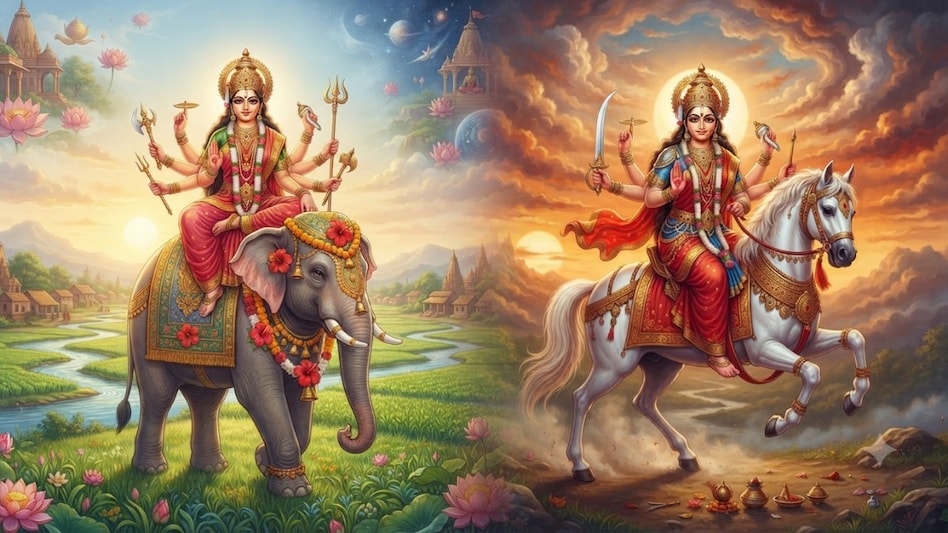
Sharadiya Navratri 2026 will begin on October 11, 2026. Worship of various forms of Mother Durga will be held over nine days. The ninth night (Mahanavami) will fall on October 19, and Vijayadashami, or Dussehra, will be celebrated on October 20. On this same day, the idols of Mother Durga installed in the pandals will be immersed.
According to religious beliefs, the vehicle on which Mother Durga arrives and departs during Navratri holds special significance. It is believed that the mode of transport is determined by the start date of Navratri, as well as the date of Vijayadashami, which determines the transport for her departure. Details regarding the arrival and departure transport of Mother Durga and the significance attributed to these vehicles are discussed next.
On what transport will Mother Durga arrive?
The 'Devi Bhagavata Purana' contains a verse concerning Mother Durga's transport during Navratri. This verse states: 'Shashi surye gajarudha, shani bhome turngme. Guru sukre cha dolayaam, budhe nauka prakirtita.' This means that if Navratri begins on a Sunday or Monday, Mother Durga arrives on an elephant. If Navratri begins on a Saturday or Tuesday, her transport is considered to be a horse. When Navratri begins on a Thursday or Friday, Mother arrives in a palanquin (doli), and if it begins on a Wednesday, her transport is considered to be a boat.
Since Sharadiya Navratri this year begins on October 11, 2026, a Sunday, according to religious beliefs, Mother Durga's vehicle will be an elephant. Thus, this time Mother will arrive on land on an elephant. In the 'Devi Bhagavata Purana', Mother's arrival on an elephant is considered auspicious. There is a belief that when Mother Durga arrives on an elephant, there is good rain, agricultural yields increase, and happiness, prosperity, and abundance grow in the country.
However, it should be remembered that these are religious beliefs and should be viewed purely from the perspective of faith.
What transport will Mother Durga leave on on October 20?
Vijayadashami will be celebrated on October 20, 2026, which falls on a Tuesday. According to religious beliefs, the transport vehicle for Mother Durga's departure is determined based on the day of Vijayadashami.
- If Vijayadashami falls on a Wednesday or Friday, Mother Durga leaves on an elephant.
- If Vijayadashami falls on a Thursday, Mother's transport is considered to be a chariot (palki).
- If Vijayadashami falls on a Sunday or Monday, the transport is considered to be a donkey.
- If Vijayadashami falls on a Saturday or Tuesday, the transport for Mother's departure is considered to be a horse or a weapon-equipped vehicle.
Since Vijayadashami falls on a Tuesday, according to religious beliefs, Mother Durga's departure will be made on a horse. Regarding this transport, there is a belief that it is a sign of anxiety and turmoil, meaning an increase in mental tension and instability in people's hearts. Nevertheless, this is entirely based on religious assertions about consequences and should not be taken as a definite prediction.
How to worship Mother Durga during Navratri?
Performing very complex rituals to worship Mother Durga is not always possible for everyone. In today's fast-paced life, people often lack time. In such cases, one can worship the goddess in simple ways, according to one's faith and capabilities.
From the first day of Navratri to the ninth day, worship of Mother Durga should be performed after morning ablutions. After this, one should recite the 'Durga Chalisa' and perform Aarti to the Mother. One should pray to Mother Durga for the removal of life problems and the fulfillment of wishes. If possible, Aarti should also be performed for the Mother in the evening. If work makes it late, one can return home, worship the Mother, and remember her. Not everyone can read the entire 'Durga Saptashati'; instead, one can reverently recite the 'Durga Chalisa' according to one's convenience.
The eighth and ninth days of Navratri hold special significance. On these days, there is a tradition of performing 'Kanya Pujan' and feeding girls. Some families perform Kanya Pujan on the eighth day, while in some families this tradition is observed on the ninth day. You can feed the girls according to your family's traditions either on the eighth or the ninth day.
If it is possible to perform Kanya Pujan on both days, then on one of the days (eighth or ninth) you can feed the girls, and on the other day distribute fruits or prasad to them. Those who are able can perform Kanya Pujan and service for a longer period during Navratri. The goal of this is to remember Mother Durga with a feeling of devotion and service.
Offer pomegranates to Mother Durga. Religious beliefs also emphasize the special significance of offering fruits to Mother Durga. During Navratri, fruits can be offered to the Mother according to one's faith. According to some beliefs, offering a pomegranate to Mother Durga is considered auspicious. Therefore, during Navratri, pomegranates can be offered daily at the feet of Mother Durga. On the day of Kanya Pujan, on the eighth or ninth day, girls can also be given a pomegranate as a fruit or prasad.
If your faith and circumstances allow, distribute fruits and prasad among the girls during Navratri. The most important thing is...
_