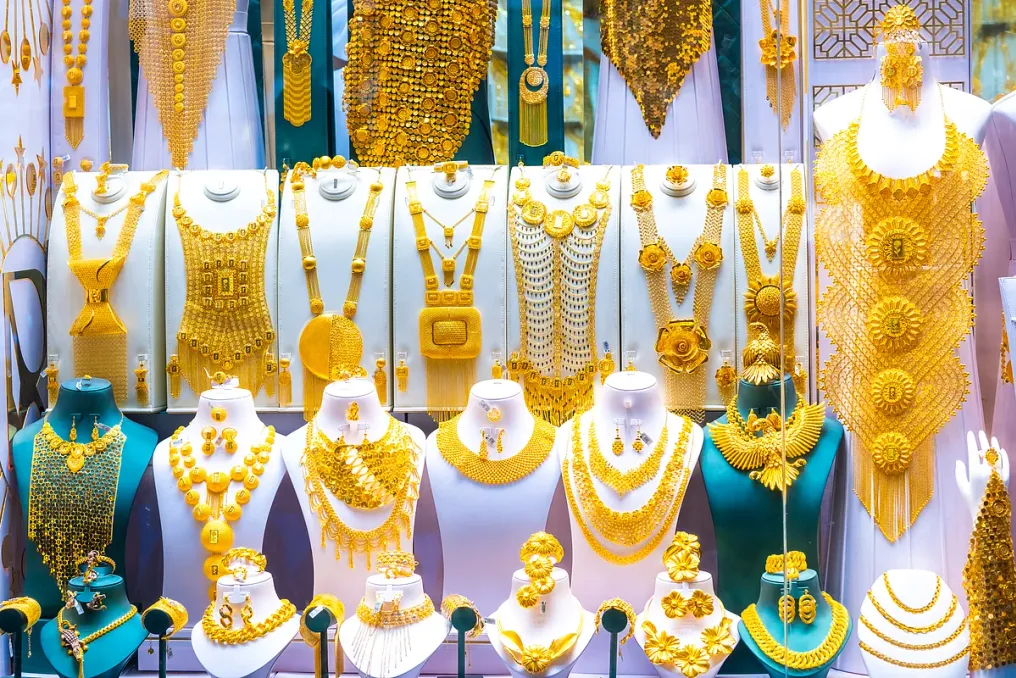
Dubai jewelers have reported that some expat and Indian families residing abroad (NRIs) are starting their festive purchases earlier due to the decline in gold prices below the 500 dirham mark, which is occurring ahead of the Indian festivals of Navratri, Dhanteras, and Diwali.
Industry leaders emphasized that the period encompassing Navratri, Dhanteras, and Diwali is one of the most significant for the gold jewelry market in the UAE. Tawhid Abdullah, Chairman of Dubai Jewellery Group, noted that purchasing gold during this time is considered auspicious, especially for jewelers serving the South Asian community, and the current price drop coincides with an ideal moment.
Abdullah added that many families are accelerating their celebratory acquisitions. He also pointed out that the price drop typically leads to increased purchases from tourists from India and NRIs, as they view it as a favorable entry point. According to him, Indian tourists benefit from a clear price advantage when buying jewelry in Dubai.
The Dubai Jewellery Group will run a Diwali campaign in participating jewelry stores from October 24 to November 12, offering attractive promotions and giveaways of 1 kg of gold.
Chirag Vora, Managing Director of Bafleh Jewellers, observed that festivals such as Navratri, followed by Dhanteras and Diwali, significantly influence consumer sentiment due to the cultural emphasis on buying gold as a symbol of prosperity. He explained that the combination of falling prices and the festive season creates a cumulative effect. Many buyers use the opportunity to lock in prices in stores to ensure they receive goods during peak festival days.
Vora also noted that NRIs and Indian tourists purchase larger volumes when prices fall. He clarified that gold in Dubai is valued based on international spot rates, bypassing import duties and VAT levied on gold in India. Thus, the price decrease increases the net savings for cross-border buyers. In contrast, price increases sometimes provoke short-term purchases in anticipation of further rises, whereas price drops consistently ensure the highest physical volume and total number of transactions among the tourist and NRI demographics.
For NRIs and Indian tourists, Anil Dhanak, Development Manager at Kanz Jewels, stated that the relationship between price and purchasing behavior has certain nuances. He said that a price decrease generally creates a stronger immediate buying opportunity because consumers feel they are getting better value. However, gold also possesses emotional and long-term investment aspects. A sharp rise in prices can create urgency among some buyers who do not want to wait and potentially pay more later. Therefore, while lower prices stimulate value-based purchases, price increases can sometimes create a sense of immediacy.
Dhanak concluded that the final decision to purchase jewelry depends not only on the gold rate. Design, purity, craftsmanship, occasion, and the client's personal requirements remain important factors. The price correction simply gives consumers an additional reason to act.
John Paul Alukkas, CEO of Joyalukkas Jewellery, noted that the festive season attracts people with the intention to make a purchase, but this year, the price movement adds an extra boost to that intention. He explained that it is less about convincing people to buy and more about providing them with another compelling reason to do what they were already planning. For clients from the NRI and Indian tourist segments, gold is not just jewelry; it is a considered purchase often planned around trips home, weddings, or holidays. When prices fall, this segment tends to act quickly as they see an opportunity to lock in the cost before travel dates or family celebrations.
Alukkas also added that it is interesting to observe purchases continuing even when prices rise, as for many NRIs, buying gold in the UAE has become a ritual associated with visits, rather than solely with price. Thus, while the price drop accelerates decision-making, the core demand from this segment remains quite resilient regardless of price fluctuations.