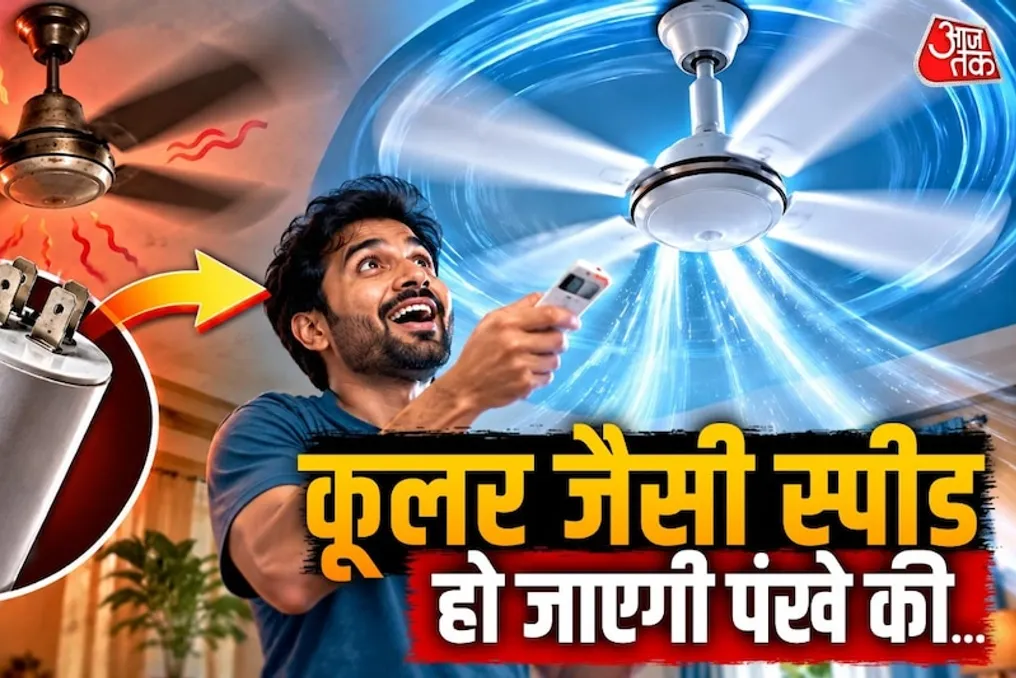
When a ceiling fan starts running slowly in hot weather, many people wonder about ways to increase its speed. Some advise installing capacitors with a higher µF value, while others claim that changing the capacitor will allow the fan to run as fast as a cooler.
However, such intervention is not always the correct solution. The fan motor and the capacitor installed in it have a specific nominal capacitance. Installing a capacitor with excessive capacity without proper understanding can lead not to improvement, but to damage to the fan itself.
The capacitor installed in the fan performs a function of assisting the motor in operation, ensuring rotation. If the capacitor wears out or fails, the fan's rotational speed may decrease, and it may start making unusual noises. In such cases, you cannot arbitrarily install any capacitor; you should use a capacitor with the same µF value as indicated on the original capacitor, information which is usually present on the old component.
Attempting to increase the fan speed by installing a capacitor with a larger capacity can cause the fan to overheat and damage the motor. Therefore, when replacing the capacitor, it is crucial to use one that matches the required capacity.
There are many capacitors available on the market with different power ratings, but this does not mean that any of them is suitable for any fan. For example, you cannot simply install a capacitor designed for a cooler or another device just because its µF is higher than what is required for a ceiling fan. You must use a capacitor corresponding to the required capacity for that specific fan.
It should be noted that a 4 µF capacitor is used to drive motors of small coolers, exhaust fans, and some large floor or ceiling fans. It is also used to maintain or increase the speed of these devices.
If your fan suddenly started running slower, the first step should be to check the capacitor itself. Furthermore, the problem may lie in the fan motor, wiring, regulator, or the voltage level in the electrical network. If the capacitor has failed, it is best to replace it with a new one that has the same capacity and corresponding characteristics.
Often, people who rely on information from social networks install capacitors with increased µF values in fans themselves. Although the fan may seem to spin faster initially, this does not guarantee safety for the motor.
Therefore, you should avoid arbitrarily replacing capacitors in an attempt to increase fan speed. The most reliable and safest method is to use a capacitor with the correct capacity. If the fan constantly overheats, smells like burning, or its speed is unstable, you must turn it off and consult an electrician for inspection.