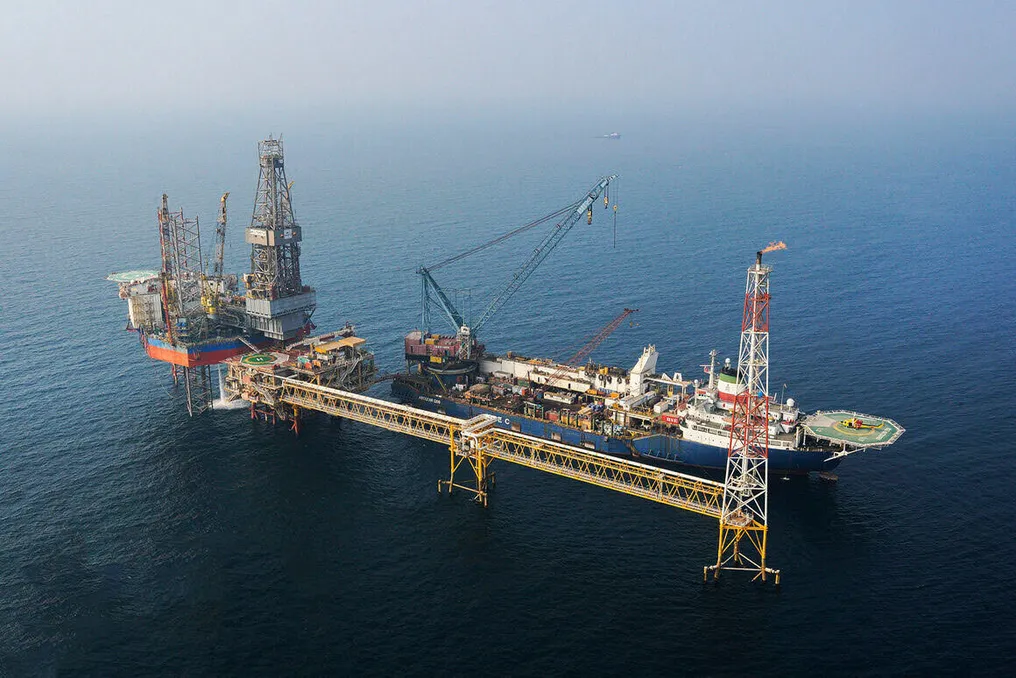
Phase 11 of the South Pars project in Iran has reached a significant milestone by achieving its nominal production capacity of 1 billion cubic feet per day at offshore point B. This success was achieved after years of delays and the withdrawal of foreign partners, such as Total from France and CNPC from China, and was made possible through the use of domestic competencies.
Achieving this goal is considered a breakthrough in gas production in the Persian Gulf, contributing to the reduction of energy imbalance and demonstrating the high level of Iranian engineering prowess.
Phase 11 is strategically important as it is located on the maritime border in the Persian Gulf. The final step was the completion of technical work on the last well in point B. Kevan Tarighati, head of Phase 11 development, reported that the drilling, completion, and perforation of the twelfth well have been finished. After the well was nitrogen-lifted, a test gas flow began, which is continuously monitored. After acid stimulation and pressure stabilization, the well will be connected to full-capacity production within a few days.
Tarighati emphasized that bringing new wells online is a strategic step towards maximizing resource extraction from the overall field, strengthening Iran's position in regional energy diplomacy.
Hamidreza Saghafi, CEO of Petropars, noted that reaching the 1 billion cubic feet per day figure at point B was the result of round-the-clock offshore drilling. With the addition of the twelfth well, gas production from platform B increased by more than 28 million cubic meters per day. He characterized this production jump as a concrete defense of national interests at the zero point of the Persian Gulf border and a means of controlling pressure decline in the reservoir. According to him, meticulous resource management allowed the team to overcome logistical complexities and bring the platform into full operation faster than initially anticipated.
Comparative data shows a high rate of development. Previously, point B produced only about 400 million cubic feet per day, using the 12D casing string and a platform relocated from point 12C, with four active wells. Over the past 17 months of intensive development, the number of active wells has tripled from four to twelve, and actual production has approached a record high of 1 billion cubic feet per day. During this period, over 26,000 meters of specialized offshore drilling were completed, bringing the total drilling on the platform to approximately 50,000 meters. This added nearly 17 million cubic meters per day to the national gas supply, which is expected to have a tangible impact on household and industrial consumption stability in the coming winter.
Development at point A has also advanced significantly, which will provide the second part of gas production from Phase 11. In the initial stage of the current period, the platform was in an early construction phase: the offshore casing was completed by about 35 percent, and the superstructure by only 4 percent. Today, a 4,000-ton casing was built, secured, transported, and installed in its final location in the Persian Gulf after more than 700 meters of precise piling. Superstructure construction has reached approximately 50 percent, despite challenging conditions.
Masoud Rezaei, an expert in offshore structural design, called the rapid progress and solving long lead-time issues an engineering feat despite supply chain constraints. Plans involve loading and installing the structure with about 80 percent progress so that the second part of Phase 11 can start operating as soon as possible.
This record was achieved despite serious technical obstacles, international equipment sanctions, security threats, and harsh marine conditions. Project representatives assert that even during regional tensions and when the contractor's construction site for the point A superstructure was under attack, construction did not stop. Working groups continued their activities, adhering to safety standards and principles. They claim that such resilience demonstrates that Iran's oil and gas industry has reached a level of technical knowledge and durability capable of withstanding the strongest external pressure.
The future plan for point A is carefully designed. After the installation of the superstructure offshore, initial operation will begin with four to six wells. Gradually, as drilling rigs arrive, one new well will be completed on average every four months. This phased drilling will continue for about three years until the platform reaches its full nominal capacity.
Petropars, which has executed over half of the South Pars projects both onshore and offshore, has transformed Phase 11 from a symbol of years of uncertainty into an engine of sustainable national energy supply. Beyond production figures, the project is presented as proof that the determination of Iranian specialists can overcome imposed limitations, offering a model for other major national projects in the oil and gas industry.