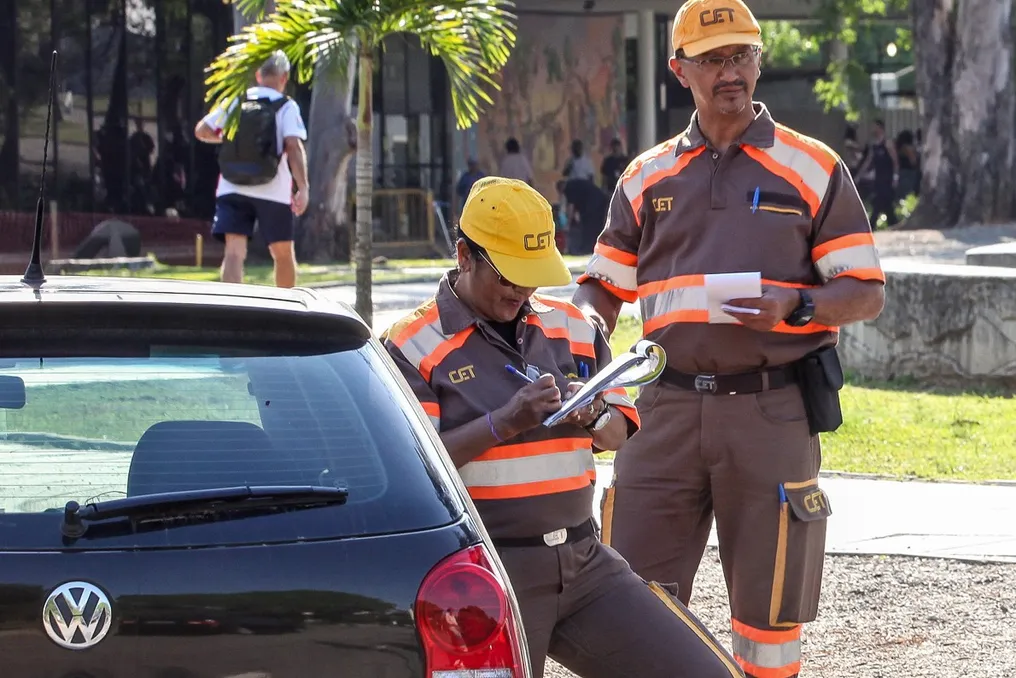
Fines issued for running a red light registered an increase of 34.7% in the city of São Paulo between January and May 2026, compared to the same period last year. This data was released by the Safe Mobility Observatory, affiliated with the São Paulo City Hall, using the most recent available reports.
In total, 124,282 notifications were issued in the first five months of 2026, surpassing the 92,233 infractions recorded between January and May 2025, which represents an increase of 32,049 offenses this year. These figures include fines captured through electronic monitoring as well as those applied manually by traffic agents. The Traffic Engineering Company (CET) reported that the number of electronic monitoring points in São Paulo has remained constant since 2014.
Most fines occur during the day
The data also indicates that most red light running violations do not happen during the early morning hours, but rather during daytime hours. In May, the most recently analyzed month, 23,125 fines were issued in the capital for this infraction. Of this total, 11,159 infractions occurred between 6 am and 5:59 pm, corresponding to 48.3% of all fines for the month. Another 4,859 fines were recorded between 6 pm and 11:59 pm, representing 21% of the total. Thus, the time slot between 6 am and 11:59 pm covers 69.3% of all offenses, while the early morning hours, between 12 am and 5:59 am, recorded 7,107 fines, or 30.7%.
CET emphasizes that enforcement is continuous, occurring daily, regardless of the time of day.
Monthly evolution of fines
Analyzing the evolution, 23,617 fines for running a red light were recorded in the capital in January 2026. This number rose to 24,355 in February and peaked at 27,979 in March, being the highest record in the first five months of the year. In April, there were 25,206 infractions, and in May, the volume decreased to 23,125.
Comparatively, in the same period in 2025, the records were lower in all months: 19,865 in January, 17,987 in February, 17,841 in March, 17,297 in April, and 19,243 in May. Throughout the entire year of 2025, the total amounted to 257,081 fines.
Critical infraction points
The intersection of Rua da Consolação (in the neighborhood direction) with Avenida Paulista is listed as the location with the highest incidence of red light running infractions in May 2026, according to the survey data. Following this are Avenida Queiroz Filho, near number 1,700, and the intersection of Avenida Pedroso de Morais with Rua Teodoro Sampaio.
Among the 15 most notified locations in May, the following are listed: Rua da Consolação (neighborhood direction) x Avenida Paulista; Avenida Queiroz Filho, 1700 (neighborhood direction); Avenida Pedroso de Morais (Itaim direction) x Rua Teodoro Sampaio; Avenida Jorge João Saad (Downtown direction) x Avenida Professor Francisco Morato; Avenida José Pinheiro Borges (neighborhood direction) x Rua Santana do Agreste; Avenida Pompéia (Barra Funda direction) x Rua Nestor Vitor; Rua dos Pinheiros (Downtown direction) x Rua Dr. Virgílio de Carvalho Pinto; Avenida Marechal Tito, 5946 (Downtown direction); Avenida Raimundo Pereira de Magalhães, 2001 (Downtown direction); Estrada das Lágrimas x Rua Visconde de Magé (Downtown direction); Rua Catumbi, 318 (neighborhood direction); Avenida Brigadeiro Faria Lima, 1134 (Itaim direction); Avenida José Pinheiro Borges (Downtown direction) x Rua Santana do Agreste; Avenida Engenheiro Caetano Álvares (Downtown direction) x Rua Baía Formosa; and Rua da Consolação, 927 (Downtown direction).
Penalty and enforcement
According to Article 208 of the Brazilian Traffic Code (CTB), running a red light constitutes a very serious infraction. The associated penalty is R$ 293.47 and the assignment of seven points on the National Driver's License (CNH). CET communicated that São Paulo has 180 radars dedicated to monitoring this infraction, out of a total of 879 devices. Furthermore, the company has 1,700 trained traffic agents to issue tickets. Enforcement operates continuously, including the period between midnight and 5:59 am.
CET also mentioned that the actual number of fines could be higher if it were not for some motorcyclists hiding their license plates using feet, backpacks, hands, or other items that prevent vehicle identification.
Risk versus time saving
Cassiano Isler, a professor at the Department of Transport Engineering at Poli-USP, published a study in September of this year focused on driver behavior, speed in urban environments, and road safety. This study was conducted in collaboration between Poli-USP, Mapfre Foundation, Federal University of Paraná (UFPR), and the National Traffic Secretariat (Senatran), aiming to understand how drivers perceive speed limits and what factors influence their actions on the roads.
Although the main focus of the research is on speed-related behavior, it points out that the perception of time savings can motivate drivers to adopt risky practices in traffic. Isler stated: 'No one leaves home with the deliberate intention of committing infractions or adopting risky behavior. However, despite the apparent obviousness of this finding, it is essential to understand what actually induces this behavior.'
He continued: 'The research reveals a paradox: more than 90% of respondents associate compliance with norms with values such as citizenship and preservation of life. However, for one-third of them, this willingness gives way to delays, daily urgencies, and the pressure exerted by the flow of other vehicles.'
The study also conducted a bibliographic analysis and traffic data review to evaluate the supposed time benefit of driving at higher speeds. The examined evidence shows that this saving is minimal. In Curitiba, driving above the limit resulted in an average travel time reduction of only 7.81 seconds per kilometer, or between 46 and 55 seconds for the entire trip. In Fortaleza, reducing the limit from 60 km/h to 50 km/h added only 6.08 seconds per kilometer, reinforcing the conclusion that increasing speed offers little benefit to the total travel time, and that any gains can be neutralized by traffic lights and the flow of the roads themselves.