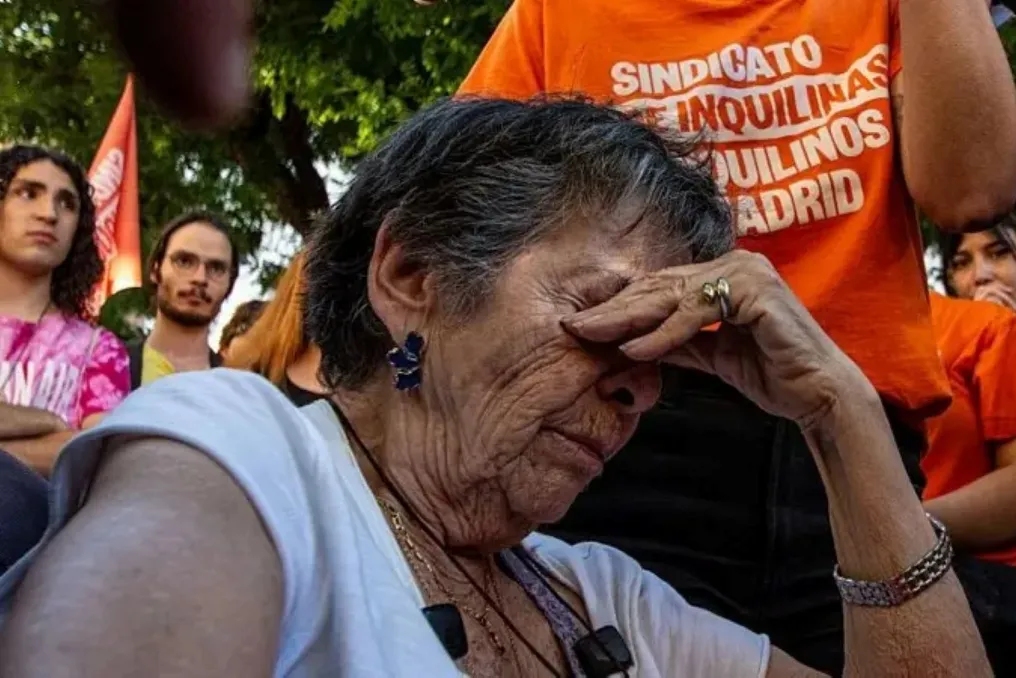
The case of the 87-year-old pensioner Maricarmen Abascal generated significant repercussion in Spain. Images of her being removed from a stretcher by paramedics from a rented apartment in central Madrid, where she had lived for seven decades, moved the country. Although Abascal managed to reach an agreement with the property owner to return to her home, the incident reignited the public debate on housing access, a persistent concern among Spaniards.
This Saturday (10/3), thousands of protesters took to the streets across Spain, demanding greater support for tenants, after the government failed to approve emergency housing legislation in parliament on Friday (10/2). Data from 2024, released by the Foundation for the Promotion of Social Studies and Applied Sociology (FOESSA), indicated that one in four Spanish families faced difficulties obtaining or maintaining a roof over their heads.
It has become progressively more difficult for thousands of people in Spain to acquire or rent a residence. According to the National Statistics Institute of Spain (INE), in April, 47.3% of young Spaniards between 26 and 34 years old still lived with their parents, citing high costs as the main impediment to buying or renting.
It is questioned how it is possible that, between 1997 and 2008, Spain built five million houses and apartments—approximately double the market demand at the time—and yet hundreds of thousands of people today struggle to access housing.
The crisis that changed the landscape
Carme Trilla, president of the non-profit foundation Hàbitat3, which specializes in social housing, explained that the change occurred because the excessive volume of construction between 1997 and 2007 gave the false impression that too much had been built.
Jorge Galindo, Director of Economic Policy at the Higher School of Business Administration and Management of Spain (Esade), agreed, stating that until 2008, the scenario was the opposite of the current one. He detailed that at that time, almost two homes were built per household formed, supported by an abundant flow of cheap credit that financed both construction and property transactions without rational criteria.
However, the financial crisis initiated in the United States, following the collapse of Lehman Brothers, triggered the burst of the Spanish real estate bubble. This led to the freezing of credit and a drop in property prices, drastically transforming the sector. José García Montalvo, a professor of economics at the Pompeu Fabra University in Barcelona, pointed out that the country went from building nearly 14 residences per thousand inhabitants—an anomaly—to two per thousand, which he considers another aberration, given that four residences are built per thousand inhabitants in other countries.
According to data from the Bank of Spain, the country currently faces a housing deficit of about 750,000 residences. However, the Spanish regulatory body recently warned that this number could exceed one million in the next two years if necessary measures are not adopted. The apparent solution would be to build significantly more than the 90,000 residences erected annually in Spain, but García Montalvo attributed the halt to the fact that the sector was decimated.
Taltavull de la Paz, an economics professor at the University of Alicante, used similar terms, indicating that the crisis caused 'tremendous consequences' to the Spanish construction sector. She emphasized that the sector shrank to the point where there are few operating construction companies today, and predicted that any recovery will require time.
The intervention of market legislation
While housing construction does not recover, population growth, mainly driven by immigration, adds complexity to the picture. Galindo clarified that household formation has been rising since 2021, with the creation of 250,000 net households annually in Spain, largely due to migration from Colombia and Venezuela.
He observed that while during the bubble period they built twice as many homes as households formed, today only one-third is built. These people arriving in the country, contributing to the economy and society, do not find adequate accommodation.
The insufficient supply combined with increased demand justifies the rise in the prices of available properties, especially those intended for rent. The expert added that rent functions as the entry point for those arriving in a new city, whether nationally or internationally, or for those becoming independent.
According to INE data, since 2015, the purchase or rental values of houses and apartments have risen by 80%, while workers' salaries have grown by only 30% in the same period. In some Spanish cities, the average rent cost reaches the equivalent of 7,000 Brazilian Reais monthly, which corresponds to 98.7% of the average salary of young people in the country.
The role of speculators and tourists
Abascal's temporary eviction resulted from a legal process initiated by the company that owned her apartment. This case also highlighted other market actors, such as investment funds and those who rent properties to tourists.
Jaime Jover, spokesperson for the Seville Tenants' Union, acknowledged the responsibility of these groups but stated that they do not act in isolation. He mentioned that investment funds are new strong participants in the Spanish market, partly encouraged by the government through tax benefits.
Jover described that the practice of these funds inflates the market through massive property acquisitions, which are resold at higher prices after three or four years, without investments in improvements. However, García Montalvo questioned the real impact of these funds, estimating that the so-called 'vulture funds' hold a tiny share of the market, about 5%, and therefore, their role is insignificant.
García Montalvo stressed that there are no large landlords in Spain; most residences belong to small owners who rent out one or two houses. The Rental Observatory indicates that about 2.4 million Spaniards own rented properties.
In recent years, many of these owners have started renting their homes to tourists or third parties for short periods, which has reduced the availability of units for families, according to experts. In 2025, Spain received 96.8 million foreign visitors, an increase of 3.2% compared to the previous year, making the country the second most visited in the world, behind only France, according to the World Tourism Organization (UN Tourism).
Trilla reinforced that the supply deficit is not only due to lower construction, but also to the fact that part of the real estate heritage is not designated for permanent housing, but rather for seasonal or tourist rental, further pressuring the market in certain areas.
What the numbers hide
The lack of supply is considered, by experts, the primary cause of the housing crisis in Spain. However, the question arises regarding the destination of the 3.8 million vacant residences, according to the INE. Galindo responds that they are located in undesirable regions, usually in municipalities where the population has moved away and is unlikely to return due to the lack of jobs and opportunities.
The Abascal case also drew attention to evictions due to rent or mortgage default. The Spanish press reported 45 daily evictions in the first quarter of 2026. However, this type of occurrence has been constantly decreasing since 2021, when 39,096 evictions were recorded, falling to 24,520 in 2025, according to the General Council of the Judiciary. The body also clarified that this statistic includes commercial premises and parking lots, not just residential occupants.
Although it seems like a positive sign, some experts argue that the statistic masks another side of the crisis. García Montalvo found the scenario strange, as despite seeming better, conditions are worsening. He pointed out that those who manage to rent are mainly digital nomads, who receive high salaries from German or Swiss companies, while the last to manage to rent are immigrants, young people, and single-parent families, who rarely succeed.
This phenomenon, according to him, causes the statistic to improve because there is no need to evict the digital nomad. García Montalvo also attributed the trend of renting rooms instead of entire residences in large Spanish cities to intense market pressure.
Faced with the wave of indignation and protests generated by the Maricarmen case, the socialist government of Spanish Prime Minister Pedro Sánchez announced several measures, including the suspension of certain evictions until 2030 and the extension of rental contracts. However, these proposals did not gain approval in Congress.