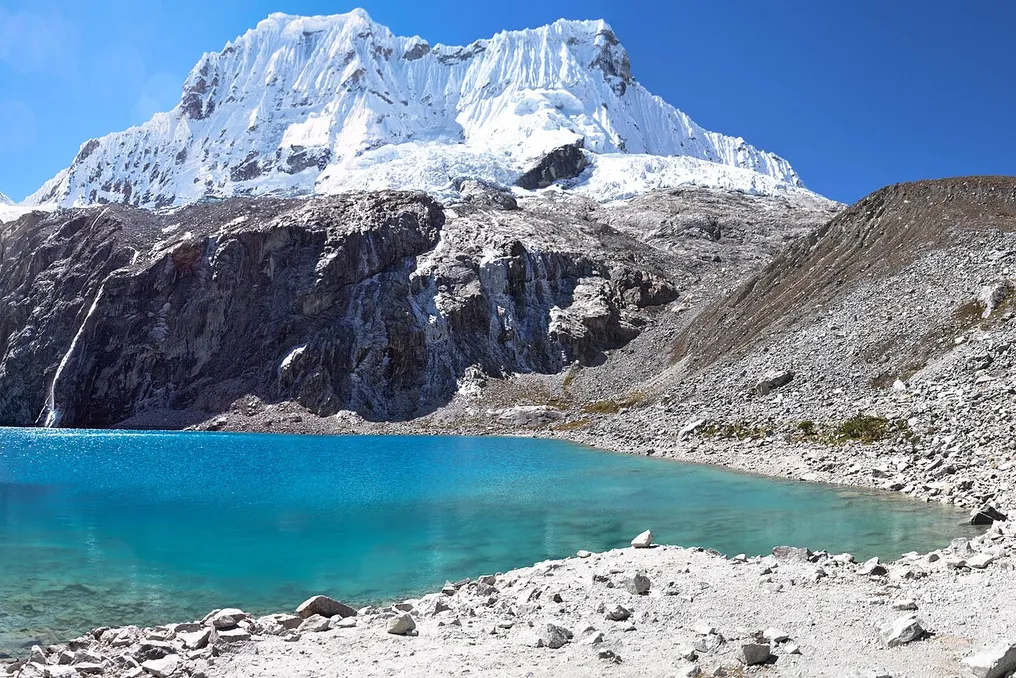
Away from the most well-known tourist circuits in southern Peru, such as Cusco and Machu Picchu, Huaraz offers an option for those who wish to explore the country's mountains without the large flow of visitors to the most sought-after destinations. This city is located in the Ancash department, approximately 400 km north of Lima, and is situated more than 3 thousand meters above sea level.
Most of the region's attractions are concentrated in Huascarán National Park, which has been recognized as a World Heritage Site and Biosphere Reserve since 1985. This park houses about 600 glaciers, over 400 glacial lakes, and 27 peaks exceeding 6 thousand meters in altitude. Huascarán itself, reaching 6,768 meters, represents the highest point in Peru.
This concentration of beauty near Huaraz allows for various opportunities for trekking activities and nature contemplation at high altitudes. Among the most famous spots are the glacial lakes of the Cordillera Blanca, notably Laguna 69, and the lakes of the Llanganuco complex, such as Chinancocha and Orconcocha, known for their intense turquoise waters.
The Llanganuco area is considered a relatively simpler access sector compared to other parts of the National Park, with an estimate that seven out of ten Huascarán visitors pass through it. Despite being a busy area by local standards, Huaraz is suggested for those who appreciate trekking and seek to avoid crowds, providing an experience distinct from that found in Cusco, whose landscapes are considered comparable.
Another notable point in the region is the Canyon del Pato, formed by the erosion of the Santa River, which carved tunnels into the rock, creating a narrow passage between cliffs, extending for about 40 km. For those interested in archaeology, the Museo Nacional Chavín, located in Chavín de Huántar, about two and a half hours from Huaraz, is an important detour. This area was a pre-Inca religious center, active between 1200 and 500 BC, or about two millennia before the construction of Machu Picchu, and its main findings are displayed in the local museum.
The best time to visit is during the dry season, between April and September, when days are usually sunny. However, the beauty of Huascarán National Park brings significant risks. Glacial lakes are susceptible to flooding, a phenomenon similar to what occurred on the border between Nepal and China in August 2026. Peruvian authorities warn that the country currently has 528 glacial lakes at risk of overflowing, with Parón, near Huaraz, being an example of danger, situated at 4.2 thousand meters in altitude.
Risks such as earthquakes and global warming can compromise the region due to glacier melt and rockfalls that contain the water; a similar event occurred in 1970, when the Ancash Earthquake caused an avalanche with 70 thousand victims. For this reason, travelers must follow warnings from the responsible bodies monitoring dangers in the park, such as the State Protected Natural Areas Service (Sernanp). Locations with a higher probability of problems due to climatic and seismic conditions may be temporarily closed to tourists. Access to the area also requires hiring specialized and duly authorized companies to operate in national parks.