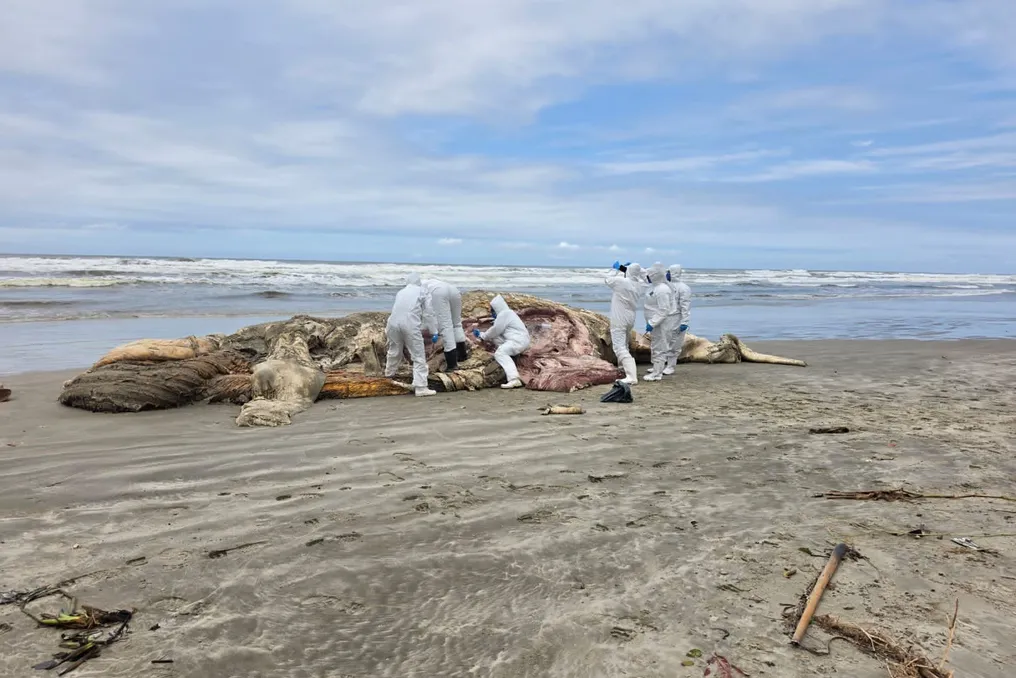
A humpback whale was found dead after washing ashore on the beach in Centro de Mongaguá, in the coastal region of São Paulo. Teams from the Biopesca Institute were mobilized to the site to perform an autopsy on the animal, although the exact cause of death has not yet been determined.
According to information provided by the Municipality of Mongaguá and the Environmental Guard (GEPAM), it is a juvenile male of the humpback species, which showed an advanced stage of decomposition. There is no official confirmation regarding its weight or dimensions.
Urban Maintenance Service teams were called to provide assistance, along with the Biopesca Institute, which began analyzing the carcass around 11:30 AM. Environmental guard Renato Ribeiro told g1 that he received the call from fishermen about the incident around 7:20 AM. He clarified that due to the rising tide, the autopsy could not be safely conducted at the site until the water level dropped. Later, the carcass will be removed by the municipal team and sent to a landfill.
Risks of Approach
The technical recommendation establishes that, in situations involving dead animals on the sand, it is essential to maintain distance, avoid any approach, and immediately notify the competent authorities to ensure the isolation of the area.
Biologist Eric Comin warned that interaction between beachgoers and marine carcasses represents significant dangers. The primary risks associated with a stranding include public health, physical safety, and the environment. The specialist explained that deceased animals can transmit highly contagious bacteria, viruses, and fungi to humans.
Additionally, the strong characteristic odor signals the release of toxic gases, capable of causing symptoms such as dizziness, nausea, and headache. There is also the risk of the animal's body rupturing due to the accumulation of these gases. Another point raised by the biologist is that the smell of meat and blood can attract predators, such as sharks. Furthermore, the fluids and fat released contaminate the water surrounding the animal's body.
About Humpbacks
According to the biologist, during this time of year, humpback whales are in a migration phase. This journey begins in the cold waters of Antarctica, where the animals spend the summer feeding and accumulating energy reserves. They then head to the Brazilian coast, which offers more suitable conditions for reproduction and nursing of the young.
Comin emphasized that this route constitutes one of the largest mammal migrations on the planet. Some of these whales travel thousands of kilometers in search of calmer and warmer environments. During this displacement, they are commonly seen on the São Paulo coast. Adult males can reach between 13 and 16 meters in length and weigh up to 50 tons. After completing the reproductive cycle, the humpbacks return to Antarctica, at which point the calves are more developed and begin to learn to feed before undertaking the long journey back.