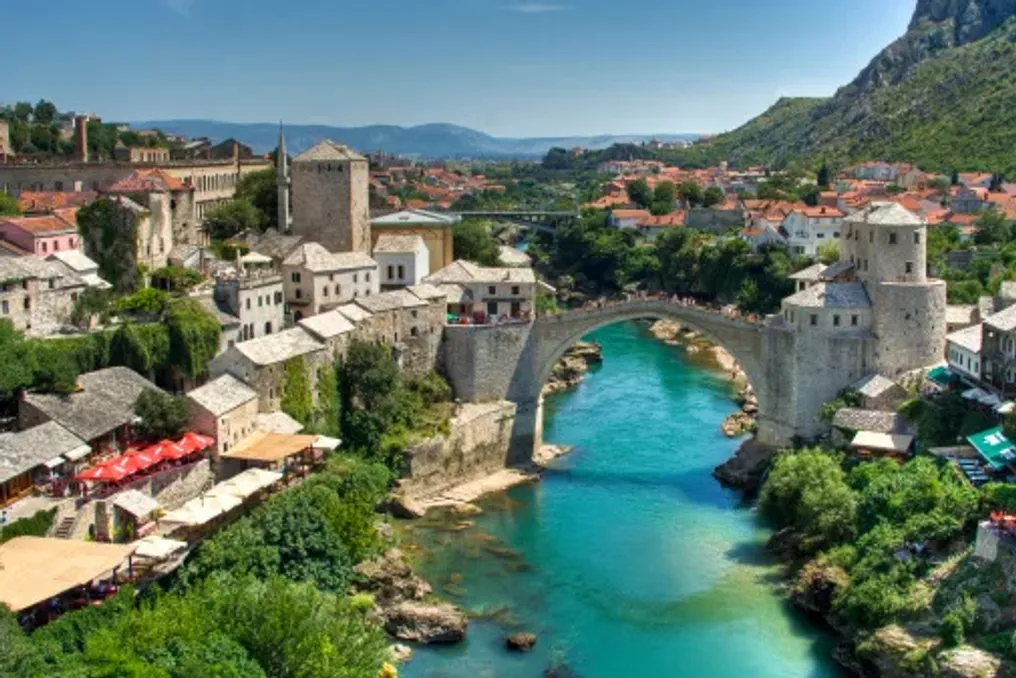
The Old Bridge in Mostar is an iconic structure easily recognizable even before visiting. This elegant stone arched bridge crosses the turquoise Neretva River, connecting two parts of the city's historic center and drawing visitors into a labyrinth of cobbled streets, bazaars, and ancient stone buildings.
By spending 48 hours in Mostar, one can see more than just postcard views: one should follow the Neretva through the city, explore Ottoman architecture and religious monuments, enjoy local Bosnian and Herzegovinian cuisine, view modern cultural spaces, and venture into the surrounding mountains and river valleys.
The Old Bridge area was included in the UNESCO World Heritage List in 2005. Although the morning should start at the Old Bridge, it is important not just to take a picture and move on.
The bridge was completed in 1566 by the Ottoman Sultan Suleiman the Magnificent, and its design is attributed to Mimar Hayruddin, a student of the renowned Ottoman architect Sinan. The original bridge was destroyed during the Bosnian War in 1993, after which it was restored using materials and techniques as close as possible to the original structure. The restored bridge and the surrounding Old Town were officially opened in 2004, and the following year this area received UNESCO World Heritage status.
Crossing the arch, you can explore both sides of the Neretva. The steep cobbled streets around the bridge lead to the old bazaar, where small stalls sell copperware, jewelry, textiles, ceramics, and souvenirs. Nearby Kujundžiluk, traditionally associated with blacksmiths, is one of the most atmospheric parts of the Old Town.
The historic center of Mostar is more than just a collection of picturesque streets. While walking through the city, one should look for traditional Ottoman houses, courtyards, and religious structures. UNESCO describes the Old Bridge area as an unusual combination of pre-Ottoman, Ottoman, Mediterranean, and Western European architectural influences. Mosques, churches, and other religious buildings reflect the city's long history as a place of coexistence of various communities.
One of the must-see stops is the mosque of Koši Mehmed Pasha, built in the early 17th century. Its location over the Neretva also allows one to appreciate how the city's buildings, the river, and the surrounding hills are harmoniously integrated.
Instead of rushing between attractions, time should be spent on the details: carved stone, wooden shutters, old bridges over smaller watercourses, and how the houses climb the slopes of the hills.
The Neretva is as important to the character of Mostar as its architecture. The river flows through the city under the Old Bridge; its stony banks and clear water form a natural corridor through the historic center. The smaller Radobolja river also contributes to the unique landscape of the city. UNESCO recognizes both watercourses as important elements of Mostar's historical urban form.
Moving away from the busiest area around the Old Bridge, one can slowly follow the river. From here, the city begins to feel less like a tourist spot and more like a place where people live, work, eat, and socialize.
It is necessary to try traditional Bosnian dishes, such as ćevapi served with flatbread and onions, burek and other filled pastries, as well as dolma and roasted meat. Bosnian coffee is another essential element of the experience, traditionally served in a small copper coffee set.
The Tourist Board of Mostar also points to restaurants offering local Bosnian, Mediterranean, Middle Eastern, and contemporary cuisine, reflecting an increasingly diverse gastronomic scene.
One should not rush the coffee. In Mostar, sitting with a small cup and watching the street is part of the experience itself.
To understand how people lived in Mostar in the past, one should visit one of the traditional Ottoman-era houses. These houses were designed around inner courtyards and with views of the river, and their thick stone walls helped mitigate the summer heat of Herzegovina. UNESCO documentation of the historic city describes traditional houses with wooden elements, projecting rooms, and open living spaces overlooking the Neretva.
Visiting such houses provides context to the stone streets outside and shows that Mostar's architectural heritage is not limited to grand monuments.
The beauty of Mostar should not overshadow its more recent history. The Old Bridge was destroyed on November 9, 1993, during the conflict in Bosnia and Herzegovina. Its subsequent reconstruction became an international heritage project, and UNESCO described the restored bridge and Old Town as symbols of reconciliation, international cooperation, and coexistence. Museums and exhibitions dedicated to the conflict offer a more complex but important perspective on the city. Time should be allocated to this part of Mostar, rather than viewing its military history as a secondary detail. This gives the restored streets and bridge a deeper meaning.
Mostar is not frozen in its Ottoman past. The city has an active program of exhibitions, theater, music, festivals, and culinary events. Recent events have included the Moba Street Food Festival, Mostar Summer, as well as literary and musical programs. The official city tourism calendar also highlights contemporary artistic and cultural events. Before traveling, one should check the local events calendar to find out what is happening during your 48 hours. A concert, exhibition, or food festival can offer a completely different view of the city after a day of exploring historic streets.
As the day turns to evening, one should return to the river. The limestone buildings take on warmer hues as the sun sets, and the Neretva becomes increasingly reflective under the bridge. This is a good time to find a cafe on the riverbank or a viewpoint and simply watch Mostar at a slower pace.
On the second morning, one can leave the city and go to Blagaj, a small village about 12 km from Mostar. The main attraction is the dramatic source of the Buna River, from which cold, clean water emerges from beneath a high limestone cliff. Next to the source is Tekke Blagaj, a historical dervish lodge and an important example of Islamic architecture in Bosnia and Herzegovina. The building combines characteristic Ottoman architectural elements with later influences. This combination is striking: a bright stone building hidden under the cliff, lush vegetation around the water, and the emergence of the Buna from the rock.
Blagaj is a place where one cannot rush; it requires time to enjoy it and its surroundings. One can walk along the river, admire the cliffs, and find a shaded spot for a drink or lunch. Restaurants near the source are especially famous for trout and other regional dishes, making the river an ideal place to continue getting to know the cuisine of Herzegovina.
The trip from Mostar is short enough for Blagaj to comfortably fit into a 48-hour itinerary, rather than requiring an overnight stay. Returning to Mostar, the second half of the day can be used to view the city from above. The surrounding landscape is dominated by rugged limestone hills and mountains, giving Mostar a dramatic backdrop that is easy to miss when focused on the Old Town. A viewpoint or a short outdoor walk will help view the city's geography from a different angle: the Neretva cutting through the valley, the compact historic center around the bridge, and the surrounding hills. The wider area of Mostar also offers activities such as hiking, mountain biking, and zip-lining for travelers who prefer more active recreation.
Conclude your 48 hours with another unhurried lunch instead of trying to squeeze in another attraction. Try more Herzegovinian delicacies, order Bosnian coffee, and return to the river for one last look at the Old Bridge. The bridge will likely remain the most vivid image in memory, but after two days, it shouldn't seem like the whole story.
Mostar is a city of rivers, mountains, food, multilayered architecture, and vibrant culture, where the famous bridge serves as a link for many of these stories. It is best to explore the historic center on foot. Comfortable shoes will be useful as many old streets are uneven and cobbled. The local currency is the Bosnian Convertible Mark (BAM). Cards are accepted in many establishments, but it is useful to have some cash for small purchases and cafes. Mostar's event program changes throughout the year, including music, theater, food festivals, exhibitions, and literary events. Before traveling, one should check official tourism and cultural catalogs. A short trip makes Blagaj an easy addition to a trip to Mostar. Allocate enough time to enjoy the Buna River and the setting around the Tekke, rather than treating it as a quick photo stop. The Old Bridge is famous for a reason, but Mostar becomes more interesting when you follow its side streets, rivers, and surrounding landscapes. Allocate unplanned time in your itinerary to sit in a cafe, stroll through the bazaar, or simply follow the Neretva.