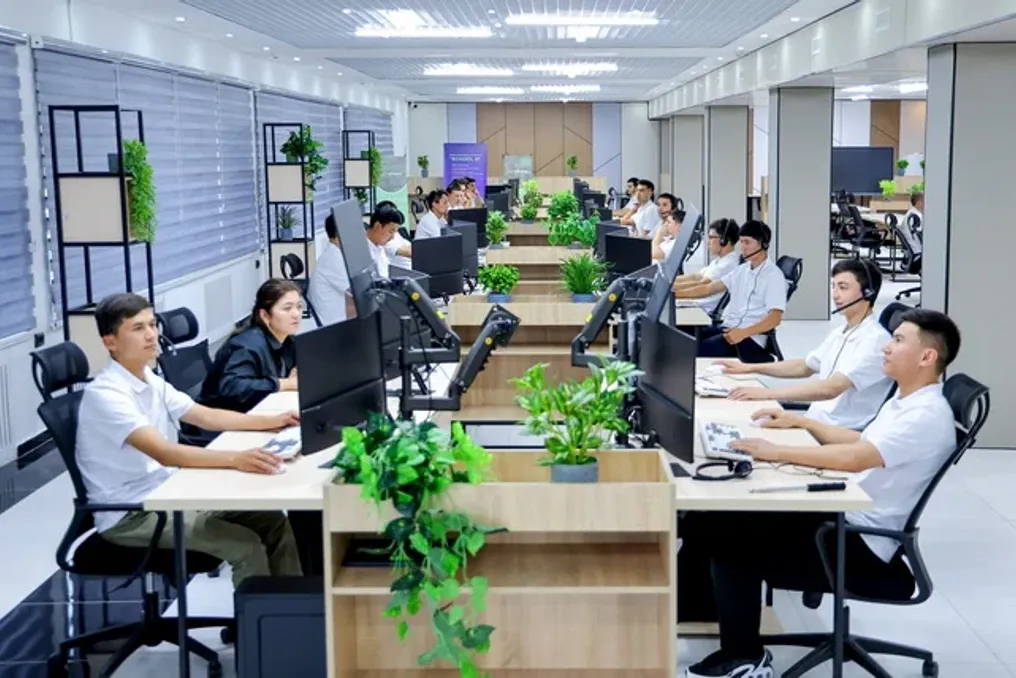
State technical colleges in Uzbekistan will gain the ability to establish spin-off companies. These companies will be able to develop new products and technologies based on startup projects with high commercial potential.
To support student startups, these companies may receive grants of up to 1 billion soums from the Fund for the Development of Vocational Education. It is expected that by the end of 2026, exemplary spin-off companies will operate in at least one technical college in the Republic of Karakalpakstan, as well as in every region and Tashkent.
The procedure for creating such enterprises was approved by Cabinet of Ministers Decree No. 524 dated September 29, 2026. This document was adopted in accordance with Presidential Decree No. PP-148 dated April 20, 2026, which concerns the implementation of the 'Youth of New Uzbekistan – 2030' strategy for the period 2026–2027 and additional measures to stimulate youth employment.
The main goal of this initiative is to introduce innovations into the vocational education system, create jobs for graduates, and support students of technical colleges.
Definition and operating conditions of spin-off companies
The rules define a spin-off company as a legal entity established by a technical college to produce goods and provide services based on startup projects that include new developments, with students participating in these processes. The founding entities can be the technical college itself, as well as private individuals and legal entities.
The technical college must own at least 25% of the company's charter capital. Companies will be established in professions and areas where training is already conducted at that college. Furthermore, the new rules do not apply to non-state professional educational institutions.
For five years after the company's establishment, known as the investment period, the state share in the charter capital cannot be privatized, and the company cannot be used for purposes unrelated to its core activities.
Application and project evaluation process
The Agency for Vocational Education under the Ministry of Higher Education, Science, and Innovation will determine within one month which technical colleges will create spin-off companies, taking into account the specialization of the respective regions.
The initiator of a project related to a new development, production, or service must conclude a founding agreement with the technical college and submit an application through the information system 'Management of Vocational Education Processes — EMIS PT'. The application must contain founding documents, a business plan, a technical and economic justification, and financial calculations. If the technical college itself is the initiator, a founding agreement is not required.
Applications are reviewed by a special commission established by the agency. The commission must consist of at least seven people and may include representatives from the ministry and foreign specialists. The director of the agency approves the composition of the commission annually by January 10. Reviewing applications takes 10 days, with a possibility of extension for five days if necessary.
The initiator must personally present their project at an open meeting. The commission evaluates the financial and economic efficiency of the project, the level of innovation, the degree of dual education implementation involving students, the potential for income from product sales, as well as demand from employers and prospects for graduate employment.
The commission's decision is sent to the applicant within three working days. In case of incomplete documents, they are returned for revision, and a new application can only be submitted after one month.
The register of spin-off companies will be maintained in the EMIS PT system, access to which is provided through the Startup Base unified ecosystem platform. Companies are obliged to provide quarterly reports to the agency.
Grant acquisition and fund utilization
To receive a grant, the spin-off company must provide the agency with a detailed project presentation, an employment contract with at least one teacher or master of vocational training, and dual education agreements with no fewer than five technical college students. Additionally, it must describe the planned production or services and specify the number of recruited students.
Projects are evaluated on a 100-point scale. Up to 30 points can be awarded for innovation, 25 for economic efficiency, 20 for employment impact, 15 for export potential, and 10 for environmental impact. The minimum passing score is 71 points; projects scoring 70 points or lower do not pass selection.
Following a positive decision, the agency and the technical college conclude a grant agreement within one month. The agreement specifies the project goals, deadlines, expected results, grant amount, financing schedule, forms of control over the target use of funds, and reporting procedures.
Funds are transferred to the technical college's treasury account. The college uses them to acquire property, equipment, technologies, intellectual property, and other assets, which are then transferred to the spin-off company's charter capital.
If the company refuses to sign the agreement, ceases operations, is liquidated, reorganized, or declared bankrupt, the grant allocation is suspended.
Vacant buildings, structures, and plots belonging to technical colleges are provided to spin-off companies for free use for up to five years. Light prefabricated structures without deep foundations or underground utilities can be built on these territories. Companies pay for gas, water, and electricity consumption based on readings from separately installed meters.
The Council of Ministers of the Republic of Karakalpakstan, as well as the administrations of regional and city centers of Tashkent, have been instructed to attract foreign investors to spin-off companies. Together with the Ministry of Poverty Reduction and Employment, they will monitor the created jobs and facilitate the employment of technical college graduates through these companies.
The Fund for the Development of Vocational Education will cover the costs of modernizing the EMIS PT system.