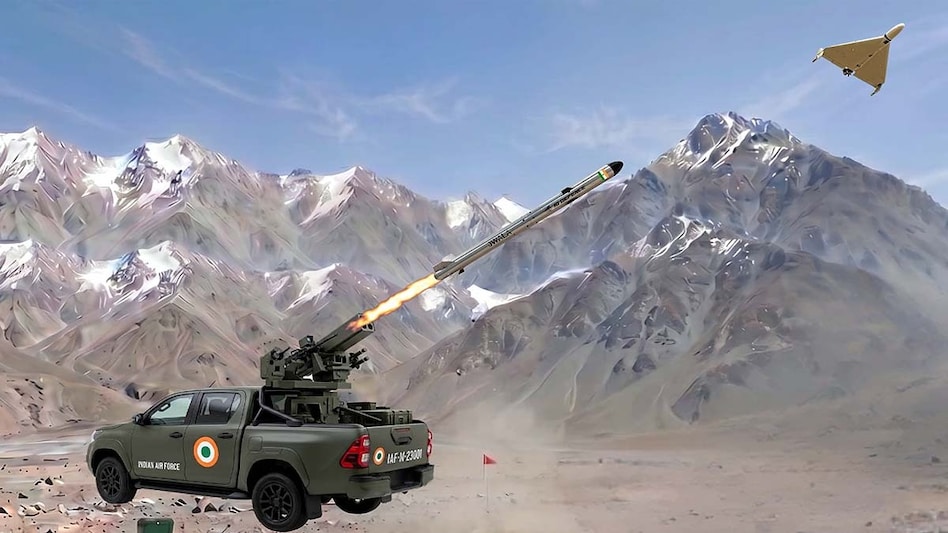
The private Indian defense company IG Defence successfully tested two solid-fuel rocket engines as part of its 'Javala' micro-rocket program. This test took place on October 3, 2026, around four in the morning, marking a significant achievement for the company.
'Javala' represents India's first indigenous private micro-rocket program, focused on developing a 'hard-kill counter-UAS' system designed to destroy drones. The increasing use of drones in modern military operations creates new challenges for air defense.
The ability to deploy a large number of inexpensive drones has increased the demand for cost-effective countermeasures. 'Javala' is being developed to meet this need, enabling it to effectively handle drone threats in conjunction with existing air defense levels.
Drone swarms have become common in modern conflicts because they are both cheap and effective. Destroying every drone with expensive missiles is economically unfeasible, leading to growing demand for low-cost interceptors that can be mass-produced.
Anup Sharma, Deputy Vice President (AVP) and Squadron Commander at IG Defence, noted that the drone threat is rapidly evolving, and the anti-drone system must develop at the same pace. 'Javala' is being created with this thought in mind. The successful engine test is an important step toward this indigenous 'hard-kill' capability. This rocket will not only be affordable but also capable of being deployed on a large scale, which will increase the depth of the missile reserve.
'Javala' is being developed not as a standalone rocket, but as part of IG Defence's extensive network ecosystem. The Grid Defend system is an AI-based ballistic control system that integrates sensors, effectors, and command systems. This system simultaneously provides detection, identification, tracking, threat assessment, and attack management.
The system collects information from multiple sensors, forming a comprehensive picture, tracking aerial threats, and directing available weaponry. Thus, a complete architecture from sensor to shooter is created, where 'Javala' functions as the 'hard-kill' interceptor, and Grid provides the intelligence and mission control.
Bodhisattva Sangpri, founder and CEO of the company, stated that they are making 'Javala' part of an intelligent defense architecture so that authorized missions can be executed autonomously, from detection to attack.
This development demonstrates the significant involvement of the private sector in the 'Atmanirbhar Bharat' (Self-Reliant India) initiative. IG Defence is working on indigenous technologies for propulsion systems, interceptors, and anti-drone systems. Following the successful test, the company will focus on system maturity, reliability, production capabilities, and scalability.
Creating a low-cost and effective system against drone threats in modern warfare is critical for national security. The combination of 'Javala' and Grid will help reduce dependence on expensive defense systems. This achievement shows that Indian private companies are becoming capable of addressing national security challenges by advancing in complex defense technologies.