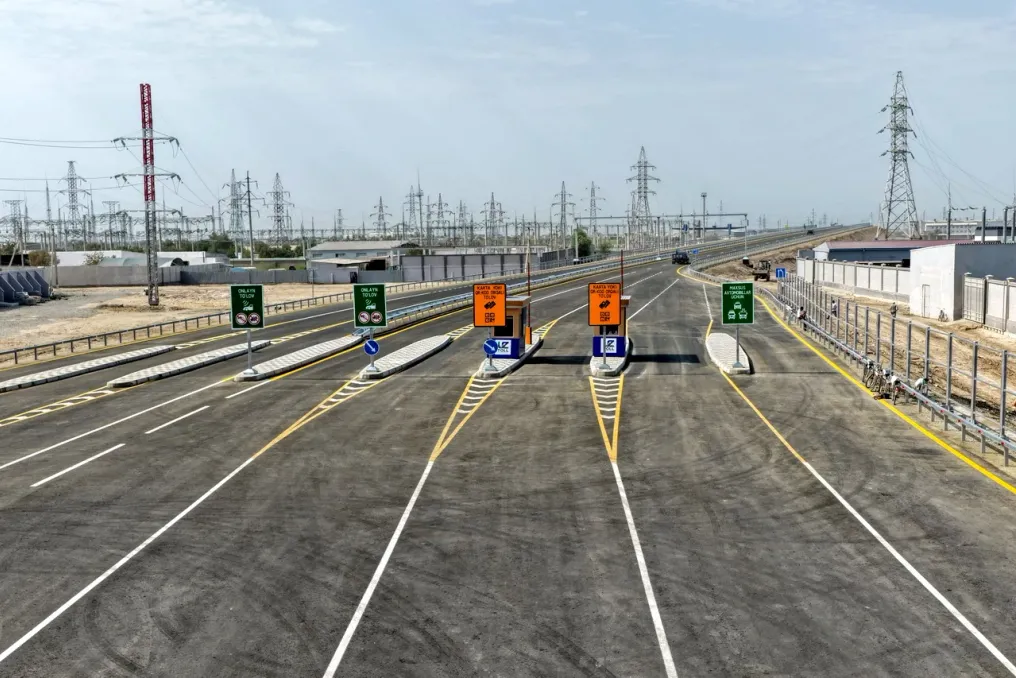
The Ministry of Transport of Uzbekistan has approved temporary rules for using the Urgench–Khiva toll road in the Khorezm region. This document establishes maximum fee rates, payment methods, traffic rules, and procedures for collecting unpaid fees from drivers.
Order No. 1 of the Ministry of Transport dated September 28, 2026, was registered by the Ministry of Justice on September 30 under number 3949 and will come into force from the date of official publication. This order was signed by the Minister of Transport Ilhom Makhamov and was agreed upon with the Ministry of Economy and Finance, as well as the Ministry of Internal Affairs. These temporary provisions will remain in effect until the Cabinet of Ministers adopts a resolution defining the general rules for operating toll roads.
Tariffs are calculated as a percentage of the Basic Calculation Value (BCV) and depend on the vehicle category and route length. Starting from September 1, 2026, when the BCV is set at 440,000 UZS, a round trip on the 35-kilometer Urgench–Khiva section will cost passenger cars and motorized vehicles of categories M1 and L no more than 0.04 BCV, or 17,600 UZS.
The maximum fee for minivans (M2) will be 0.10 BCV, or 44,000 UZS, and for buses (M3) — 0.15 BCV, or 66,000 UZS. Owners of trucks with two and three axles (N1, N2, O1, O2, and O3) will pay up to 0.20 BCV, or 88,000 UZS, while trucks with four or more axles and articulated vehicles (N3 and O4) will pay up to 0.30 BCV, or 132,000 UZS.
On the 28-kilometer Yangiarik–Khiva section, the tariffs are as follows: 0.033 BCV, or 14,520 UZS, for passenger cars; 0.08 BCV, or 35,200 UZS, for minivans; 0.12 BCV, or 52,800 UZS, for buses; 0.16 BCV, or 70,400 UZS, for trucks with two and three axles; and 0.24 BCV, or 105,600 UZS, for heavy trucks and articulated vehicles. Movement of trucks with four or more axles is permitted only after the complete laying of the final layer of pavement.
The road operator will determine the specific tariff, but it must not exceed the established maximum rates. The same tariff will apply to all users of the same vehicle category. Citizens legally entitled to free passage can use the road without payment, and their list will be posted on information boards.
Fees can be paid through a personal electronic account in the operator's mobile application, at a payment point, or under deferred payment terms. Two types of toll collection systems will be used on the road. In the barrier system, drivers stop at a payment point, pay the fee, and continue moving after the barrier is raised. In the barrier-free system, vehicles pass without stopping, and their license plates and travel times are automatically recorded by cameras and control towers.
When topping up an electronic account, any existing debt is settled first, and the remaining balance is used for subsequent trips. Road usage is based on a public contract, which is considered concluded by the driver at the moment of paying the fee or purchasing a road ticket.
If a driver uses deferred payment in the barrier-free system, the operator will send a notification requiring the debt to be repaid within five working days. The notification will specify the license plate, date and time of travel, the amount due, the payment method, the appeal procedure, and the consequences of non-payment. If the fee is not paid within five working days, the operator will take legal action to collect the debt.
Drivers have the right to dispute charges. The operator is obliged to review the complaint within five working days and, if justified, cancel the debt or recalculate the amount. In cases provided by law, the operator may exchange information with state bodies to restrict the ability of a vehicle with an unpaid debt to undergo technical inspection, re-register, be transferred to another person, or leave Uzbekistan.
The toll road prohibits the passage of heavy, oversized, or dangerous cargo, agricultural machinery, special construction equipment and mechanisms, bicycles, mopeds, and scooters with an engine volume of less than 25 cubic centimeters or power of less than 0.25 kW, pedestrians, or towed vehicles.
Stopping on the road is permitted only in case of an accident or mechanical failure of the vehicle. In such situations, the driver must immediately report the incident via a short number to the Department of Internal Affairs of the Khorezm Region for Road Safety and to the operator.
It is forbidden to bypass payment points and control towers, conceal or alter the vehicle's license plate, open the barrier without permission, or stop at a payment point for reasons unrelated to payment.
Before starting movement on the toll road, the operator is obliged to publish the tariffs, conditions, and payment methods, as well as information about an alternative free road, in the media, social networks, at road entrances, and on the website of the Roads Committee under the Ministry of Transport.
The operator is responsible for the maintenance and repair of the road, evacuation of broken-down vehicles, informing drivers about accidents and adverse weather conditions, as well as compensating for damage caused to vehicles due to road defects.
Collected fees will be transferred to a separate account of the Target Fund for Road Development under the Ministry of Economy and Finance. These funds will be used to finance road repair and maintenance, winter upkeep, landscaping, equipment purchases, staff salaries, and information systems.
The operator will prepare an estimate of expenses, which will be approved by the Roads Committee in consultation with the Ministry of Economy and Finance. Funds remaining after covering maintenance costs will be used to repay loans and borrowings attracted to finance the construction of the road.