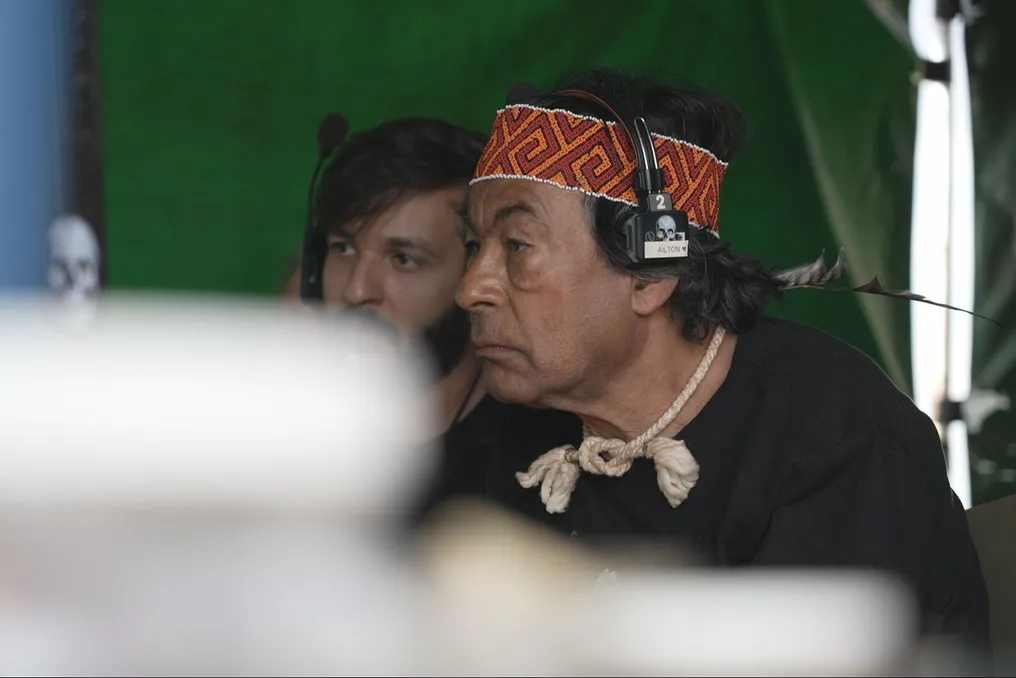
The writer, environmentalist, and only indigenous member of the Brazilian Academy of Letters, Ailton Krenak, is about to make his directorial debut in cinema. The film was shot in Chapada Imperial, located in Brazlândia, Federal District.
Filming took place over one month in a private environmental preservation area covering 4 thousand hectares, involving about 50 people. The production narrates a fictional story centered on a Xavante spiritual leader, using the Cerrado as the main setting. Krenak chose this region to set the plot, which unfolds in the 1960s.
Krenak explained that although it is fiction, it is based on the experience of an individual who remained in the original Cerrado, without modern infrastructure such as roads or documents, for over a hundred years. The film's title has not yet been revealed, and its premiere is scheduled for 2027.
For Krenak, directing cinema represents a new way of telling narratives. He drew an analogy between this work and the creation of the book 'Ideas to Postpone the End of the World,' where he also discusses the relationship between humanity and nature. He stated that audiovisual media, specifically cinema, is a fascinating resource for telling this story differently from the literary format.
The film tells the story of a spiritual leader
The narrative is a work of fiction inspired by the long life experience of an indigenous person who lived more than a hundred years in the Cerrado. The story is told from the perspective of a spiritual leader who guides his people in the face of changes threatening their territory. Krenak declared that he is celebrating the Cerrado biome by telling the story of a person originating from this ecosystem.
The director describes the central character as a 'master of dreams,' someone responsible for inspiring others and sharing stories. The plot also dialogues with Krenak's experiences with important people in his journey. The main role is played by the Xavante filmmaker Divino Tserewahú, recognized as one of the pioneers of Brazilian indigenous cinema. In the film, Tserewahú acts in his first role as an actor.
The cast also includes actor Johnny Massaro, who plays a young Salesian sent with the purpose of catechizing the indigenous people.
Set village was built by Xavante indigenous people
The production is the result of a collaboration between a producer from Minas Gerais and one from Brasília. To recreate the depicted village, seven Xavante indigenous people from the Sangradouro Reserve, in Mato Grosso, traveled to Brazlândia to erect the huts used in the filming. They went to the Federal District solely to build this set village.
The structure was meticulously planned to mirror the characteristics of a village from the 1960s, the historical period addressed in the film. The variety of landscapes in Chapada Imperial also motivated the choice of location, as, according to Gabriel Brito, the area allows for gathering various scenery in a single space.
Marta Imperial, one of the owners of Chapada Imperial, informed that the constructed huts will not be removed; they will remain and can be used in future audiovisual productions. Furthermore, she plans to use the location for educational activities, presenting students with aspects of indigenous culture.