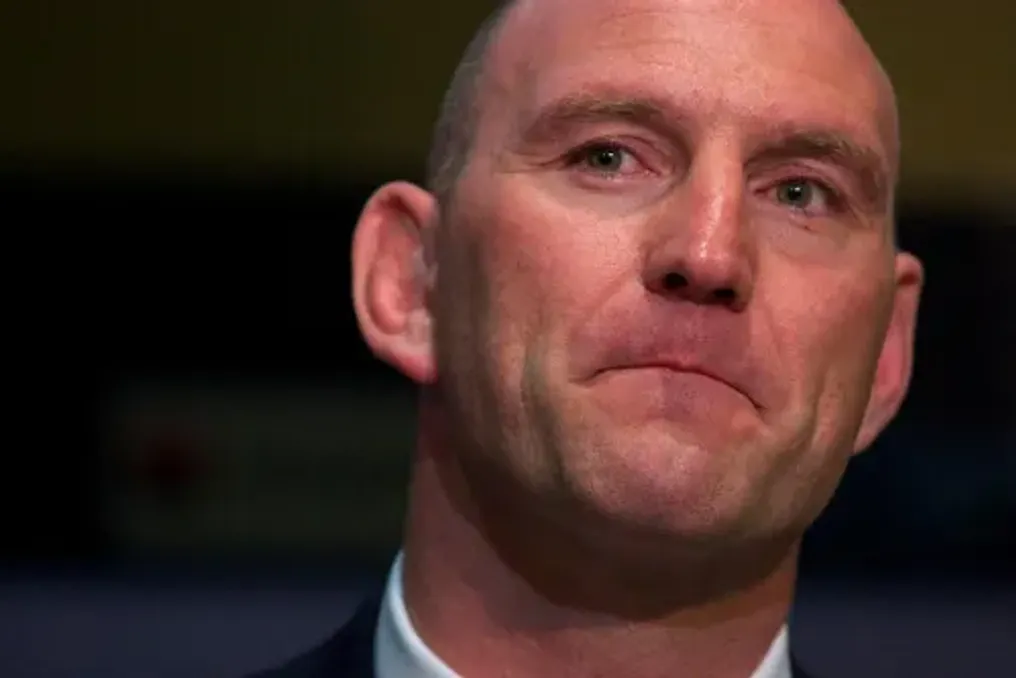
The auction related to Lawrence Dallaglio's bankruptcy highlights a sad trend in professional sports, where financial difficulties and post-career challenges force legendary athletes to sell their greatest achievements.
Few things symbolize an athlete's decline as painfully as putting a championship medal up for sale. This week, former England captain Lawrence Dallaglio announced that he is selling his 2003 Rugby World Cup winner's medal after declaring himself bankrupt.
The 54-year-old athlete put up for auction a number of valuable items from his brilliant career, including medals, trophies, and caps. Dallaglio was one of the stars of the England team that dramatically defeated Australia in Sydney 23 years ago to win the World Cup in extra time. Now, the gold medal, which symbolized the peak of his career, has become a financial asset.
"I had financial problems — I could have done much better," admitted Dallaglio. His story resonated in South Africa as well.
Last year, former South African Springbok player Adrian Richter also parted with his 1995 Rugby World Cup winner's medal. Richter captained the 'Boks' team in a group match against Romania, scoring two touchdowns, and also scored twice against Canada. He came on as a substitute in the quarter-final against Samoa but did not participate in the semi-finals or the final.
For Richter, selling the medal was a matter of survival, not sentiment or choice. "I definitely didn't sell it because I wanted to. I can't find a job. It's not good," he stated. Richter, who was 59 at the time, candidly spoke about the pressure of providing for his family: "At my age, I can't find a job. Nobody wants to hire me. It's absolutely awful."
The stories of Dallaglio and Richter serve as a harsh reminder that sporting immortality does not guarantee financial stability. While some athletes successfully turn fame and wealth into a comfortable life after retirement, others face difficulties when the applause fades, contracts disappear, and income dries up.
Some make catastrophic investments. Others spend more than they can afford, unable or unwilling to adjust a lavish lifestyle after their careers end. Problems can be exacerbated by gambling, alcohol, and other addictions, while the loss of purpose and identity accompanying retirement can make the transition even harder.
The sports world is full of cautionary tales. O. J. Simpson went from being a superstar of American football to an actor and TV host before his life descended into one of the most famous sagas in American sports history. Although he was acquitted of the murders of Nicole Brown Simpson and Ron Goldman in 1995, he was later convicted in 2008 of armed robbery and kidnapping in Las Vegas and served nine years in prison.
Mike Tyson earned hundreds of millions of dollars during his illustrious heavyweight boxing career, but extravagant spending and a series of legal and personal problems ultimately led to his bankruptcy in 2003. His expenses included luxury mansions, expensive cars, and even Bengal tigers. The man who once ruled the heavyweight division eventually served several prison terms.
John Daly was one of golf's bright figures—capable of incredible shots, heavy drinking, and extraordinary gambling losses. He won the PGA Championship in 1991 and The Open Championship in 1995, but his off-course problems became almost as famous as his on-course successes. Daly said that he once lost $1.65 million playing slot machines in just five hours, estimating his lifetime gambling losses to be in the range of $50 to $60 million. His career was a striking combination of triumph and turmoil. Today, he sells merchandise outside the Augusta National Golf Club during the Masters week.
Evander Holyfield became a heavyweight world champion and earned an estimated $200 million during his career. However, he admitted that it was difficult to refuse friends and family who asked him for financial help. Poor financial decisions ultimately cost him most of his fortune, including his mansion and valuable memorabilia. Today, Holyfield earns money through appearances and other commercial projects.
Diego Maradona was one of the greatest football players, representing Argentina in four World Cups and earning a multimillion-dollar fortune. However, his life outside of football is overshadowed by addiction, financial problems, and legal battles. Tax debts and fines worsened his problems, and his restless lifestyle consumed much of his wealth. When Maradona died in 2020, his financial affairs were still subject to legal disputes.
Boris Becker seemed destined for success. The German won 49 singles titles, six Grand Slam tournaments, and Olympic gold, earning a huge fortune during his brilliant career. Reckless spending and serious tax issues ultimately destroyed much of his wealth. In 2017, Becker was declared bankrupt, and in 2022, he was sentenced to two and a half years in prison in the UK for concealing assets and loans during bankruptcy proceedings. He served part of his sentence before being released and deported to Germany. Becker's story, like those of many others, illustrates the brutal difference between earning wealth and keeping it.
Perhaps the saddest part of the stories of Dallaglio and Richter is this: the medals they won are priceless from a sporting perspective, but when bills need to be paid, even a piece of history has a price.