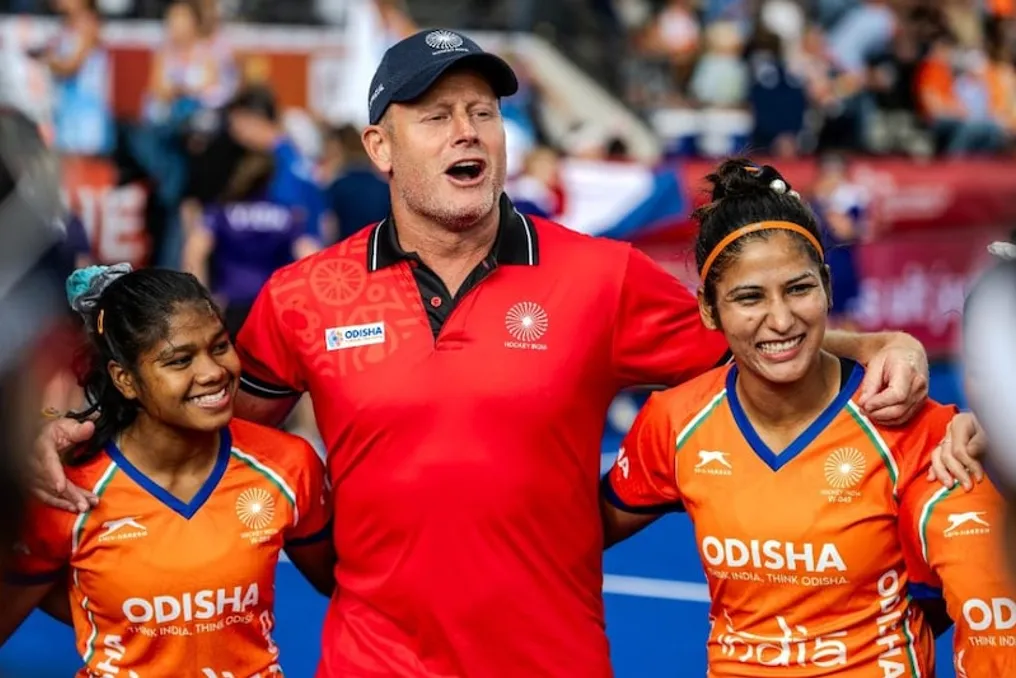
After a 44-year wait, the Indian women's hockey team shone not only with the brilliance of gold but also with the entire history of the journey that led them to this moment. At the 2026 Asian Games final, India defeated the silver medalists from the Paris Olympics, China, with a score of 1-0, winning the gold medal. Thanks to this victory, the Indian women's hockey team also qualified for the 2028 Los Angeles Olympics.
During the celebration in the locker room, head coach Shard Marin became part of this historic moment alongside the players. However, the true story of this victory is not limited to the 60 minutes of the final; it lies in the changes that occurred over the last nine months, which transformed a team suffering from lack of confidence and injuries into a cohesive and fearless unit.
When Shard Marin returned in January as the head coach of the Indian women's hockey team, he faced a difficult task. The team's play was unstable, they had left the FIH Pro League, and injuries were negatively affecting the squad. In this situation, Marin focused primarily on strengthening trust within the team. His approach differed from that of other coaches. On the field, his voice was often heard in Hindi, giving instructions such as: 'A little forward, go back, Dipu run, Shilpi pass.'
He allowed the players to play according to their own understanding instead of restricting them with an excessive number of instructions. Instead of long speeches before major matches, his trust proved more valuable to the players. Shard Marin believed that once on the field, players should have the freedom to make decisions based on their position. Therefore, long '70-minute speeches' were not part of his style before important games.
The Indian athletes also felt this philosophy. Players, from young defender Sakshi Rana to experienced goalkeeper Savita Punia, were given a sense of confidence to openly express their playing style. This shift gradually reflected in the team's performance. India returned to the Pro League by winning the FIH Nations Cup. After this, the team showed impressive results at the World Cup, finishing fifth. This was the best performance of the Indian women's team at the World Cup in 52 years. A notable feature of this campaign was the participation of 11 players in the World Cup for the first time. Thus, Shard Marin had to work not only with experienced players but also give responsibility to young talents on the big stage. India lost only one match throughout the tournament—this defeat was against the Netherlands, who, as co-organizers, ultimately became champions. In that match, both goals against India were scored from penalties.
One cannot understand the whole story by looking only at hockey tactics. Shard Marin also paid great attention to increasing team cohesion. Wearing 'unity bracelets' on the players' wrists was part of this idea. His goal was to ensure that any disagreements within the team remained in the past, and that the players would play for each other. Support staff also played an important role in this process. Scientific consultant Wen Lombard, drag-flick consultant Taake Taakema, assistant coach Matias Villa, and other performance experts constantly worked with the players.
Prime Minister Narendra Modi also highly praised Shard Marin's contribution to Indian women's hockey. In May, addressing the Indian community in The Hague, Netherlands, he mentioned the contribution of Dutch coaches to Indian hockey. PM Modi stated that Dutch coaches made a significant contribution to improving Indian hockey, and that Marin played a key role in the consistent success of the women's team. Now, a new task lies before them.
A historic moment for Indian women's hockey is the victory over China at the 2026 Asian Games in Nagoya, which happened after 44 years. This victory also paved the way to the Los Angeles Olympics. The next main goal for Marin and his team is now the 2028 Olympics.