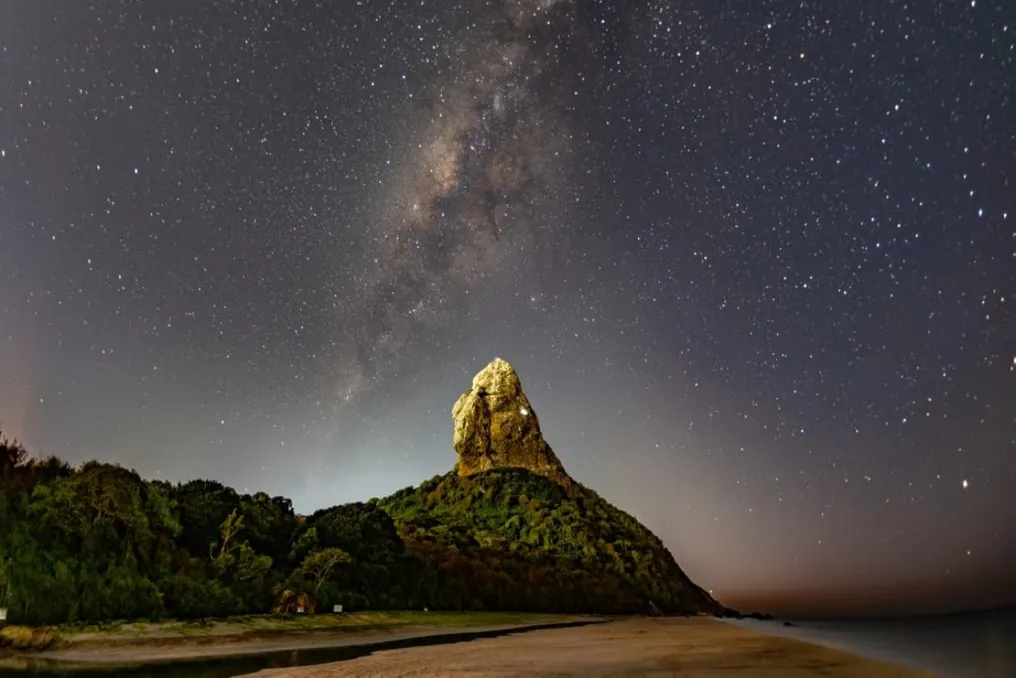
Photographer Léo Caldas, originally from Brasília, visited Fernando de Noronha for the first time and created a series of impressive images of the Milky Way. Specializing in astrophotography, he focuses on capturing the night sky, including stars, planets, and galaxies.
During his six-day stay on the island, Caldas prepared eight time-lapse videos. This technique allows slow phenomena to be displayed by combining frames taken at specific intervals. For this, he used cameras and a drone, taking about two thousand photographs.
He mentioned that Fernando de Noronha was a dream for him. He conducted research and found that there were few night photographs of the island. Therefore, he planned the trip during a period with low rainfall, organizing the visit to coincide with two full moons and a dark sky period.
Most of the material was shot using a drone. This device was used in five videos along pre-programmed routes. For instance, it departed from Porto de Santo Antônio and headed towards Forte dos Remédios. The drone flew at a speed of 5 km/h, taking a picture every two seconds, after which all images were combined into an accelerated video.
Among the videos created on the island, Caldas's favorite was the one showing the Milky Way against the backdrop of Morro dos Irmaush. He left the camera at Pedra do Bode around 6:00 PM and programmed the shoot. Then, he went to Forte dos Remédios, took pictures of the fortress, and later returned for the camera. At that moment, the Milky Way was perfectly positioned behind Morro dos Irmaush, with its characteristic landscape.
Caldas has been doing similar shoots for 15 years, although photography is not his main profession. He works as a physical education teacher in the state education system of the Federal District and creates these images as a hobby, subsequently publishing the material on social media.
NASA
One of the photos taken by Léo Caldas received international recognition. His picture of a total solar eclipse, taken in 2019, was selected by NASA for the Astronomy Picture of the Day (APOD) website, which publishes astronomical images daily.
He recalled: 'The eclipse is the most impressive natural phenomenon. I managed to capture a flock of birds flying in front of the eclipse. The image went viral and was chosen as NASA's photo of the day.'
Noronha among the highlights
Léo Caldas plans trips specifically for photography and videography and has visited various places in Europe, South America, and the United States, as well as many locations in Brazil. He noted that Noronha was one of the most beautiful places he has photographed. He compared Fernando de Noronha and Lençóis Maranhenses, calling them two very different places in the world that he has photographed.
The photographer is satisfied with the trip's outcome but would like to take pictures of the Marine National Park, access to which is restricted at night. He stated: 'I just lack photos of the park, which require special permits. I was thinking about shooting Baía dos Golfinhos. Who knows if I can get those shots on my next visit to Fernando de Noronha.'