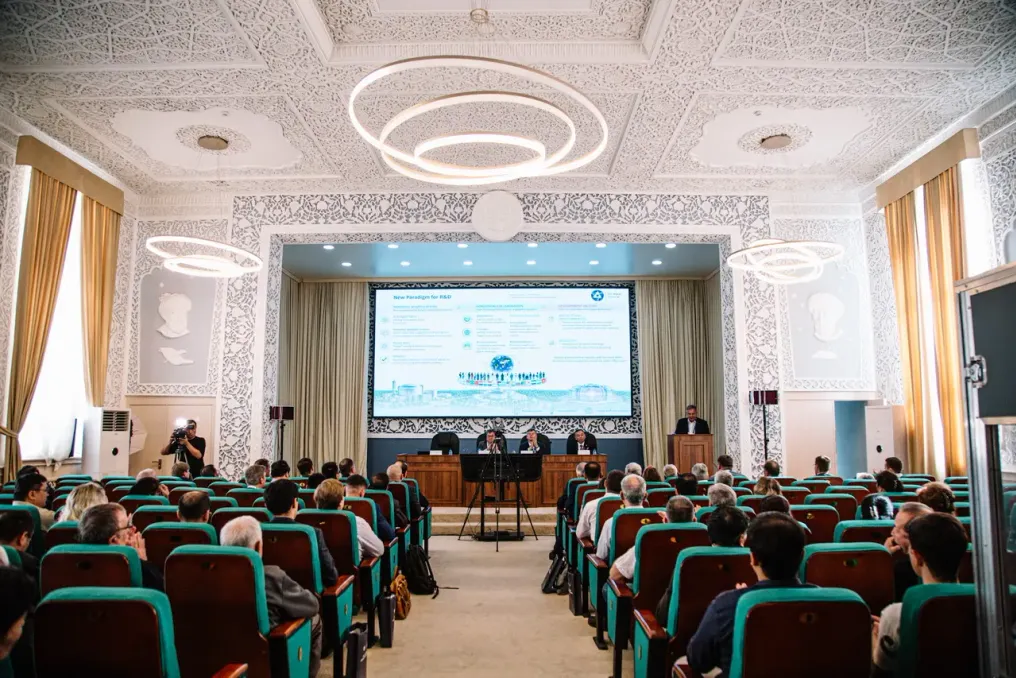
The third meeting of the Advisory Council of the International Research Center based on the Multipurpose Fast Research Reactor MBIR took place in Tashkent. The event was held at the Institute of Nuclear Physics of the Academy of Sciences of Uzbekistan and attracted over 150 delegates from 72 organizations representing 18 countries.
The main focus of the meeting was on developing research infrastructure, coordinating scientific programs, and solving engineering problems related to the prospects of nuclear energy technologies. Participants also discussed specialist training and the formation of national research plans.
Stepan Kalmikov, Vice President of the Russian Academy of Sciences and Chairman of the Advisory Council, emphasized the international nature of the project and its significance for 'megascience' research. According to him, the scientific program of the International Research Center is aimed, among other things, at closing the nuclear fuel cycle, reducing radioactive waste volume, and expanding the resource base of nuclear energy.
Kalmikov noted that the wide composition of participants reflects the interest in nuclear research from scientific centers, industrial companies, academic institutions, regulators, financial institutions, international organizations, and universities. The meeting gathered representatives from countries such as South Korea, India, CIS states, Brazil, and African countries.
Evgeny Abakumov, Deputy General Director for Science and Strategy of Rosatom, reported that the corporation's management is involved in implementing the MBIR project and integrating it into the international scientific agenda. He stressed that holding the Council meeting in Tashkent demonstrates the global scientific community's interest in this project, and that the MCI MBIR consortium goes beyond a local initiative, developing as an international platform for advancing nuclear research.
Shavkat Ayupov, President of the Academy of Sciences of Uzbekistan, also noted the growing interest of specialized organizations in the research conducted at MCI MBIR. In his opinion, the work at the reactor can provide an additional impetus to the development of global nuclear energy.
Participants received a address from Mikhail Kovalchuk, President of the Kurchatov Institute National Research Center. The address was read by the center's Vice President, Alexander Blagov. It highlighted the importance of 'megascience' infrastructure for technological progress and national security. Kovalchuk specifically highlighted the prospects of jointly using the under-construction MBIR and the operational PIK reactor, which, in his assessment, is capable of providing a wide range of neutron fluxes for research.
Special attention was paid to creating a unified scientific program for 'megascience' facilities, including the participation of partners from CIS countries. Ilham Sadykov, Director of the Institute of Nuclear Physics of the Academy of Sciences of Uzbekistan and Academician, highlighted the potential of combining the capabilities of MBIR with the existing research base of the institute. This base includes the modernized VVR-SM research reactor and a complex of accelerators. According to Sadykov, this combination will allow experiments in materials science, testing computational codes, and producing radioisotopes.
He also added that cooperation between research centers can contribute to ensuring nuclear safety and the peaceful use of atomic energy.
Vasily Konstantinov, CEO of LLC Consortium MCI MBIR, spoke about expanding the international membership of MCI MBIR. He reported that both Russian and foreign partners continue to join this platform. Among promising areas, he named the study of the possibility of creating a low-energy facility using solutions integrated into MBIR. The projected capacity of such a facility could be around 50 MW, with a significant part of the generated heat being used for electricity generation.
Konstantinov also emphasized the possible application of artificial intelligence technologies at various stages of new solution development—from setting research tasks to practical implementation of results. The meeting in Tashkent became a platform for discussing the further development of international scientific research cooperation around MCI MBIR, as well as opportunities to combine existing and planned scientific capacities for implementing joint programs.