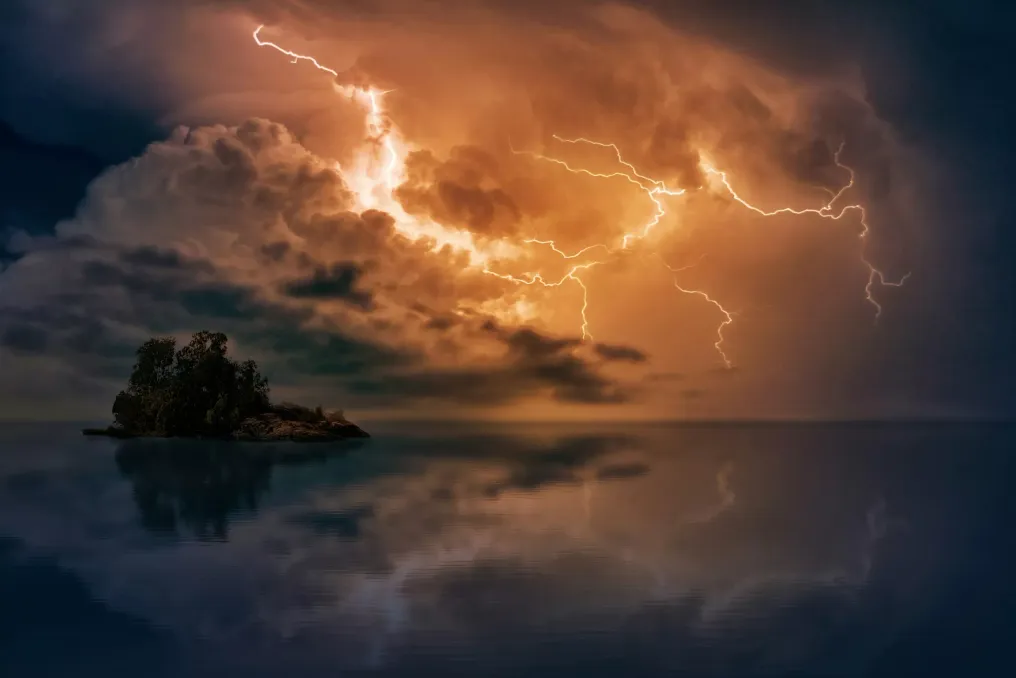
Lake Maracaibo in Venezuela hosts one of the world's most consistent natural lightning phenomena, known as Catatumbo lightning. These thunderstorms can develop over the lake for hours, occurring near the mouth of the Catatumbo River.
The conditions for these powerful storms are created by a combination of the lake's warm water, surrounding mountains, and converging air currents. For a traveler, this is not just a sight to photograph and forget; the experience takes place after dark, from the water, as the surrounding landscape dissolves into darkness.
The vast Lake Maracaibo serves as a constant source of warm, moist air, while the surrounding mountains, including branches of the Andes, influence the movement of this air. At night, cooler air flows down from the mountains, while warm, moist air remains over the lake. The collision of these air masses fuels deep thunderstorms responsible for this phenomenon.
Studies have shown that the most intense activity is concentrated in the southwestern part of Lake Maracaibo, especially at night. The warm surface of the lake and the adjacent terrain contribute to the repeated formation of storms in the same area.
Local residents knew about this unusual feature long before scientists could study it using satellites. The lightning became known as the Maracaibo beacon because it could be seen from significant distances across the lake, and historically, it was used by sailors as a natural navigational aid. Historical mentions of the phenomenon date back centuries.
This history adds another layer to the modern observation. You are watching the same atmospheric event that once helped guide ships through these waters. Travelers traditionally go to Lake Maracaibo after sunset to watch the storms from boats. There is a certain harmony in experiencing Catatumbo in this way. From the shore, the focus remains on the landscape, but on the water, you are surrounded by it.
However, there is no guarantee of perfectly timed viewing. Catatumbo lightning is a natural phenomenon, and its frequency and intensity change depending on atmospheric conditions. This uncertainty is part of the adventure.
The scale of the phenomenon is astonishing. Satellite observations have identified Lake Maracaibo as a global hotspot for lightning. NASA has recorded hundreds of flashes in the region on average per day, and the Guinness World Records has recognized Catatumbo for the highest concentration of lightning. Some studies have recorded lightning activity for nearly 300 nights a year, with individual displays lasting several hours.
The localized nature of the activity is particularly appealing to tourists. Storms consistently occur over the same part of the lake, meaning it is not just a random trip to Venezuela on the right night; geography is part of the attraction.
Lake Maracaibo itself is noteworthy. It covers about 13,000 square kilometers and is connected to the Caribbean Sea, forming an unusual lacustrine estuary system. It is also a busy working environment that has faced significant environmental pressure, including oil pollution, algal blooms, and nutrient pollution.
For the tourist, this complicates the impression a postcard might create. The lake is not pristine wilderness. It is a living landscape shaped by communities, industry, weather, and a long history of human use. The lightning exists within all of this.
This is what makes watching it from the water so captivating. There is no tourist center or viewpoint here. You are simply on the lake after dark, surrounded by mountains and open water, waiting for the weather to decide.
A trip to this region requires careful planning. Current government travel advisories caution against travel to the state of Zulia, so anyone considering a visit should check the latest recommendations and local conditions before making plans.
Catatumbo lightning serves as a reminder that some of the best travel experiences cannot be booked, planned, or guaranteed. They depend on being in the right place and having the patience to wait. Over Lake Maracaibo, warm waters, mountains, humidity, and moving air combine to create a spectacle that has fascinated people for centuries. And if the conditions are right, the reward is simple: sitting on the dark water in Venezuela and watching the night sky come alive above your head.