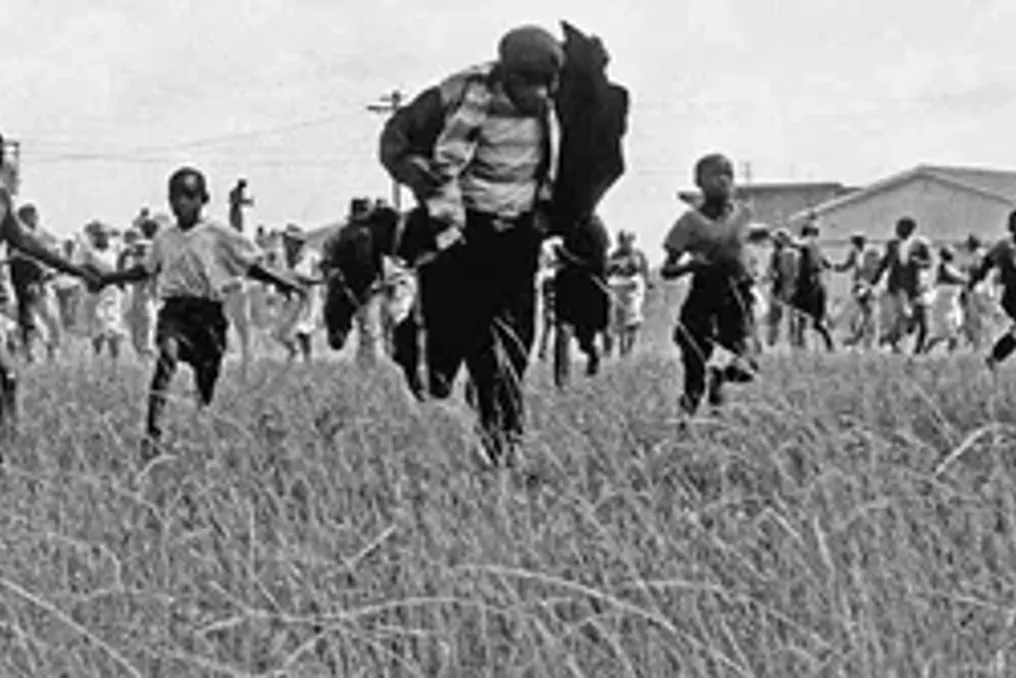
The renowned photojournalist Ian Berry passed away on September 13, 2026. He covered conflicts around the world, but is best known for the pictures he took during the Sharpeville massacre in South Africa.
The mass killing occurred on March 21, 1960, when police opened fire without warning on a peaceful crowd of protesters. The incident resulted in 91 deaths, many of whom were wounded in the back while trying to escape the gunfire.
On that day, about five thousand people gathered near the police station in Sharpeville, near Johannesburg. They came there at the call of the Pan-Africanist Congress to protest against passports. These documents were introduced by the apartheid state, which required all Black South Africans to carry them to restrict and control their movement.
Apartheid was a racist ideology implemented by the National Party after it gained power in South Africa in 1948. The government enacted a series of laws, including the Group Areas Act and the Population Registration Act, aimed at ensuring white supremacy.
Resistance to apartheid grew in response to these repressive laws and was led by liberation movements: the African National Congress, the Communist Party of South Africa, and the Pan-Africanist Congress. The peaceful protest in Sharpeville ended in a mass killing when the police fired live ammunition into the crowd without warning.
Recent studies indicate that no fewer than 91 people died, and over 230 were injured. At the time, British photographer Ian Berry worked for Drum magazine, a South African publication targeting urban Black readers and styled like magazines such as Life and Picture Post. His photographs from Sharpeville were distributed worldwide, exposing the brutality of the apartheid regime.
In an interview conducted with him in July 2024 as part of research for his book 'Afterimages of Apartheid', Berry recalled that many journalists and photographers were present in Sharpeville on the morning of March 21, 1960. He recounted that the well-known South African photographer Peter Magubane had been sent on another assignment on the day of the massacre, so Berry himself was dispatched to Sharpeville by Drum editor Tom Hopkinson, despite it being his day off.
Berry took numerous shots of the waiting crowd. When he decided to leave, the shooting began, and he crouched on the grass, continuing to photograph. Berry's photographs are the only existing images of the massacre in the moment it occurred. These pictures helped shape history. Berry's images of Sharpeville, along with photos of its aftermath taken by photographers like Magubane and Alf Kumalo, played a key role in shaping support for the nascent global anti-apartheid solidarity movement.
Apartheid was declared a crime against humanity by the United Nations General Assembly in December 1966. Despite widespread condemnation of the regime's racist policies, the South African state became increasingly militarized and aggressive. The work of photographers was critically important in documenting more than two decades of fierce struggle following the massacre, until apartheid ended in 1994.
Who was Ian Berry?
Ian Berry was born in England in 1934 and moved to South Africa in 1952 to start his career as a photojournalist. He worked for the English-language newspaper Rand Daily Mail, one of the few publications criticizing the apartheid regime, as well as for Drum magazine. His presence at the Sharpeville massacre changed his life, and he testified before the commission investigating the massacre in 1960.
He left South Africa in 1961. The following year, he joined Magnum Photos and began working for The Observer, a London-based newspaper covering world events. In the 1960s, under the editorship of David Astor, the paper supported the fight for racial equality in South Africa.
In 1968, he documented the Russian invasion of Czechoslovakia at the time, and also took pictures of conflicts in Ireland, Israel, and Vietnam among other places. A series of his works depicting life in England was published as a book in 1978, and he released two photo books about South Africa. His latest book, 'Water', explores the vital importance of this resource for people around the world.
Documenting the Massacre
When asked if he feared death in Sharpeville, Berry replied: 'It happened too quickly.' He had two Leica cameras; the first ran out of film, so he used the second camera with a wide-angle lens. Leica developed the first lightweight portable cameras that could hold a roll of film capable of taking 36 shots before reloading. The invention of a discreet, easily transportable camera revolutionized photography and allowed events to be documented in real-time.
Berry recalled: 'All I could do was photograph people running towards me.' He realized the police were firing live ammunition only when a woman fell near him. After the shooting stopped, Berry realized he was the only one moving in the field and that he should leave as soon as possible to prevent his film from being confiscated by the police.
The apartheid regime declared a state of emergency on March 30, 1960. Thousands of people were arrested, and opposition parties were banned and forced to operate underground. This marked the beginning of the armed struggle against apartheid.
Berry's images were supposed to appear in a special edition of Drum magazine dedicated to Sharpeville, but the magazine owner, Jim Bailey, feared the publication would be shut down by the government and refused to print the story. Instead, Berry's pictures from the massacre were sent to the Camera Press photo agency and published worldwide, including in Paris Match, Stern, Time, and Life magazines.
Magubane's famous photographs of the mass burials in Sharpeville were included in the May 1960 issue of Drum. Berry's photographs of the massacre itself did not appear in South Africa until October of the same year.
The Art of Evidence
Berry's photographs played a key evidentiary role during the investigation commission hearings held in 1960. They demonstrated that the police were shooting the crowd as they fled, and they also proved that they were reloading their weapons. Despite this, no police officer or government official was held accountable for the massacre.
After the massacre, the apartheid state passed the Damages Act in 1961, which prevented victims from suing the government or the police. This law remains in effect. In September 2026, the organization Lawyers for Human Rights announced the start of a case aimed at overturning the Damages Act and securing compensation on behalf of the victims of the massacre and their surviving relatives.
This case serves as a reminder that Berry's photographs are more than just iconic images of South African history; they are evidence of a crime against humanity and may finally play a role in ensuring justice for the survivors of Sharpeville. The author notes that his favorite shot by Berry shows two women protesting against apartheid shortly before the Sharpeville massacre. One of the women holds a sign that reads: 'We want to celebrate freedom, not fascism.'
boolean