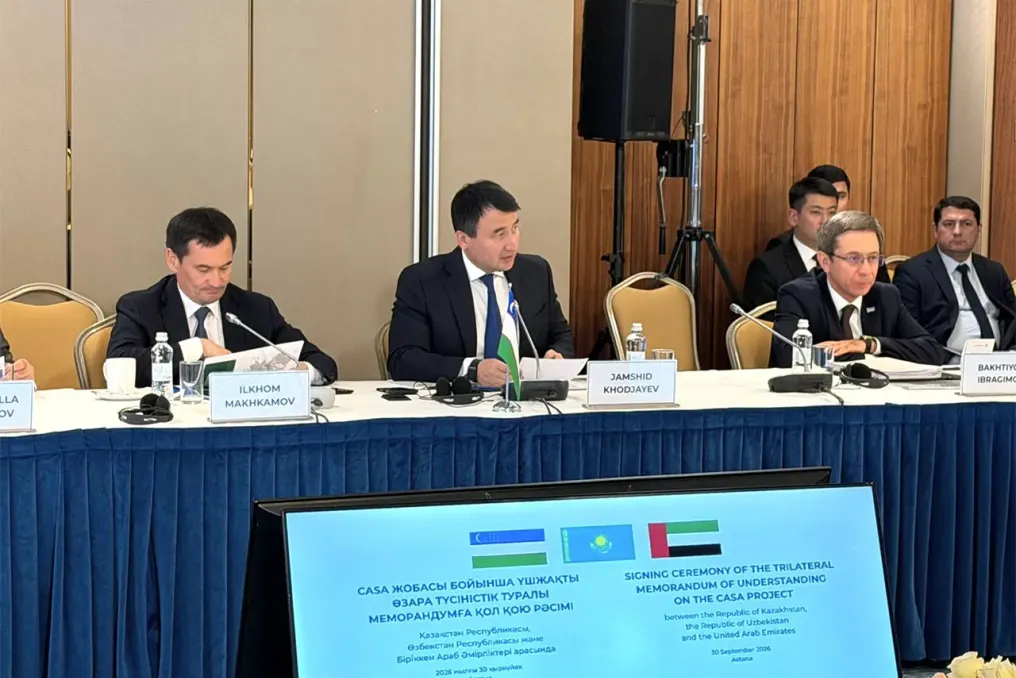
Deputy Prime Minister of Uzbekistan Jamshid Khojaev announced the expansion of practical cooperation between Uzbekistan and Kazakhstan in the fields of trade, industrial interaction, and transport connectivity following the meeting in Astana.
At the meeting, Deputy Prime Minister and Minister of National Economy of Kazakhstan Serik Zhumangarin participated. The parties discussed the implementation of a joint program for economic and trade cooperation, which covers projects in areas such as agriculture, tourism, petrochemicals, logistics, energy, and industry.
Particular attention was paid to eliminating obstacles to bilateral trade, increasing the capacity of border crossings, developing transport infrastructure, and promoting specific industrial initiatives.
One of the key outcomes of the meeting was the signing in Astana of a trilateral memorandum of understanding on the CASA project between Uzbekistan, Kazakhstan, and the United Arab Emirates.
This project envisions the creation of an economic route between South and Central Asia through Uzbekistan, Afghanistan, and Pakistan, providing access to Indian Ocean ports.
According to Khojaev, integrating this route with Kazakhstan's transport network will form the basis for the China-Kazakhstan-Uzbekistan-Afghanistan-Pakistan corridor. The goal of this route is to expand the region's opportunities to access South Asian markets.
Uzbekistan views the planned route not only as railway infrastructure but also as an integrated economic ecosystem. Its development is expected to include digital solutions, terminals, warehouses, industrial sites, and service infrastructure.
Attracting private investment and financing from international financial institutions for the implementation of these projects is also planned. Khojaev noted that projects of this scale can shape a new architecture of regional connectivity, where transport infrastructure supports the growth of trade, industrial cooperation, and access to new markets for the countries of the region.