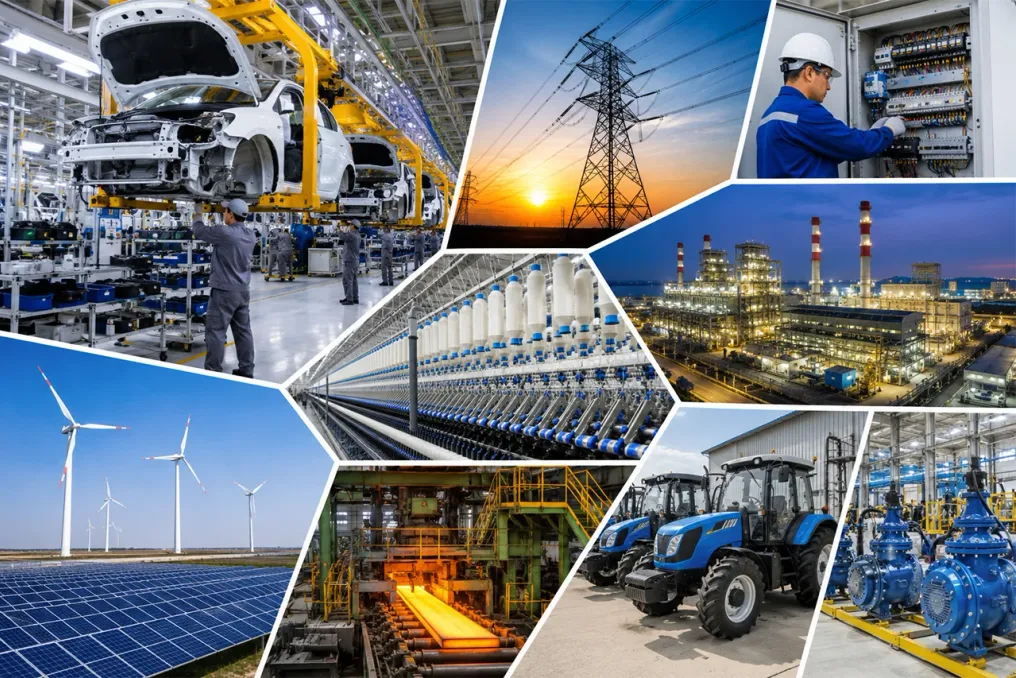
According to data from the National Statistical Committee of Uzbekistan, industrial production in Uzbekistan reached 926.5 trillion soums from January to August 2026, demonstrating an 8% growth compared to the same period last year.
Manufacturing accounted for the largest share of total industrial output, providing 805.7 trillion soums, or 87% of the total amount. Production in this sector increased by 9.1%.
The electricity, gas, steam, and air conditioning production sector amounted to 58.2 trillion soums (6.3% of the total volume), showing an increase of 11.8%. Mineral extraction and quarrying contributed 57.8 trillion soums (6.2%), although production in this sector decreased by 2.4%. Water supply, sewerage, waste collection, and disposal provided 4.8 trillion soums (0.5%), with output growing by 10.2%.
Within the manufacturing sector, the food industry, beverages, and tobacco accounted for 20.1% of output, while textiles, clothing, and leather goods occupied 11.9%. Chemical products, rubber, and plastics provided 6.3%.
Metal products, electronics, mechanical engineering, automobiles, other transport equipment, as well as machine repair and installation collectively accounted for 15.2%. However, hydrocarbon extraction decreased: natural gas output fell by 16.3% to 24.2 billion cubic meters (from 28.9 billion last year), and condensate production decreased by 14.8% to 648.3 thousand tons. Oil production fell by 2.2% to 425 thousand tons, and coal mining decreased by 10.2% to 4.4 million tons.
Concurrently, gasoline production increased by 4.6% to 811.3 thousand tons, and diesel fuel output grew by 6.1% to 834.3 thousand tons. Portland cement production increased by 2.2% to 14.1 million tons.
Electricity generation increased by 7.3% to 60.5 billion kWh. Large enterprises produced 40.4 billion kWh, which was 2% less than the previous year. Small enterprises whose main activity is electricity production increased output by 32.4% to 20.2 billion kWh. Heat generation by large enterprises decreased by 19.1% to 10.9 million Gcal.
Passenger car production increased by 9.2% to 310.4 thousand units. Cobalt showed the largest production volume with 107.1 thousand cars, an 8.2% increase. Among brands, BYD demonstrated the fastest growth, increasing output by 84.5% from 12.9 thousand to 23.9 thousand cars. Onix production grew by 16.1% to 23.5 thousand units, KIA increased production by 12.9% to 19.4 thousand, and Haval by 17.4% to 6.2 thousand.
Meanwhile, Damas production decreased by 4.9% to 55 thousand cars, and Tracker output decreased by 0.5% to 29.8 thousand, while Chery production decreased by 2.7% to 5.8 thousand. An additional 1.5 thousand Chevrolet Damas Move cars were produced. Truck production increased by 42% to 3.9 thousand units, and automotive engine production grew by 6.9% to 160.7 thousand units.
In the textile sector, cotton fiber production increased by 50.9% to 543.7 thousand tons. Cotton fabric output grew by 18.2% to 74.7 million square meters, knitted fabric production increased by 5.2% to 56.6 thousand tons, and knitted underwear production grew by 43.4% to 96 million units. However, knitted outerwear production decreased by 9.5% to 35.1 million units. Additionally, Uzbekistan produced 972.3 thousand tons of wheat flour.
By region, the largest volumes of industrial output were recorded in Navoi region (205.7 trillion soums), Tashkent (158.4 trillion soums), and Tashkent region (147.7 trillion soums). The highest growth rates were shown by Jizzakh region (13.2%), followed by Samarkand region (9.4%) and Andijan region (9.1%). The lowest growth rates, at 7.2%, were noted in both Navoi region and Karakalpakstan Republic.
The average industrial output per capita across the country was 24.1 million soums, higher than 17.5 million soums the previous year. This indicator grew by 106.1%, corresponding to an increase of 6.1% in comparable prices.
Industrial output per capita exceeded the national average in Navoi region (184.4 million soums), Tashkent (49.6 million soums), and Tashkent region (46.5 million soums). Growth in production per capita above the national level was recorded in Jizzakh region (11.1%), Samarkand region (7.4%), and Andijan region (7.3%).
As of September 1, 2026, there were 65.3 thousand industrial enterprises in Uzbekistan. The largest group consisted of food producers with 13.2 thousand enterprises (20.2%), followed by producers of other non-metallic mineral products—9.2 thousand enterprises (14%), and clothing producers—6.7 thousand enterprises (10.3%).
Additionally, 5.4 thousand enterprises were engaged in finished metal product manufacturing, 4.5 thousand in furniture making, 4 thousand in textile production, and 3 thousand in rubber and plastic product manufacturing.