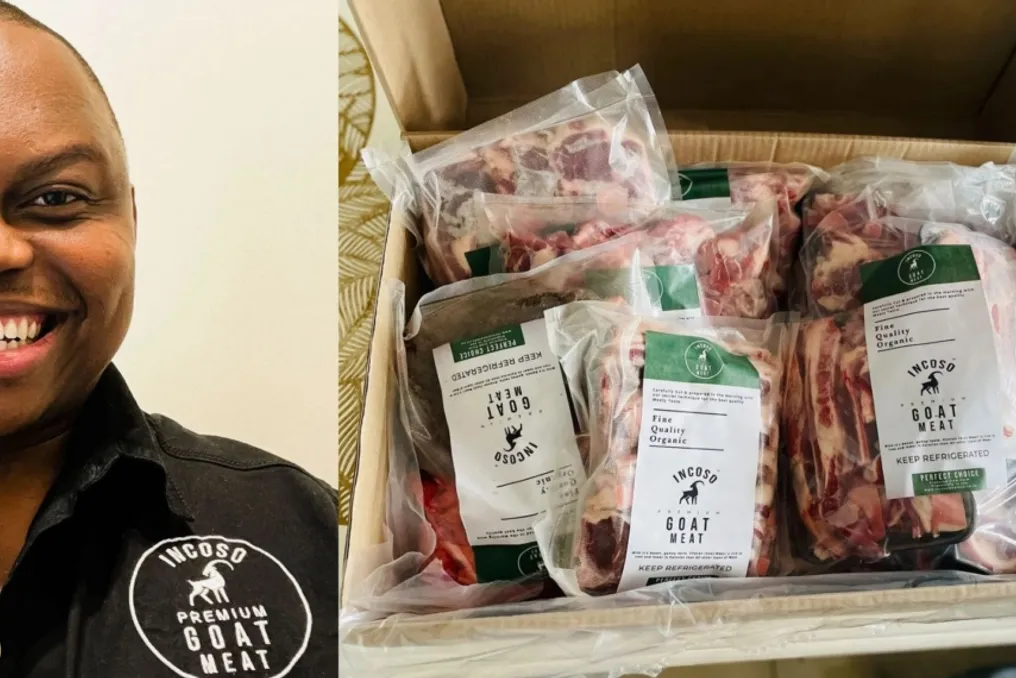
Goat farming is an established part of livestock in South Africa, with demand linked to traditional and cultural practices. Buhlebenkosi Mbatha saw an additional opportunity in the market by studying goat meat processing and formal markets.
With eight years of experience in goat farming, he investigated the value chain, which led to the creation of Incoso Goat Meat. The business was launched in 2022 with the aim of exporting South African goat meat to international markets, including Dubai in the United Arab Emirates.
Mbatha told Food for Mzansi that he transitioned from being a primary farmer to coordinating various links in the goat value chain. He helps primary farmers raise and maintain suitable animals that can then serve as raw material for products such as meat and milk.
Mbatha has no formal education in agriculture; his father is a retired priest, and his mother is a retired teacher. His interest in goat farming arose after hearing Dr. Bandile Mhize speak at the Amandla Omnotho conference in Etkutwini around 2017 or 2018.
At the time, Mbatha assisted with conference marketing and was responsible for video and audio recording. He recounted accidentally overhearing Mhize discussing goat farming, which sparked his interest in the untapped potential of the industry in South Africa. In 2018, as a graduate of the University of Pretoria without a job, Mbatha acquired five goats and began farming using local goats in Ulundi, KwaZulu-Natal.
He later gained experience with Kalahari Red goats through a farming program supported by the Department of Agriculture. His own husbandry experience, along with training other farmers, gave him a deeper understanding of goat farming, livestock, and the challenges facing the goat meat value chain. Although the goat meat industry is still developing, Mbatha believes that goat farmers should be taken more seriously as commercial suppliers.
His transition to goats is also linked to his background in marketing. In 2013, Mbatha earned a Bachelor of Information Science degree in publication, followed by a postgraduate diploma in digital innovation and marketing, both from the University of Pretoria.
Thanks to this experience, he was interested in more than just keeping goats. He wanted to understand what was necessary to raise animals that could ultimately enter the commercial processing market. He explained: 'That's why I started goat farming, not just to keep animals, but to understand the process of raising animals suitable for agro-processing. My goals and interests were how we could rebrand goats to become a more marketable asset in the country's economy.'
This approach now dictates the management of his operations. Mbatha sources live goats from farmers through the Qhakaza Goat Farmers Association and inspects the animals daily, either himself or through his staff.
Mbatha explains that Incoso Goat Meat outsources slaughtering to commercial and small abattoirs, while cutting and packaging are done in-house. He emphasized: 'Our packaging is our calling card, and it has been noted by all retailers for its brand design and for preserving the meat for a long time.'
Animals are selected based on age and breed, after which Incoso advises the abattoir on processing procedures, which are part of the company's intellectual property and standard operating procedures. Mbatha added: 'We ensure that the animals we buy from farmers are intended for food production, not breeding, so we never worried about odors that concern people.'
This method is based on years of trials and refinement of procedures during his farming activities. The company sells whole carcasses, ragouts, steaks, mince, sausages made from goat meat and offal, and experiments with products such as goat meat salami and biltong. By-products, such as skins, are sold to tanneries that make bags and children's shoes.
The company's market includes Jackson’s Real Food Market and Food Lovers Market in Gauteng, The Harv Table restaurant by chef Leko Madlala, Hlope butcheries in Pietermaritzburg, hotels in Gauteng and KwaZulu-Natal, as well as private chefs and catering services. Incoso also has a network of resellers in KwaZulu-Natal and Mpumalanga, with networks being established in the Eastern Cape and Limpopo.
Mbatha reported that the company secured an export deal for Dubai through an international importer based in the UAE, although the parties cannot be named due to non-disclosure agreements. Mbatha notes that goats are often associated with African cultural and Asian religious practices, which has led to misconceptions about the meat and the weakness of the formal supply chain.
He points out that most goat trade still occurs through informal markets and private consumption, with little investment directed towards developing a strong local commercial goat meat market. For Mbatha, changing this situation means presenting goat meat as a proper commercial commodity so that retailers are willing to stock it. This is where Incoso acts as a wholesaler, supplying retail stores and food service establishments.
Mbatha asserts that the business built its market by improving packaging and branding while working with farmers to ensure the goats meet client specifications. The goal is to provide retailers with a consistent product that encourages repeat customers and attract more farmers into the formal goat meat value chain. He shared lessons learned: 'Develop thick skin and learn from mistakes. Stick to your vision. Know your numbers. Business is confidence, not just passion.' In conclusion, he urges aspiring agripreneurs to keep working on their ideas, and business owners to delegate when necessary. 'Become good at what you do. You don't have to do everything yourself.'