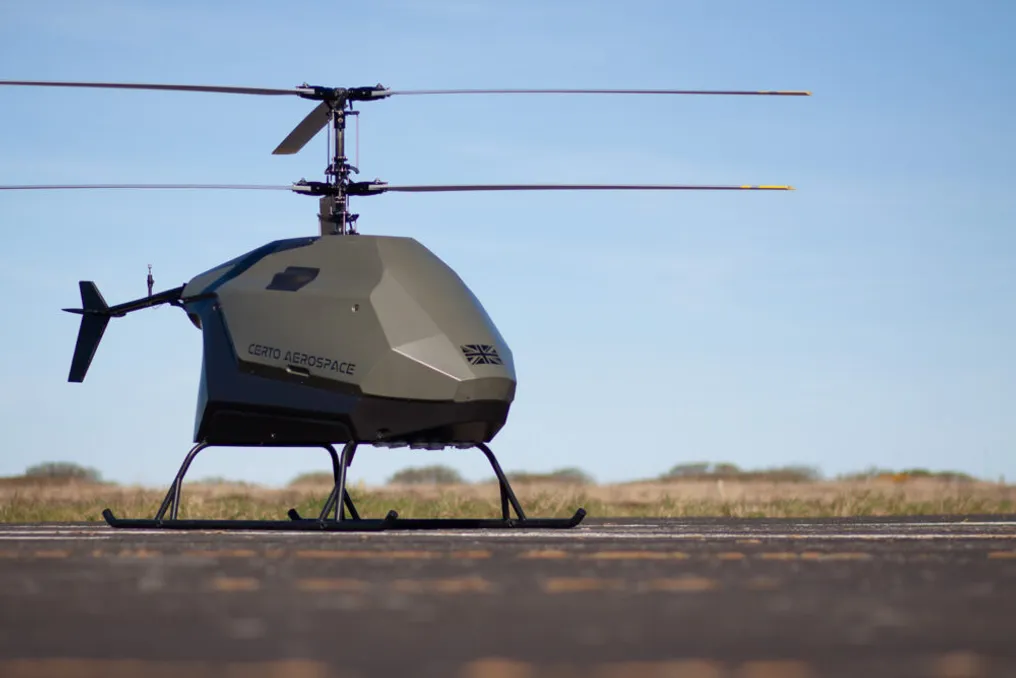
The British aerospace startup Certo Aerospace has secured £5 million in an early-stage venture capital round. These funds are designated to accelerate the development of the autonomous heavy aircraft, Capstone. The financing was obtained following three years of intensive flight testing, demonstrations for the Ministry of Defence, and integration work with BAE Systems.
Capstone is a 600 kg class unmanned aerial system featuring coaxial vertical take-off and landing. It utilizes two counter-rotating main rotors on a single axis, which eliminates the need for a traditional helicopter tail rotor while maintaining a compact size suitable for operation in confined spaces.
According to data published via BAE Systems, in its integrated configuration, the aircraft is capable of carrying a payload of up to 280 kg. Furthermore, it provides a flight time of up to ten hours and a maximum range of 300 miles. Certo's internal calculations indicate the potential to carry a payload of up to 300 kg depending on the mission configuration.
Since 2023, the aircraft has been flying, completing its third year of testing under Civil Aviation Authority approval. As part of the Ministry of Defence's MORRIGHAN project, Capstone has successfully executed logistics and casualty evacuation tasks using autonomous takeoff, navigation, descent, and precise landing.
Royal Navy trials also included deploying sonar buoys, acoustic processing, and data transmission for anti-submarine warfare. Meanwhile, BAE Systems is collaborating with Certo through FalconWorks on developing Capstone for military applications. This includes the UK Army's NYX project, which focuses on creating next-generation autonomous aerial vehicles that operate alongside Apache helicopters. The joint proposal aims to achieve initial operational capability by 2030.
The attraction of £5 million represents the upper limit for early rounds, reflecting the significant capital expenditure inherent in defense technology and equipment, as opposed to purely software solutions. Transitioning from prototyping to mass production requires stable engineering blueprints, controlled supply chains, and rigorous assembly procedures.
Coaxial rotor systems introduce mechanical complexity related to rotor head geometry, transmission, vibration control, and blade tracking. To mitigate these risks, Certo employs a modular open-system architecture. Payloads, avionics, onboard computers, and communication links can be replaced without redesigning the core aircraft, providing the engineering team with a clear path to scaling production by the end of the decade.