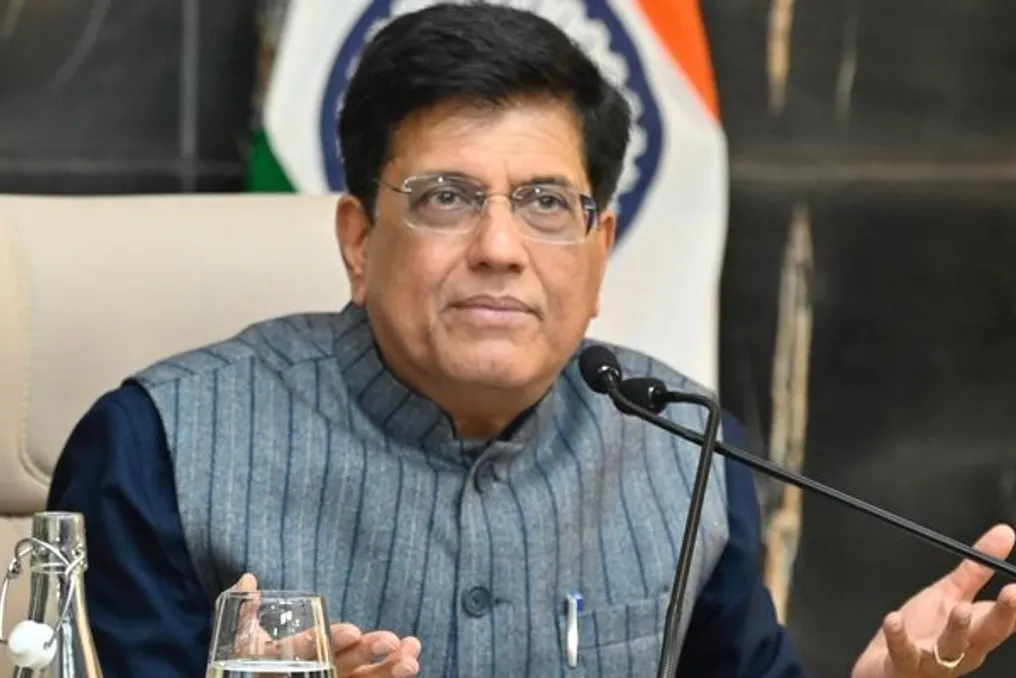
The Minister of Commerce and Industry, Piyush Goyal, stated that India does not have a structural surplus of production capacity in the sectors defined by the G20 Presidium, emphasizing that the country's production capabilities meet both domestic and global needs.
He noted that the issue lies not in the industrial capacity itself, but in distortions that can arise from hidden subsidies and support, leading to geographical concentration of production. The Minister added that diversifying supply chains and production is a legitimate goal, but it cannot be used as a pretext for taking measures outside the rules of the World Trade Organization (WTO) or for shifting the burden of correction onto developing countries, which need to maintain room for implementing industrial policy.
Goyal confirmed that India's production capacity meets its domestic and global needs, and that there is no structural surplus in the sectors indicated by the G20 Presidium. He also expressed India's solidarity with other G20 members regarding concerns that support distorting trade in some countries leads to dumping and predatory pricing. In response to such practices, India uses scientifically based WTO measures, including anti-dumping and countervailing duties.
These statements are significant against the backdrop of the U.S. Trade Representative (USTR) initiating two separate Section 301 investigations on March 11 and 12 covering 60 economies regarding forced labor and excess industrial capacity. A conclusion was reached on one investigation concerning forced labor, resulting in a 10% tariff being imposed on countries, including India; the results of the second investigation are pending.
The U.S. has highlighted issues of excess capacity in sectors such as steel, textiles, aluminum, automobiles, batteries, cement, chemicals, electronics, energy products, glass, machine tools, machinery, non-ferrous metals, paper, plastics, processed food and beverages, robotics, satellites, semiconductors, vessels, solar modules, and transport equipment.
In a statement from the Ministry of Commerce, quoting Goyal, it is said that India shares the concern of many members regarding how trade-distorting support in some economies leads to dumping and predatory pricing, and that India counters this through scientifically based WTO measures, such as anti-dumping and countervailing duties, which are subject to judicial review.
Goyal also emphasized that India is the world's fastest-growing major economy, possessing an internally driven economy that serves 1.4 billion people, and is actively building value creation supply chains from design to finished product, acting as a reliable link in global supply chains.
The Minister participated in the closing day of the G20 Trade Ministers meeting in Milwaukee, Wisconsin, where he spoke at sessions dedicated to structural capacity surplus and production, the update of the Most Favored Nation principle, ending forced labor in global supply chains, and the closing of the meeting.
Speaking on ending forced labor in global supply chains, Goyal stated that India's commitment to eradicating forced labor is absolute and unconditional. He added that border measures must be based on specific and verifiable evidence, not assumptions about an entire country, region, or sector, and must comply with due legal process and WTO rules. He pointed out that the International Labour Organization (ILO) is the competent, universal, and tripartite body on labor standards.
India supports the goal of eliminating forced labor and voluntary exchange of best practices among G20 members, provided that such cooperation does not involve monitoring members, creating new obligations, or using information as a basis for unilateral trade actions. Regarding the update of the Most Favored Nation principle, the minister noted that India's trade with G20 members depends on a transparent, non-discriminatory, and rules-based trading system. He stressed that the Most Favored Nation principle is a key guarantee of this system, ensuring the application of equal conditions for both the smallest and largest trader. Goyal also emphasized that consensus remains a central element of the WTO, and a special and differential treatment regime must be maintained so that developing countries can catch up with developed economies. Furthermore, he called for the restoration of the two-tier dispute settlement system.