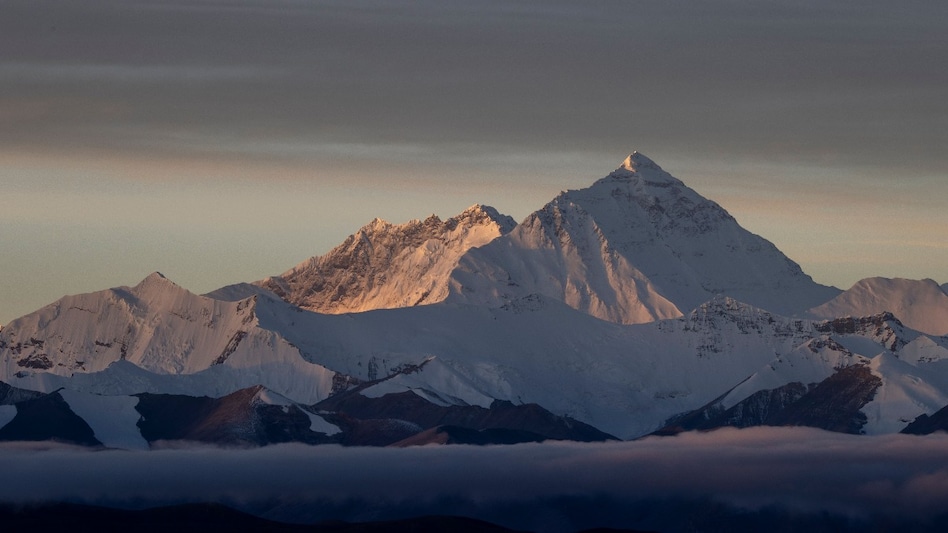
The History of Mount Everest's Name: How It Got Its Name and What Its Former Names Were
Read more
Aaj Tak
www.aajtak.in

The History of Mount Everest's Name: How It Got Its Name and What Its Former Names Were

When people hear about Mount Everest, the world's highest peak, they picture a majestic, snow-covered mountain and the mountaineers who have conquered it. However, it is known that this summit was never called Everest.

In the 19th century, when a British exploratory group determined the height and location of this mountain, it was initially named 'Peak XV'. At the time, in Tibet and surrounding areas, it was called 'Chomolungma'. The name was later given in honor of Sir George Everest, the General Topographer of the British Survey.

Interestingly, George Everest himself did not support the idea of naming the peak after him. He insisted that the names of mountains and other geographical features should be preserved according to local languages and traditions. Nevertheless, in 1865, the world's highest point was named Mount Everest.

In the early 1800s, with the support of the British government, the Great Trigonometrical Survey of India began. The goal of this survey was the precise cartographic mapping of the land, mountains, and other geographical features of the Indian subcontinent. During this work, researchers conducted measurements and calculations in various regions over a long period.

As a result of this activity, in 1852, the team identified a massive peak near the border between Nepal and Tibet in the Himalayas. Its height was then measured at approximately 29,035 feet. Initially, this peak was not given a specific name, but was called 'Peak XV'. Later, Andrew Waugh proposed naming it after his predecessor, Sir George Everest.

Sir George Everest was born on July 4, 1790, in Wales. He received education in English military schools and spent a significant part of his life in India. He worked for the British East India Company and joined the Great Trigonometrical Survey in 1818. Within this project, he worked for about 25 years. In 1823, he was appointed head of the survey, and in 1830, became the General Topographer of India. After retiring in 1843, he returned to Great Britain and was knighted in 1861 for his work. However, his own opinion regarding the naming of the mountain now known by his name differed.

George Everest placed great importance on local names during the surveys. He believed that the name of a place should be the one used by the local inhabitants for a long time. Therefore, when Andrew Waugh proposed naming the highest peak 'Mount Everest', George Everest objected. His argument was that local names should be prioritized. He also noted that the pronunciation of his name might be difficult for local people.

However, the British surveying group did not have complete information about the local names of this peak. In Tibet, it was called 'Chomolungma', which means 'Goddess of Peace' or 'Mother of Peace'. Information about the names used by Nepal was also unavailable to the team, as Nepal at that time did not permit the British surveying group entry into its territory.

Andrew Waugh informed the Royal Geographical Society in a letter addressed in 1856 that he had learned from his predecessor George Everest the necessity of naming geographical features by their true local names. But finding the local name of this peak proved difficult, and the probability of discovering it was low before obtaining permission to enter Nepal.

Despite this, discussions about the name continued. Ultimately, in 1865, the Royal Geographical Society decided to name the world's highest peak 'Mount Everest'.

The irony is that George Everest did not approve of this decision. He died on December 1, 1866, at the age of 76. It is unclear whether he ever saw this mountain with his own eyes, which is now known by his name. Thus, the Himalayan peak registered as 'Peak XV' became Mount Everest. Nevertheless, the history of its local names reminds us that the identity of a place is connected not only to its name on the map but also to its people and their traditions.
Similar stories

Tenzing Film: A Story of Tenzing Norgay's Struggle for Recognition, Not Just the Everest Ascent
Read more
www.aajtak.in

Tenzing Film: A Story of Tenzing Norgay's Struggle for Recognition, Not Just the Everest Ascent

Behind the famous photograph of two people on the summit of Everest—Edmund Hillary and Tenzing Norgay—lies a deeper story touching upon themes of identity, equality, social status, and the perseverance in realizing one's own dreams. The upcoming film from Apple Original Films, Tenzing, reveals this non-obvious narrative thread through its trailer.

Although at first glance the film seems like a typical adventure movie about mountain climbing, director Jeffrey Piddem strives to delve deeper into the inner world of a person for whom this mountain was not just the highest point in the world, but an integral part of his faith and life.

In the film, Tenzing Norgay is played by Jaden Funtsok, and the role of mountaineer Edmund Hillary is played by Hollywood star Tom Hiddleston. William Duff portrays Captain John Hunt, the leader of the British expedition. The most interesting thing about the trailer is that the plot is not limited only to the conquest of Everest by Hillary and Tenzing; here Tenzing is shown as a man who worked for many years within British expeditions, but for him, being merely part of someone else's venture was not enough. He wished to climb the mountain he considered his since childhood.

This is where the main conflict of the film begins. The British mountaineers viewed Everest as a peak to be conquered, whereas for Tenzing, it was a matter of faith. He revered the mountain as Chomolungma, a sacred goddess. Thus, the same mountain range was perceived completely differently, and the trailer masterfully conveys this distinction.

In Tenzing's eyes, this was not a struggle against nature, but rather a relationship with it. This is why Everest in the film feels not just like a location, but a living character in the story. There is also a struggle for respect in this story.

During the 1953 British expedition, limiting Tenzing to the role of a porter carrying a serge was insufficient. In the plot, he fought for recognition as a full member of the mountaineering team. This seemingly minor demand raises a major social and historical question: can a person who knows the way up this mountain better than anyone else be sidelined simply because they are not British? The film attempts to illuminate this question within the narrative itself, avoiding direct speeches.

Tom appears very reserved in the role of Edmund Hillary. The film presents both characters not as rivals, but as people from different worlds between whom mutual respect and trust gradually grow. As they approach the altitude, the boundaries of class and rank blur, and the two mountaineers become comrades. Perhaps this is the most human part of the film: history recorded their names together, but to achieve this, they had to take different paths.

Another remarkable character is Tenzing's family, especially his wife. His spouse is presented not just as part of his personal life, but as a person who understands and supports his dreams. The trailer shows the price that family and home must pay while Tenzing moves toward the mountain. Because of this, the ascent of Everest ceases to be just an adventure; with every step, the question arises about how many people are willing to sacrifice for the greatest dream.

The visual presentation of the film is also a strong point of the trailer. Snow-covered peaks, labored breathing in the thin air, winds cutting through the silence, and the dangerous heights of Everest—all of this works to immerse the viewer in the atmosphere. The aerial photography of the mountains and the sounds of snow are particularly impressive.

However, the main appeal of the film lies in the attempt to view a historical achievement from a different angle, which the world has seen in the same picture for decades. We know the story of reaching the summit of Everest, but few talk about how often Tenzing had to start over to earn his place even before the ascent. The film tries to fill exactly this gap.

Popular