Meta officially launches smart glasses in South Africa
Read more
TechCentral
techcentral.co.za

Meta officially launches smart glasses in South Africa

Meta has officially announced the launch of its smart glasses in the South African market. EssilorLuxottica, the manufacturer of these glasses in collaboration with Meta, stated in a joint announcement on September 24th that it plans to expand its retail network into ten new markets over the coming months. These include South Africa, Israel, Poland, and New Zealand.

In an addendum to its own announcement made a day earlier, Meta indicated that the Oakley Meta, Ray-Ban Meta, and Ray-Ban Meta Optics models will become available in these new markets later this year. The list of new markets also includes Turkey.

However, the collection of more affordable Meta Glasses will not be included in this list; its launch is scheduled first in Singapore, South Korea, Mexico, and the UAE, followed by Brazil. This line includes the Meta Adventurer model priced at $249 USD, which Meta calls its most accessible option currently.

Although the glasses are already sold in the country through the retailer Evetech, which offers the standard Ray-Ban Meta Wayfarer model for approximately 10,745 Rand, neither brand has an official local retail presence. Warranty support is handled through the retailer, not Meta.

Features local buyers won't see immediately

Local consumers will not immediately have access to Meta's new feature—the personal AI agent Muse. Although Meta claims Muse is available in the US and Canada, the joint statement indicates that on the company's AI glasses, it will only be available in the US. A similar restriction applies to Meta's new hearing enhancement feature, which has received approval from the U.S. Food and Drug Administration.

Launched on September 8th, Muse can perform tasks such as sending emails, booking travel, filling out forms, and making purchases, always consulting the user before executing sensitive actions. Furthermore, Meta demonstrated Muse Charm—a pocket watch-sized gadget equipped with a 5G modem to connect to the agent.

According to Reuters, Meta supplied Muse despite internal concerns regarding improper management of access to sensitive personal data. Meta had previously postponed the release in April to enhance security, a point CEO Mark Zuckerberg used to argue that competition and responsibility were already forcing AI labs to act regarding safety.

The Ray-Ban Meta (Gen 3) model is already available starting from $449. Meta notes that it has become thinner and provides up to nine hours of battery life, one hour longer than Gen 2. Available styles include Aviator and the new Zena cat-eye frame. The LED continues to notify bystanders when the wearer is taking photos or videos.

The Ray-Ban Meta Audio line, which lacks a camera, weighs only 43 grams, lasts up to 12 hours, and starts at $349 on October 13th. Meta informed UploadVR that this model has been under development for years and is not a reaction to public outcry over camera glasses.

Neither the Audio line nor Meta's new VR glasses, expected in 2027, were mentioned in the context of expansion into South Africa.

Official availability is likely to spark a privacy debate. As noted in a TechCentral column in July, the Personal Information Protection Act (Popia) treats biometric data as special personal information but largely exempts 'exclusively private or domestic' activities from this classification.

This column referenced an investigation by a Swedish newspaper that found sub-regional workers in Kenya viewing intimate footage captured by the glasses. It also noted that Meta conducted internal facial recognition testing and then discreetly removed this code from the accompanying application in June following pressure from civil society, although Meta states it has not made a final decision. The article also mentioned a July firmware code from Meta that disables the camera if the LED is covered or damaged.

Additionally, Meta plans to implement 'private processing' in its AI glasses later this year. According to the joint statement, this will ensure that new AI features operate 'with consumer privacy in mind.'

Similar stories

Meta Unveils Four New AI Devices to Reduce Smartphone Dependency
Read more
www.aajtak.in

Meta Unveils Four New AI Devices to Reduce Smartphone Dependency

Mark Zuckerberg and Meta have recently placed significant emphasis on artificial intelligence (AI). Therefore, the strong focus on AI at the company's Connect 2026 event was not a surprise. At this meeting, the company presented not only AI concepts but also a range of entirely new devices.

Zuckerberg demonstrated the Ray-Ban Meta Gen 3 with camera-free functionality, new virtual reality (VR Glasses), and the company's first dedicated AI hardware device—the Muse Charm. According to the company, these gadgets are aimed at integrating AI into daily life.

Ray-Ban Meta Audio

The first device introduced was the new Ray-Ban Meta Audio smart glasses, designed for users who need smart glasses but without a camera function. These glasses do not allow for taking photos or videos because they lack a camera. Instead, they are equipped with speakers and microphones, enabling music listening, making calls, live translation, and interacting with Meta's AI.

The absence of a camera is also due to privacy concerns. The presence of a camera in smart glasses raised questions about recording the data of surrounding people. With the absence of a camera in the new glasses, concerns about video recording are eliminated.

These glasses weigh only 43 grams and can operate for up to 12 hours on a single charge. The total battery life with the charging case reaches 48 hours. The starting price is $349, and shipping will begin on October 13.

Ray-Ban Meta (Gen 3)

For those who require AI glasses with a camera, Meta has released an updated version—the Ray-Ban Meta (Gen 3). This model features a 12-megapixel camera capable of recording video in 3K Ultra HD resolution. It is also equipped with a set of six microphones that helps reduce background noise by over 90 percent.

The battery in Gen 3 has been improved compared to the previous generation and now provides up to 9 hours of operation. The model is available in Aviator, Zena, and Wayfarer styles. The starting price is $449, and it will support Meta's new Muse AI.

Meta VR Glasses

Meta presented not only AI glasses but also new virtual reality glasses (Meta VR Glasses). A distinguishing feature of these glasses is their design, which resembles regular spectacles instead of a bulky VR headset. They weigh about 100 grams and are equipped with a 5K resolution microOLED display. To function, they must be connected to a small computing puck, which contains the data processing system and battery.

With these glasses, users will be able to watch movies on a large virtual screen, play games, and work on multiple virtual screens simultaneously. The company claims that control can be managed through hand gestures and eye movements. The price of these glasses is set at $1,299.99, with a launch planned for Spring 2027.

Muse AI with Key

Next, we look at Meta's most compact device—the Muse Charm. This is a small AI gadget that can be worn as a keychain. It includes a microphone, speaker, small display, and fingerprint sensor. Thus, communicating with the AI no longer requires taking out your phone every time and opening an application.

Meta's Muse AI goes beyond simply answering questions; the company positions it as a personal AI agent capable of assisting the user with daily tasks. Meta's plans are clear: instead of embedding AI within the phone, the company aims to distribute it through glasses, small devices, and other household items. The combination of camera-less glasses, Gen 3 glasses with a camera, and the new VR experience makes observing how much the need to take out a phone for AI usage will decrease in the future a very intriguing prospect.

Meta launches camera-free smart glasses, Ray-Ban Meta Audio, in response to privacy concerns
Read more
olhardigital.com.br

Meta launches camera-free smart glasses, Ray-Ban Meta Audio, in response to privacy concerns

On Wednesday, the 23rd, during the Connect 2026 conference, Meta unveiled its first smart glasses equipped with artificial intelligence (AI) and devoid of a camera. These new devices, named Ray-Ban Meta Audio, were designed to mitigate concerns raised about the more controversial uses of the company's AI glasses.

Unlike other models offered by the company, the Ray-Ban Meta Audio operate solely with audio functionalities. They allow users to listen to music and podcasts, make calls, translate speech, and interact with Meta's AI assistant, known as Muse.

The development of this product was carried out in collaboration with EssilorLuxottica, Meta's partner in AI-focused hardware projects. The initial price set for the device is US$ 349 (equivalent to R$ 1,850).

Statement on the new product category

Meta CEO Mark Zuckerberg commented during the presentation that after developing the idea, the company identified the possibility of creating a new line of products centered on audio glasses. He asked the public: 'Once you get used to high-quality audio, it's simply something you want all the time, right?'

The decision to eliminate cameras also helped Meta design a thinner device compared to its previous models. The Ray-Ban Meta Audio weighs 43 grams and includes adjustable arms, replaceable nose pads, and hinges with protection against excessive stretching.

Battery life can reach 12 hours on a single charge, according to Meta. When used with the provided charging case, this duration can be extended up to 48 hours. The glasses will be available in various color options and combinations, totaling 23 color and lens arrangements, in addition to two new frame designs.

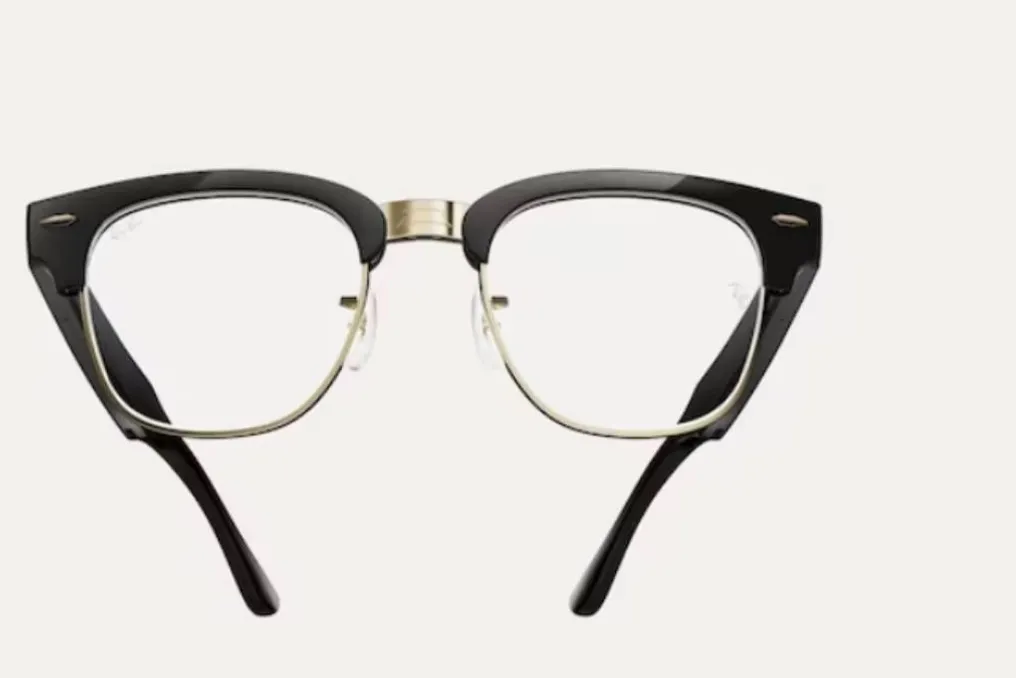
Among the new styles are the Clubmaster, which recalls the retro look of Ray-Ban models, and the Burbank, characterized as a classic and timeless rectangular frame. As with other Meta smart glasses, the Ray-Ban Meta Audio can be ordered with corrective lenses, if necessary.

Pre-sales of these glasses will begin on October 13th.

Next Generation with Camera

In addition to the camera-free glasses, Meta also presented the next version of its smart glasses equipped with a camera, the Ray-Ban Meta (Gen 3). This line will maintain the Ray-Ban Meta Wayfarer model and introduce two new styles: Aviator and Zena, the latter featuring a frame shape closer to a cat-eye style.

The renewed models will feature a 12 MP camera capable of recording videos in 3K Ultra HD resolution, along with a six-microphone system and a battery that lasts up to nine hours. The glasses, developed by Meta in partnership with EssilorLuxottica, will also receive an increase in the variety of available colors and styles.

The company also announced a new collaboration with singer Lisa, following a previous work with Kylie Jenner. Meta reported that the glasses will be launched in more countries globally. All of Meta's AI smart glasses will have access to Muse, the company's new AI personal assistant.

Meta anticipated several features that will be implemented in the devices. Innovations include Dolby Atmos Capture, a function that selects the best image among multiple captured frames, and the option to choose between landscape and portrait formats. The company is also working on auditory enhancement features for people with hearing impairments, more detailed responses, different audio modes, and customizable controls.

Another highlighted feature is the so-called 'private processing,' which, according to Meta, prevents the company itself from accessing user data.

Popular