Creutzfeldt-Jakob disease (CJD), responsible for the death of influencer Lito Sousa from the Aviões e Música channel, was confirmed in 547 individuals in Brazil between 2005 and 2021. This record covers the first seventeen years since the illness became mandatory for notification.
During this period, the Ministry of Health received a total of 1,576 suspected notifications through the Notification Disease Information System (Sinan), of which only slightly more than a third received a definitive diagnosis. Lito's wife, Mila, had disclosed the diagnosis in a video on August 21, mentioning that the diagnosis took time and that in the preceding weeks, the influencer had lost some of his mobility.
Five states account for almost 70% of cases
The South, Southeast, and Northeast regions were the areas where the disease confirmations were concentrated. São Paulo leads the ranking with 202 cases, representing 37% of the national total. Minas Gerais follows in second place with 57 cases, followed by Paraná (44), Rio de Janeiro (38), and Rio Grande do Sul (35). Together, these five states are responsible for 376 of the 547 confirmed cases, totaling approximately 69%.
The elderly are the most affected group, and the progression of the disease is rapid. The age group of 55 to 74 years accounted for 60.2% of notifications, and the average age among suspected cases was 66 years. This profile is consistent with the sporadic form, which is the most common and generally occurs between the ages of 60 and 80.
According to medical literature adopted by the ministry, the evolution is fast: about 90% of patients die within six months to one year after the onset of symptoms, showing an average survival of five months. The official bulletin counts 290 deaths among the analyzed notifications, although it notes inconsistencies in data filling and monitoring.
More notifications do not mean more sick people
An increase in the volume of notifications was observed over the historical series, with a sharper growth starting in 2012. The peak was recorded in 2019, with 174 records, corresponding to 11% of the total. In 2020 and 2021, during the Covid-19 pandemic, the numbers showed a decline.
The ministry assesses that this increase may be a reflection of more thorough sanitary surveillance, capable of identifying and registering suspicions that previously went unnoticed, and not necessarily an increase in the actual cases of the disease.
It is important to note that no Brazilian case has been linked to the new variant of CJD, the one associated with the consumption of beef contaminated by bovine spongiform encephalopathy, popularly known as 'mad cow disease'. Since 2005, the ministry has not registered any case or death related to this variant in the country. Although confusion between the two diseases is frequent when a case gains great visibility, the sporadic form, which has no food link, is responsible for the majority of clinical presentations.
Disease caused by proteins that change shape
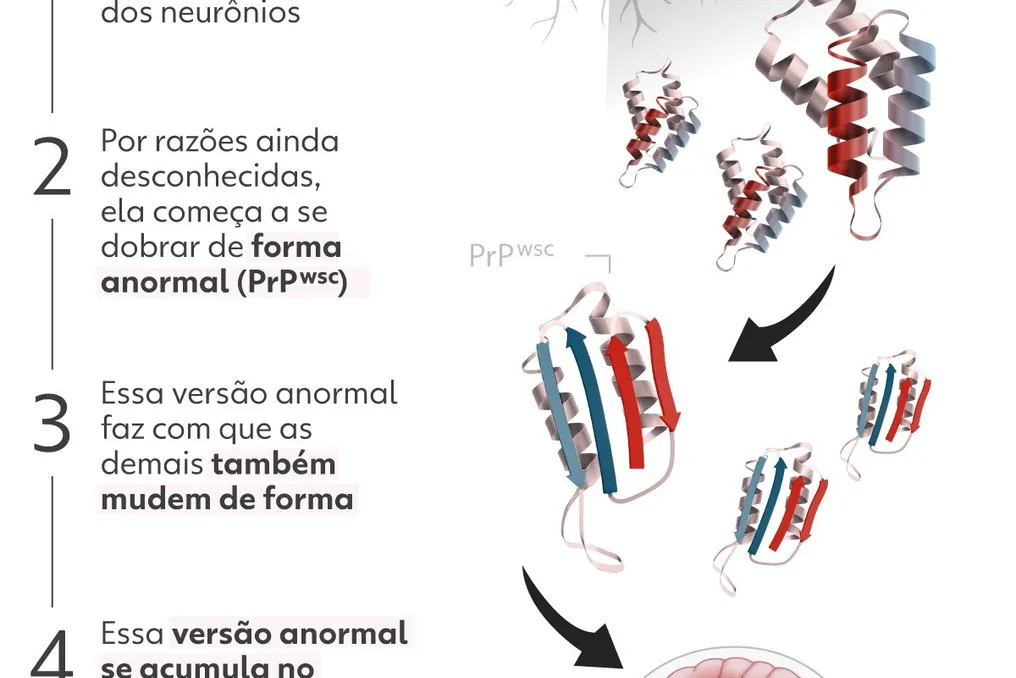
CJD is part of the group of prion diseases. Prions are proteins that acquire an anomalous configuration and cause healthy brain proteins to transform in the same way. This cycle replicates in a chain, leading to the accumulation of modified versions and causing progressive damage to brain cells. This mechanism explains why symptoms such as memory loss, behavioral changes, and impairments in coordination and movement can worsen in just a few months, a pace considerably faster than other neurodegenerative pathologies.
In the sporadic form, the most common, scientists still do not know the factor that initiates the first transformation or the reason why it affects certain people and not others. There are other, even rarer, prion diseases, such as Gerstmann-Sträussler-Scheinker syndrome and fatal insomnia, which prevents the patient from sleeping. Estimates used by entities such as the UK's National Health Service (NHS) suggest an incidence of one to two cases per million inhabitants annually, even in nations with well-established monitoring systems.
Symptoms are confused with those of other diseases
There is no exclusive initial sign of CJD. The clinical picture can begin with forgetfulness, changes in behavior, difficulty walking, imbalance, or involuntary movements, all signs common to much more prevalent conditions. Professor Marcio Luiz Figueredo Balthazar, from the Department of Neurology at the Faculty of Medical Sciences of the State University of Campinas (Unicamp), clarifies that Alzheimer's, the best-known dementia, progresses over years or decades, while CJD manifests rapidly, resulting in a much shorter survival.
The speed of development is an indicator that aids suspicion but does not confirm the diagnosis. CJD falls into the group of rapidly progressing dementias, which have multiple etiologies, including encephalitis, autoimmune diseases, other neurodegenerative problems, and metabolic alterations. Since some of these conditions are treatable, it is imperative that the doctor rules them out before confirming a CJD diagnosis.
Combined exams and test still restricted access
No single exam can resolve the investigation in all patients. The neurologist integrates the clinical history with brain magnetic resonance imaging, which can show strong patterns that reinforce suspicion, in addition to performing a lumbar puncture for cerebrospinal fluid analysis, electroencephalogram, and blood and CSF tests to exclude other causes.
A recent advance is RT-QuIC, an acronym for real-time quaking-induced conversion. This test uses cerebrospinal fluid to indirectly detect the characteristic activity of prions: the sample is placed in contact with normal proteins, and if prions are present, they alter their shape, allowing the reaction to be measured. In certain studies, the test achieved a specificity close to 100%, implying that a positive result indicates the disease with very high probability. However, sensitivity varies, and some cases may go unnoticed.
According to neurologist Jerusa Smid, from the Hospital das Clínicas of the University of São Paulo (USP), the Emílio Ribas Institute of Infectology, and the Albert Einstein Israeli Hospital, the test helps in closing the diagnosis in most cases, but it is not yet widely available in Brazil.
What the Brazilian numbers do not show
Of the 1,576 suspected cases reported between 2005 and 2021, 457 were ruled out and 572, or 36.3%, did not receive a final classification. The report also does not detail the clinical evolution of more than half of the examined notifications. This data demonstrates limitations in disease surveillance, preventing conclusions about how many cases do not end up being diagnosed.
For Jerusa, CJD is not as rare as national records suggest. The low frequency itself helps explain the difference between the occurrence observed in other countries and the Brazilian one: a neurologist may see thousands of patients with memory complaints and find very few cases throughout their career, making it difficult to remember the disease in time, and the necessary tests require centers with greater infrastructure. The survey ends in 2021, which makes it impossible to know if the increase in notifications persisted after the pandemic period.