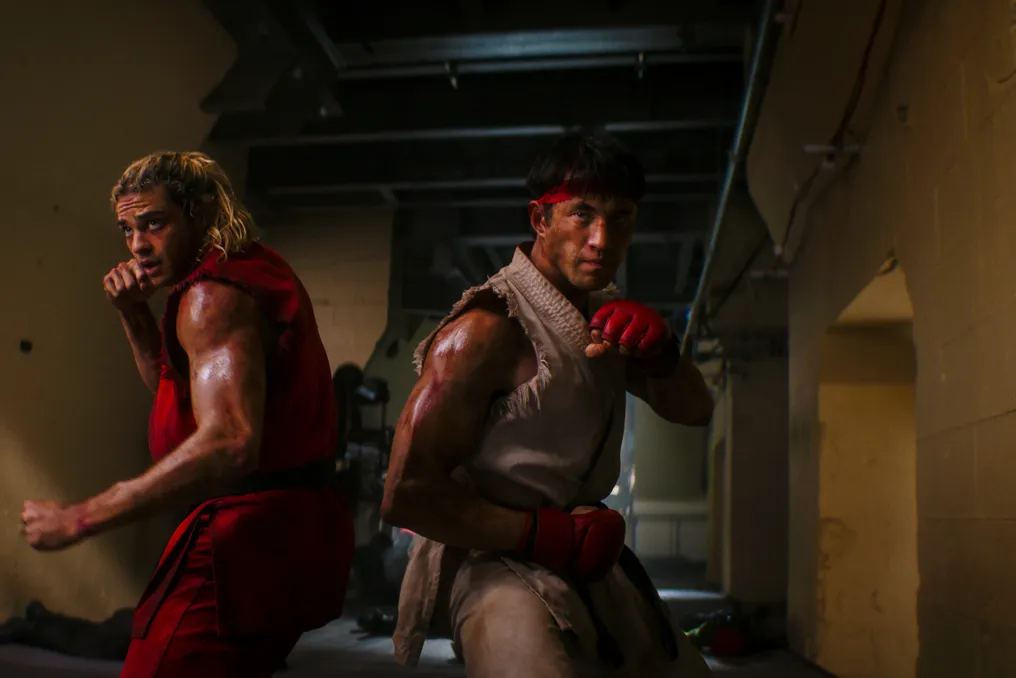
The actors involved in the new cinematic version of 'Street Fighter' faced physical difficulties, including injuries and accidents during filming. However, these adversities seem insignificant when compared to the turmoil that occurred during the original 1994 adaptation, which featured Jean-Claude Van Damme and Raul Julia.
Scheduled for release on the 15th in Brazil, the recently adapted fighting game series opted to incorporate the vibrant aesthetic and caricatured rhythm characteristic of arcade games. To realize this vision, director Kitao Sakurai, known for 'Bad Trip', required the cast to be in excellent physical condition and perform the fights with the minimum number of stunt doubles.
In this new film, Andrew Koji, a 38-year-old British actor and martial arts specialist, played Ryu, wearing his gi and kimono. Although he dispensed with stunt doubles in most sequences, he suffered a serious incident during the final confrontation against the antagonist Akuma (played by Roman Reigns). Koji reported in an interview with g1 that it was not just an ankle sprain, but a calf tear while filming the fight against Akuma. He added that there were still fight scenes with Blanka and Ken that were partially completed while he was injured.
Physical intensity was also notable for David Dastmalchian, who took on the role of M. Bison. In a fit of rage, Dastmalchian repeatedly hit a pile of cement blocks. Upon removing his gloves, he noticed his hands were covered in blood, which excited him about the performance.
Callina Liang, who plays Chun-Li, dedicated three months of intensive training focused exclusively on her lower body, practicing Muay Thai, Taekwondo, and Wushu, aiming to replicate the muscular thighs and quick kicks of the Chinese police officer. She mentioned gaining almost 10 kilos in a month and a half, eating every two hours, despite questioning if her legs would become as large as in the game.
The toughest test for Liang was a two-week sequence of non-stop fights in Bison's office. She described the experience as chaos, but the most fun of her life.
However, director Sakurai acknowledges that the madness of the current production does not compare to what happened thirty years ago. He joked about how lucky the filming process was not as extreme as that of the original 'Street Fighter', stating that the current film does not belong to the same universe as the 1994 one, but references it affectionately, given the history of various 'Street Fighter' media.
The nightmare of 1994: cocaine, hunger, and improvisation
If the injuries sustained in 2026 were the result of athletic effort, the behind-the-scenes of 'Street Fighter: The Final Battle' (1994) were marked by crises and tragedies. Under the direction of the inexperienced screenwriter Stephen E. de Souza, this project from three decades ago faced a series of disasters in Thailand, where part of the film was shot.
Jean-Claude Van Damme, the Belgian star, was under the strong influence of cocaine addiction, which resulted in frequent absences from morning shoots and the invention of medical excuses. This forced the director to create improvised scenes with supporting actors so as not to lose shooting days. Additionally, he became involved in an extramarital affair with singer Kylie Minogue, who was cast last minute as Cammy after Souza discovered the relationship in an airplane magazine.
Raul Julia, chosen to play Bison, a renowned Puerto Rican actor, had recently undergone stomach cancer surgery. He arrived in Bangkok in a weakened, thin, and unrecognizable state. The production had to reorganize the entire schedule to allow Julia to rest and regain weight before recording close-up dialogue. Despite completing his role, the actor passed away before the premiere.
The set conditions in Bangkok were precarious: the facilities had holes in the ceiling allowing natural light to enter, making night shoots impossible. The water from the local river caused severe skin irritation for the crew, and some cast members suffered from malnutrition due to local food. Producers also experienced heart attacks and serious traffic accidents.
There were also internal conflicts: the stunt coordinator, Charlie Picerni, clashed with the director because the fights did not have adequate rehearsal time. To make matters worse, Capcom requested drastic blood cuts in the editing to avoid adult censorship in the United States, which led to the erasure of classic special moves, such as Ryu's Hadouken visual effects, which hadn't even been finalized in time.
Koji commented, comparing the two eras, that Jean-Claude Van Damme liked to cause trouble, almost preventing the film from finishing. He contrasted this with the current set, saying it was the opposite: 'There were no divas, no jerks, just people passionate about the franchise.'
The weight of Raul Julia's legacy
Replacing Julia, whose grand and operatic performance helped keep the 1994 film from total oblivion, represented the biggest psychological challenge for the new Bison. Dastmalchian admitted that Julia's shadow was intimidating.
The actor stated that Julia always gave 1000% of himself, whether in dramas, comedies, or video game adaptations. He could have only given 60% if he thought it was just a game, but he gave everything he had.
To give the psychotic villain his own flavor without simply imitating him, Dastmalchian sought inspiration from darker sources. He mixed the insanity of Marlon Brando in 'Apocalypse Now' (1979) with the tyranny of real leaders, such as Idi Amin, portrayed by Forest Whitaker in 'The Last King of Scotland' (2006), and even Shakespearean characters. He reflected on Mussolini, David Koresh, and the malicious cunning of Iago in 'Othello', concluding that Bison is someone who genuinely believes he is the most powerful entity on the planet and suffers when his physical body fails to keep up with that ambition.
Fearless of silliness
While the 90s adaptation tried to mask the fantastic mythology in a generic 'Commando' style soldier narrative to please toy manufacturers, the current film chose the opposite path: embracing the absurd. Sakurai declared that, for a long time, adaptations tried to make the games more serious and sober, like in 'The Dark Knight', but that 'Street Fighter' is colorful, irreverent, and absurd, deciding to dive deep into that insanity.
If the reputation of the games in cinema depended on blood, sweat, and bruises to be surpassed, the 2026 group has already paid that price. And this time, without having to hold anyone hostage to the chaos experienced in Thailand.