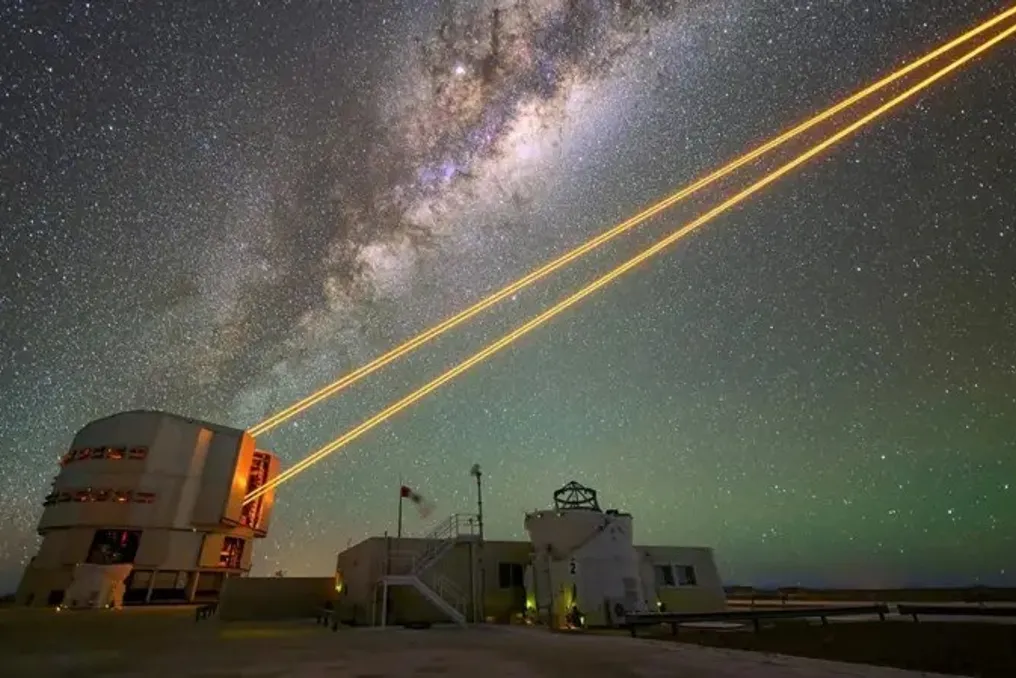
On certain nights in the Chilean desert of Atacama, it is possible to witness a remarkable spectacle: enormous beams of laser cutting across the sky. From a considerable distance, these rays appear to emanate from a complex mountainous structure, reminiscent of science fiction scenarios.
Upon closer examination, it is discovered that the source of these lasers is a large telescope, composed of several units. It is in these facilities that teams of night astronomers position the lasers to generate an 'artificial star' in the upper layers of the Earth's atmosphere.
Recently, the moment was recorded when astronomers simultaneously fired four lasers from distinct structures on the mountain peak. This equipment is the Very Large Telescope (VLT), located in Paranal, Chile, and its operations are conducted by the European Southern Observatory (ESO). At the end of 2025, engineers finalized the installation of the last of the powerful lasers, increasing the total number to seven.
The use of lasers in astronomy has roots in the Cold War (1947-1991), when American Armed Forces developed technology to monitor satellites of the former Soviet Union (1922-1991). Astronomers later identified that similar methods could optimize terrestrial observations.
A significant challenge for ground-based telescopes is the Earth's atmosphere. Gases present in this environment distort the light from stars before it reaches the instruments' mirrors, and atmospheric conditions are constantly changing.
Astronomer Amelia Bayo, an ESO project scientist and VLT performance guide, explains that while the atmosphere offers protection, it is detrimental to the clarity of light coming from stars and galaxies. Without compensation, the image captured by the detector would be unstable and blurred.
To solve this issue, astronomers employ a technique called 'adaptive optics.' Bayo details that after the distorted light reaches the primary mirror, it is redirected to a secondary mirror that can deform it, thus correcting the atmospheric distortion.
In the VLT, one of these adaptive mirrors incorporates piezoelectric materials, capable of generating electrical charges and altering their shape at very high speeds. Furthermore, this mirror is suspended within a magnetic field, remaining in a state of levitation.
For adaptive optics to function, a fixed and luminous reference point in the sky is required—a bright star. Bayo uses the analogy of identifying a melody: if the sound is weak or has too much noise, identification is difficult. Similarly, a bright star provides more data to aid in correcting the distortion.
Although natural stars can be used, to observe areas of the sky without sufficiently bright stars, astronomers resort to lasers. When fired toward the observation area, the lasers stimulate a sodium-rich layer in the atmosphere, at approximately 90 km altitude. The sodium atoms release photons that are captured by the telescope's mirrors, thus constituting the artificial star.
The VLT's lasers utilize advanced technology. Bayo compares previous equipment, which required toxic liquid dyes and long engineering periods for stability, with current perfectly stable devices that emit a much more powerful beam, requiring only the press of a button to launch the laser, which remains fixed throughout the night.
Following updates in 2016, one of the VLT's four 8.2-meter telescopes, named Yepun, gained the functionality to fire four lasers simultaneously, allowing for the correction of atmospheric disturbances over a wider field of view. Each laser has a power of 22 Watts, equivalent to about four thousand times the maximum power of a laser pen, concentrated in a 30 cm diameter beam.
Currently, the four main VLT telescopes (Antu, Kueyen, Melipal, and Yepun) can operate together, forming a giant 'virtual' telescope with a larger field of view. Together, their large mirrors can capture much sharper details than any instrument alone.
The VLT has been fundamental in crucial astronomical discoveries in the 21st century, including the first image of an exoplanet and the determination of the positions of stars orbiting the Milky Way's central black hole.
Regarding operational safety, astronomer Itziar de Gregorio-Monsalvo, ESO representative in Chile, assures that there is a protection mechanism against aircraft. If airplanes cross the airspace near the observation site, the lasers are automatically shut down. Therefore, those who wish to witness a large telescope firing lasers in Atacama must approach by land to see this rare scene of creating an artificial star in the atmosphere.